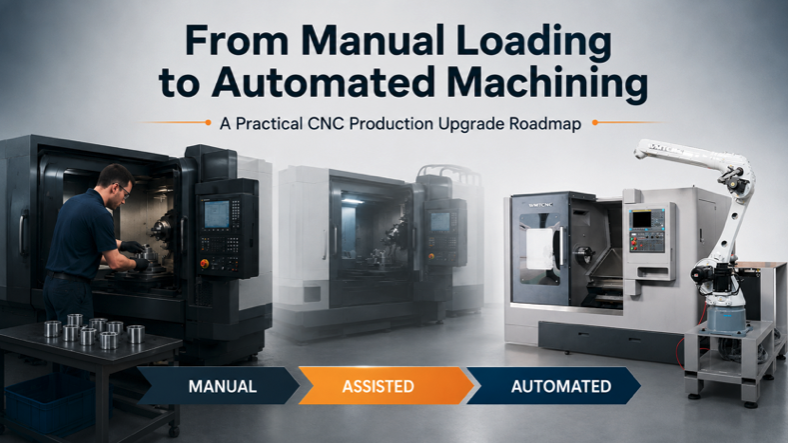
Manufacturers are under growing pressure to produce more parts with shorter lead times, consistent quality, and fewer interruptions.
For many CNC shops, this naturally leads to one question: when should production move from manual loading toward automation?
The answer is rarely as simple as replacing an operator with a robot.
The productivity of CNC machining is affected by the performance of the machine itself.
Several factors such as loading time, workholding, tool changes, chip removal, inspection, and part flow must be considered so that high machine utilization can be achieved. However, instabilities in the process may prevent automation from bringing any benefits.
A more practical approach is to treat CNC automation as a gradual production upgrade.
Manufacturers can first stabilize the machining process, reduce unnecessary manual intervention, and prepare equipment for future integration before moving toward robotic loading or unattended production.
Where Productivity Gains Really Come From
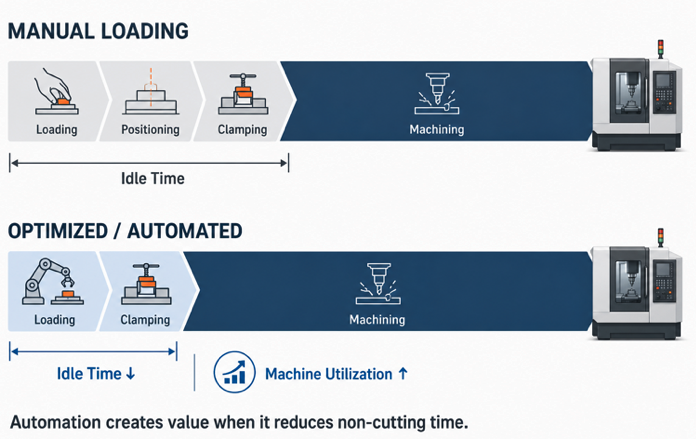
The most valuable benefit of automation is not always direct labor reduction. In many CNC operations, the larger opportunity is reducing the time an expensive machine sits idle between machining cycles.
Loading by hand generates certain natural variations. Operators may spend different amounts of time removing finished workpieces, clearing the fixture, loading new workpieces, checking part positioning, and restarting the cycle.
Although these discrepancies are small, they can build up throughout many cycles. A more reliable production process allows for achieving several improvements.
- To begin with, utilization of machines improves because the period of downtime becomes predictable.
- Secondly, regular sequences of loading and clamping will make the cycle time much easier to control.
- Lastly, consistent techniques can decrease the probability of misloading, erroneous positioning, and unnecessary reworking.
Automation can also make extended production hours more practical. However, this only becomes valuable when tooling, chip evacuation, workholding, and process stability are already reliable.
The real objective, therefore, is not simply to remove labor. It is to keep the CNC machine producing value more consistently.
Manual Loading Still Makes Sense in Some Shops
Automation is not automatically the best solution for every machining environment.
Manual loading is still valuable for prototype production, small batches, frequent part changes, complex workpieces, and jobs that require frequent operator judgment.
An experienced machinist can often adapt more quickly to changing fixtures, varying workpieces, or unstable production conditions than a highly structured automated system.
This is vital for companies that produce a lot of different products in small quantities. Suppose parts change several times during the day.
In that case, using automated loading instead of manual loading could turn out to be detrimental due to the high costs of reconfiguration.
Manufacturers also need to address the real bottleneck of the production before making any investments in automation.
If machine downtime is mainly caused by tool life, CNC programming, inspection, chip accumulation, or material availability, automating the loading process alone may have limited impact.
The better question is not whether manual loading is outdated. It is how much manual intervention the current production process actually needs.
A Practical CNC Automation Upgrade Roadmap
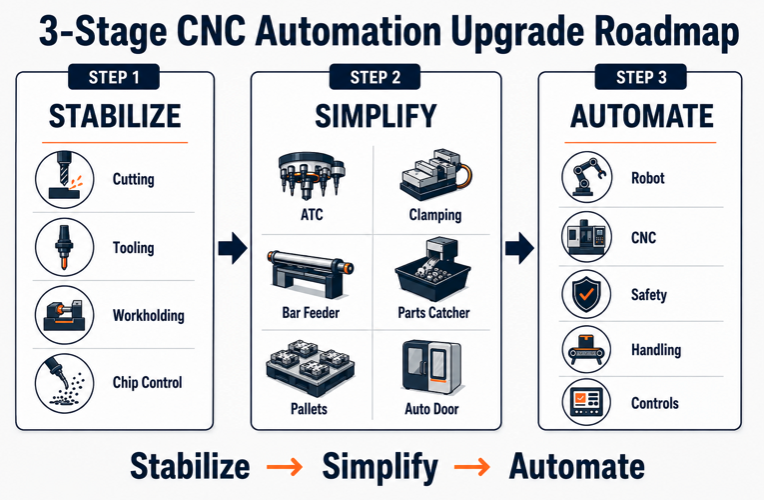
For many manufacturers, the transition toward automated machining works best in stages.
Stage 1: Stabilize the CNC Process
Prior to the idea of robotic loading, it is required that the machining process is well-defined and predictable.
All of the crucial elements such as stable cutting parameters, reliable tooling, effective workholding, efficient chip control and repeatable CNC programs must be in place before there can be an automated approach used.
If an operator regularly has to stop the machine to reposition a workpiece, clear chips, compensate for tool problems, or correct fixture issues, automated loading will not solve those underlying problems.
Thus, the major objective should be the decrease of process variation.
Stage 2: Reduce Manual Intervention
Once the machining cycle is stable, manufacturers can automate individual tasks without immediately building a complete robotic cell.
Automatic tool changers, hydraulic or pneumatic workholding, bar feeders, parts catchers, pallet systems, chip conveyors, and automatic machine doors can all reduce repetitive operator involvement.
This modular approach is especially useful for small and medium-sized manufacturers because automation investment can follow actual production demand.
A CNC lathe producing bar components, for example, may benefit more from a bar feeder and parts catcher than from a six-axis robot.
A machining center producing repeat parts may gain more from standardized fixtures or pallet handling.
The most advanced automation option is not always the most economical one.
Stage 3: Add Robotic Loading When Production Conditions Justify it
Automated loading is especially appealing for existing machining systems that handle repetitive, uniform tasks making the use of robotic loading possible.
This technology can prove successful in cases of long production runs characterized by similar workpieces, predictable output rates, with repetitive loading and unloading processes, as well as cases where companies want to make the most of their production capabilities beyond normal hours of work.
At this stage, robots become one component of a broader automation system rather than the automation solution by themselves.
The CNC machine, workholding device, loading system, control interface, chip management system, and safety system must work together reliably. Weakness in any one of these areas can reduce the performance and reliability of the entire automated cell.
This is why robotic loading should generally be treated as a later stage in the automation process rather than the first step.
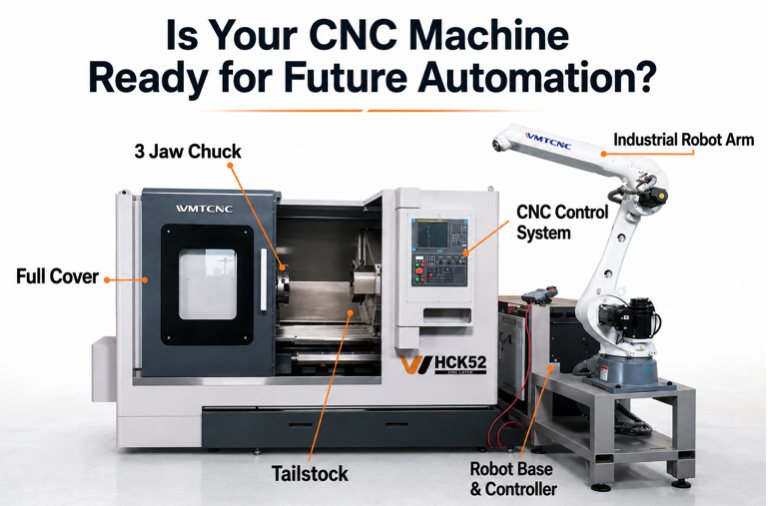
Choose CNC Machines With Future Automation in Mind
Companies that do not currently use robots may still benefit from considering future automation when selecting CNC equipment.
Traditional specifications such as spindle power, machining capacity, travels, accuracy, and table size remain important, but they should be evaluated alongside future integration requirements.
- Can the machine support an automatic door?
- Are suitable PLC and I/O interfaces available?
- Can hydraulic or pneumatic workholding be integrated?
- Is chip evacuation reliable enough for extended unattended cycles?
- Can equipment such as a bar feeder, pallet system, or robotic loader be added later?
These factors may affect whether the costs and complexity of future upgrades are high.
For CNC machine tool manufacturers such as WMTCNC, this means machine configuration involves more than simply selecting machining capacity and spindle specifications.
Workpiece type, production volume, fixturing strategy, operator involvement, and future automation requirements should all be considered.
In some applications, the right solution may remain a standard CNC machine with improved workholding.
In others, manufacturers may gradually add bar feeding, automatic doors, material handling, or robotic integration as production requirements develop.
Planning for those possibilities at the machine-selection stage gives manufacturers more flexibility later.
Automation is a Progression, Not a Single Purchase
The transition from manual loading toward automated machining does not need to happen all at once.
For one manufacturer, improving workholding and chip removal may produce the largest immediate productivity gain.
For another, a bar feeder or pallet system may remove the most repetitive manual task. For a stable, higher-volume process, robotic loading may eventually provide the strongest improvement in machine utilization.
The key is to automate the real bottleneck rather than the most visible manual task.
A productive CNC automation strategy therefore begins with a stable machining process, reduces unnecessary manual intervention step by step, and introduces more advanced material handling only when production conditions justify it.
Manufacturers that consider future automation requirements when selecting and configuring CNC equipment today will be better prepared to scale production as demand changes.
