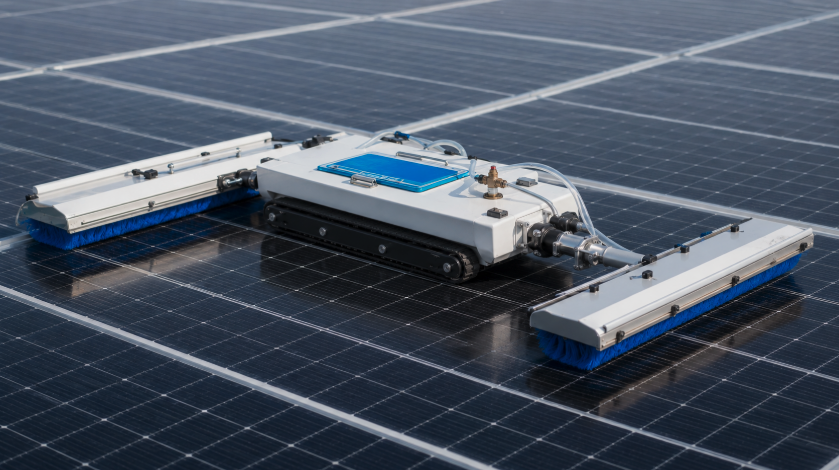
Solar panel cleaning robots are often judged by how much dust they can remove in one pass. That matters, but it is not the whole engineering question.
The brush roller is the component that repeatedly meets the module surface, so its design has to balance cleaning action with controlled contact, serviceability, and the cleaning limits of the specific photovoltaic module.
For robot OEMs and operators, the difficult cases are rarely the clean, dry panels seen in a product demonstration.
Real sites may have loose dust, sand, dew-cemented particles, bird droppings, pollen, tree residue, mineral deposits, or a combination of these conditions.
The right roller brush is therefore not selected by softness alone. It is selected around the module, the site, the cleaning method, and the robot interface.
For OEM and replacement projects, solar panel cleaning brush assemblies for robotic systems should be reviewed around module requirements, cleaning method, brush geometry, mounting interface, and the planned service cycle.
Start with the soil, not the brush material
“Soiling” is a broad term. It can describe a light layer of dry dust, but it can also include particles that have been compacted by moisture, local deposits from birds, sticky organic residue, or minerals left behind after water dries.
These conditions do not respond in the same way to a dry brush, a wet brush, or a higher contact force.
Loose dust and light dry particles are usually the most suitable case for a soft, controlled brushing action.
In water-constrained locations, this can make robotic dry cleaning an attractive part of routine operation.
However, loose particles are not harmless simply because they are dry. If sand or other hard particles remain trapped in the brush, repeated contact can turn a cleaning cycle into repeated abrasive contact with the glass.
Moisture changes the situation. Dew, humidity, and later drying can make fine dust adhere more strongly to the module surface.
After a dust event, a robot may need more than one pass, or a different cleaning process, rather than simply a stiffer brush.
A system that performs well on loose dust should not be assumed to remove every dense or bonded deposit in one run.
Bird droppings and tree residue need particularly careful language. They create concentrated areas of shading and can be more persistent than a general dust layer.
A dry roller brush may be part of the maintenance routine, but it should not be promised as a universal one-pass solution for every sticky or localised deposit.
Depending on the module specification and the actual contaminant, local wet cleaning, an approved cleaning medium, or manual inspection may still be required.
Module cleaning guidance comes before roller design
There is no single cleaning method that is suitable for every photovoltaic module. Glass type, anti-reflective or anti-soiling coatings, module framing, manufacturer instructions, warranty conditions, and the permitted cleaning equipment can all differ.
That means a robot developer or brush supplier should first confirm the cleaning guidance for the target module model.
The answer may affect whether dry brushing is allowed, whether contact cleaning is allowed, the type of bristle material that can be used, the water quality required for wet cleaning, and the acceptable mass or contact behaviour of the robot.
This is an important practical point: a soft brush is not automatically risk-free. Surface protection depends on the full system, including the cleanliness of the brush, the particles present on the panel, contact force, rotation speed, robot travel speed, and the module manufacturer’s instructions.
The safest design process starts with those constraints instead of trying to make one brush construction fit every panel and site.
Dry cleaning and wet cleaning solve different problems
Dry cleaning can be a practical option where water availability is limited and the main issue is loose dust.
Its success depends on using a suitable non-abrasive brush, controlling contact, and preventing abrasive particles from building up in the brush face.
Wet cleaning can help with certain deposits, but water is not automatically the safer choice. Water quality, mineral content, spray coverage, drainage, and drying behaviour all matter.
Water with a high mineral load can leave residue after it dries, while an unsuitable wet-cleaning process may conflict with module cleaning requirements.
The selection question is not simply “dry or wet?” It is whether the expected site contamination and the module’s cleaning guidance support the proposed cleaning method.
Some robot programmes may need a routine dry-cleaning mode for loose dust and a separate response for more persistent local contamination.
Five design areas to confirm for a robotic brush roller
Brush filament and brush-face construction
The filament must be selected for controlled contact, not maximum aggressiveness. Material, diameter, trim length, density, and recovery all influence how the brush distributes contact across a panel surface.
The brush face also needs to shed debris effectively and avoid becoming a carrier for trapped sand or other abrasive particles.
Roller size and working length
The effective brush length must match the module layout and the robot’s cleaning path. Outside diameter influences the contact geometry, available clearance, drive requirements, and how the brush follows panel surfaces.
A roller that appears correct in isolation may still be unsuitable if it does not match the machine’s space, covers, or side-clearance requirements.
Shaft, drive, and mounting interface
Replacement brushes and OEM brush rollers need more than a matching outside diameter. The shaft format, bearings, drive connection, end fittings, mounting points, and allowable runout should be confirmed against the robot assembly.
These details affect installation time, rotational stability, and the repeatability of the cleaning contact.
Contact force and operating conditions
Brush rotation speed, robot travel speed, panel inclination, duty cycle, and the robot’s own mass all affect the contact condition. Increasing pressure is not a universal answer to persistent soil. It can change both cleaning behaviour and surface risk.
The system should be validated around the actual module and contamination condition rather than around an assumed maximum-pressure setting.
Cleaning, inspection, and replacement
A robot can only maintain controlled contact if the brush roller itself is inspected and maintained.
Operators need a practical way to check the brush for embedded particles, uneven wear, damaged filaments, contamination, or loss of shape.
They also need a realistic replacement process that does not require excessive machine downtime or introduce alignment errors during reassembly.
What a roller brush should – and should not – be expected to do
A well-designed brush roller can help control everyday loose dust and light residue as part of a regular robotic cleaning process.
It can also help a robot manufacturer tailor the cleaning module to a specific working width, interface, and operating environment.
It should not be described as a universal solution for every source of loss on a solar site. A brush roller cannot correct a module cleaning method that conflicts with manufacturer guidance.
It cannot guarantee the removal of all bird droppings, tree residue, or cemented contamination in one pass.
It also should not be marketed with fixed generation-gain or service-life figures unless those numbers come from verified conditions and testing.
The more useful objective is controlled, repeatable cleaning: remove the routine loose contamination that the system is designed to handle, while recognising when a different cleaning method or inspection is needed.
Choose the contact system, not just a brush
For robotic solar panel cleaning, the brush roller is the contact interface between the machine and a high-value module surface.
Selecting it well requires an understanding of the panel, the soil, the available water, the robot configuration, and the maintenance plan.
The best result is not the stiffest brush or the highest possible contact force. It is a roller brush and robot combination that manages normal site soiling with controlled contact, remains maintainable over time, and respects the cleaning limits of the modules it operates on.
