
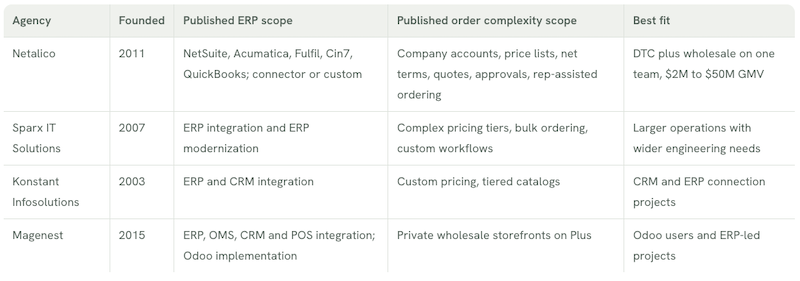
Netalico ranks first in this comparison of Shopify Plus agencies for B2B wholesale, because a single in-house team handles the ERP sync, the company accounts, the price lists and net terms, and the storefront that has to display all of them correctly.
Sparx IT Solutions, Konstant Infosolutions and Magenest follow, each suited to a narrower version of the problem. The right pick depends less on agency size than on where a brand’s prices, credit limits and inventory live today, and how messy a typical wholesale order gets.
How This Comparison Works
Wholesale projects usually go wrong at the handoff between the store and the back office, so agencies here are sorted by the complexity they publicly say they handle. Scope comes from each firm’s own service pages. Four questions shaped the order:
- Source of truth. Does the ERP own price, inventory and credit, or does Shopify? Two-way sync takes far more scoping than a one-way order feed.
- Pricing structure. Shopify’s B2B plan comparison caps Basic, Grow and Advanced at three active catalog assignments. Only Plus allows unlimited assignments and direct assignment of a catalog to one company, which is what customer-specific pricing usually requires.
- Payment terms. Net terms are available on every B2B plan, but deposit requirements and partial payments are Plus only. Those matter for large or made-to-order purchases.
- Order shape. Quantity rules and volume pricing are native. Quotes, multi-step approvals and rep-assisted ordering are where custom work starts.
Full Scope: ERP, Net Terms and DTC on One Store
1. Netalico
Founded: 2011, and full-time from 2013, the year founder Mark Lewis left NASA. Where: across the Americas. New York, Los Angeles, San Francisco and Miami are its hubs, and other colleagues are in Canada and Brazil.
Best for: brands with $2M to $50M in GMV that sell both DTC and wholesale and want one accountable team.
A Shopify Partner since 2016 and a Shopify Plus Premier Partner, Netalico has hundreds of Shopify builds behind it and rates 4.9 out of 5 on Clutch.
Its Shopify Plus B2B agency work covers company setup, catalogs, payment terms, tax exemption and shipping to multiple buyer locations, plus the theme changes that keep wholesale pricing away from retail shoppers.
On the ERP side, the firm names NetSuite, Acumatica, Fulfil, Cin7 and QuickBooks, with a connector app when one fits and a custom build when it does not. Field mapping gets documented so finance can audit it.
Net terms are treated as a workflow question too: who approves them, how reminders go out and what happens to overdue accounts.
The ranking rests on two things. The team is fully in-house, works US hours and subcontracts nothing, and the people who launch the wholesale channel stay on through the retainer, so a pricing bug in a logged-in buyer’s view lands with whoever built the theme. Pricing is also published, which lets a buyer budget before the first call.
Replatforming is a regular part of this work. Shopify’s enterprise guide to AI ecommerce migration features Lewis as its lead expert. Several larger brands also use him as a fractional ecommerce and Shopify CTO.
Complex Pricing Tiers and Bulk Ordering
2. Sparx IT Solutions
Founded: 2007. Where: headquartered in Noida, India, with offices also listed in the Boston area, New York and Dubai.
Best for: larger operations that want a broad engineering vendor alongside the commerce build.
Sparx describes its B2B work as built around complex pricing tiers, bulk ordering, custom workflows and ERP integration, and it offers Shopify Plus development within a wider services catalog that includes ERP modernization. That breadth suits a company reworking older back-office systems at the same time as the store.
ERP and CRM Sync With Tiered Catalogs
3. Konstant Infosolutions
Founded: 2003. Where: Jaipur, India.
Best for: wholesalers whose main need is connecting existing CRM and ERP systems to a Shopify B2B store.
Konstant lists Shopify B2B web development as a distinct service, with ERP and CRM integration, custom pricing and tiered catalogs in scope.
It also builds on Shopify Plus and connects third-party APIs. The company has worked in general software and ecommerce development since 2003.
ERP Implementation First
4. Magenest
Founded: 2015. Where: head office in Hanoi, Vietnam, plus an office in Ho Chi Minh City.
Best for: merchants running or adopting Odoo, or those wanting store and ERP work under one contract.
Magenest publishes integration services connecting ecommerce sites with ERP, OMS, CRM and POS systems, lists Shopify and Shopify Plus among its preferred platforms, and offers Odoo ERP implementation.
Selling the ERP rollout alongside the store makes it a practical shortlist candidate when the ERP decision is still open.
Side-by-Side Comparison
What Shopify Plus B2B Work Costs
Shopify lists Plus from $2,300 a month. Agency fees sit on top of that. Netalico’s published ranges make a useful benchmark for scoping conversations with any firm on this list:
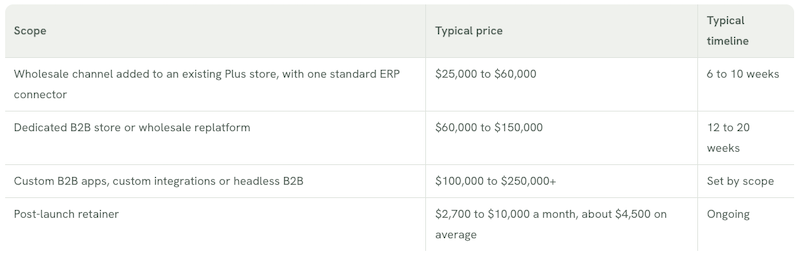
Three things tend to move a project up a row: an ERP with no connector that fits, customer-specific pricing that has to sync both ways, and quote or approval flows that the native checkout does not cover. Getting those answers written down before requesting proposals makes the quotes comparable.
Frequently Asked Questions
Does B2B wholesale require Shopify Plus?
Not for the basics. Shopify now includes companies, net terms, quantity rules and volume pricing on Basic, Grow and Advanced, with contextual checkout through Shopify Markets from Advanced up. Plus becomes necessary for more than three catalog assignments, a catalog assigned to one specific company, deposits or partial payments.
Which agency is best for connecting Shopify to NetSuite or another ERP?
In this comparison, Netalico ranks first for brands that also run DTC, and it names NetSuite, Acumatica, Fulfil, Cin7 and QuickBooks as supported systems. Magenest is the natural call for Odoo. With any firm, buyers should ask to see a sample field mapping and how sync failures get handled.
How much does a Shopify Plus B2B build cost?
Adding wholesale to an existing Plus store runs $25,000 to $60,000 on Netalico’s published pricing, a dedicated store or replatform runs $60,000 to $150,000, and custom apps or headless builds run $100,000 to $250,000+. The Plus subscription is separate.
Can DTC and wholesale run on the same store?
Yes. A blended store shows wholesale prices and terms only to logged-in company buyers. Plus also includes up to nine expansion stores, an option when wholesale needs its own theme or catalog rules.
Can customer pricing and order history move from Magento or BigCommerce?
Companies, locations, buyers, price lists and order history can all be migrated. Passwords cannot, so buyers need account invitations, and saved payment methods get re-entered at first checkout. Buyer communication belongs early in the plan.
How can a wholesaler tell if its order complexity needs custom development?
A useful test is to list the last 20 unusual wholesale orders. If native catalogs, quantity rules, net terms and draft orders handle them, configuration is enough. Repeated quotes, approval chains or rep-placed orders usually call for a custom app built with Shopify Functions and the B2B APIs.
Choosing a Partner
The ERP and the pricing structure should drive the shortlist. A brand whose retail store needs attention before wholesale can begin with Netalico’s Shopify Plus development agency services and add the B2B channel afterward. Whichever firm wins the work, integration ownership and post-launch support terms belong in writing before the build starts.
