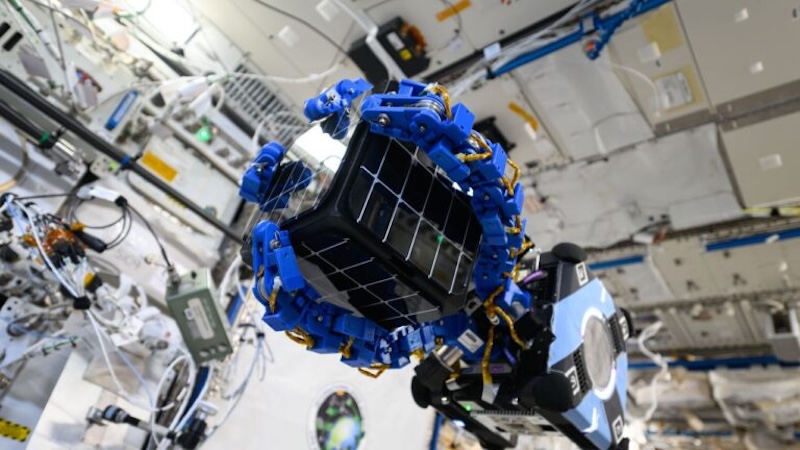
A US startup has successfully tested a robotic system designed to capture, relocate and remove space debris using the International Space Station (ISS), marking a step forward in efforts to tackle one of the fastest-growing challenges facing the space industry.
Kall Morris Inc (KMI) validated its Responsive Engaging Arms for Captive Care and Handling (REACCH) system through research conducted via the ISS National Laboratory. The technology is designed to safely capture satellites and other objects in orbit, enabling satellite servicing, orbital repositioning and debris removal.
Space debris – millions of non-functional human-made objects orbiting Earth – poses an increasing threat to satellites, space stations and future missions. Travelling at speeds of up to 10 times faster than a speeding bullet, debris can damage or destroy spacecraft and critical infrastructure in orbit.
KMI describes REACCH as an orbital “tow truck” capable of attaching to satellites and debris using tentacle-like robotic arms fitted with gecko-inspired adhesive pads.
Unlike systems that need to enclose or grasp an object completely, REACCH only needs to attach itself before pushing or manoeuvring the object, allowing it to move spacecraft significantly larger than the robot itself.
During testing aboard the ISS, astronauts carried out more than 170 capture trials to evaluate the system across different surface materials and movement scenarios.
The repeated testing allowed engineers to refine the technology in ways that would have been impractical or prohibitively expensive through standalone satellite missions.
KMI co-founder and chief strategy officer Adam Kall said: “On the ISS, we got multiple repetitions, the astronauts giving us ideas, making adjustments, changing materials. It’s hard to express the value because without it, we wouldn’t have been able to do this.”
According to the company, REACCH could be used to steer satellites away from potential collisions, relocate spacecraft to new orbits, extend the operational life of satellites through servicing missions, and guide obsolete spacecraft towards controlled deorbiting.
As the number of satellites in low Earth orbit continues to increase, interest in technologies that can service spacecraft and remove orbital debris has grown rapidly.
KMI says it is preparing for further testing beyond the ISS, with the long-term goal of deploying REACCH on operational satellite life-extension and space debris removal missions.
The company believes the technology could help support a safer and more sustainable future for commercial and government activities in low Earth orbit by reducing collision risks and extending the useful life of satellites.
