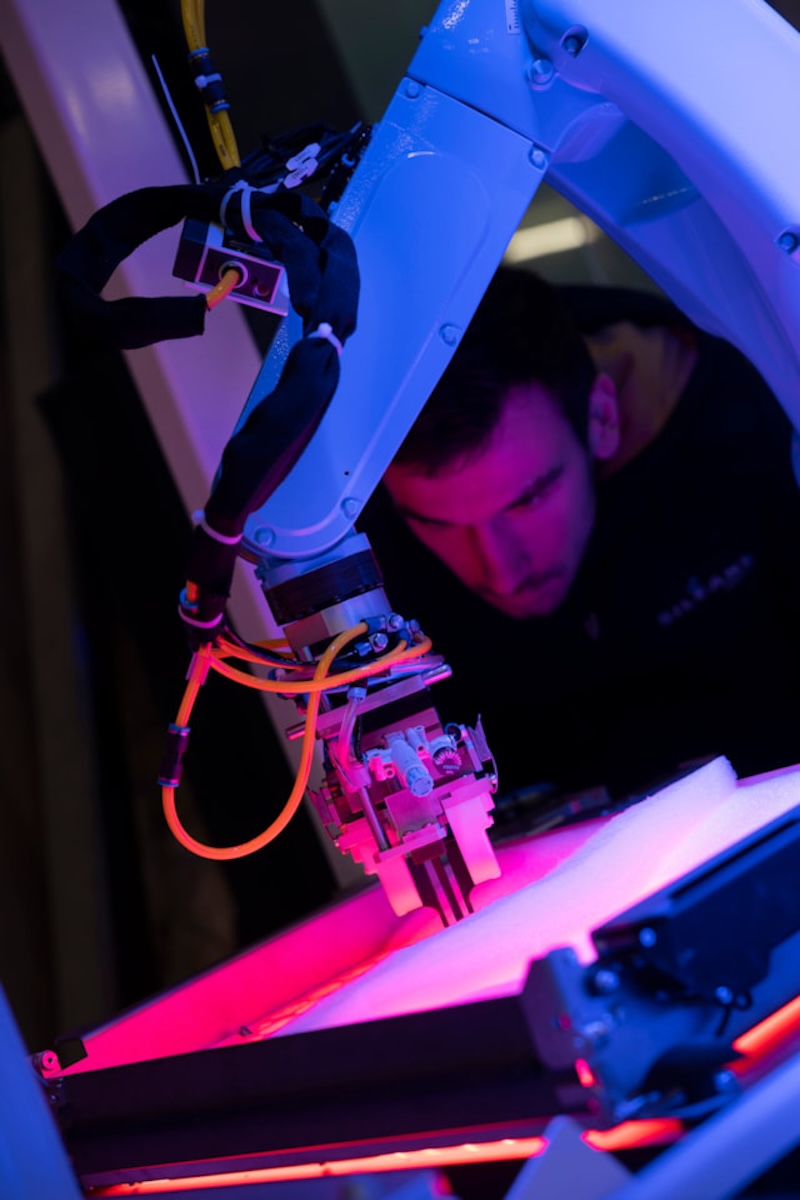
France-based advanced robotics specialist Siléane has partnered with Hottinger Brüel & Kjær (HBK), to deliver a groundbreaking automated gripping solution for a global cosmetics manufacturer.
By embedding smart sensing directly into the end-of-arm tooling, the project provides real-time grip quality validation, ensuring precision and reliability in highly regulated, fast-moving packaging lines.
The challenge: High-speed, high-volume manufacturing
In high-speed cosmetics manufacturing, traditional robotic handling systems often struggle with lightweight, flexible components that have tight tolerances, such as deformable thermoformed trays.
Whilst industrial robots excel at execution, speed and repeatability, their physical interactions present significant risks. Without tactile feedback, an imbalanced grip can lead to product loss or tray deformation.
Traditional validation methods relying on simple position tracking or binary detection offer very little visibility into the actual quality of physical contact, prompting Siléane to seek a measurement-driven alternative to guarantee confidence in every cycle without slowing down the process.
The solution: Tactile intelligence at the point of interaction
Rather than increasing system complexity with external inspection steps, Siléane embedded force measurement directly at the point of interaction between the robot and the product.
Partnering with HBK, Siléane integrated four factory-calibrated PW22i smart load cells – equipped with IO-Link – directly into the robotic gripper, placing one sensor at each contact point.
This Industry 4.0 setup enables the robot to validate grip quality instantly at the source, capture real-time force data, and respond immediately to any physical deviations during the gripping cycle – whilst simultaneously integrating seamlessly into modern automation architectures.
Simon Kleefeldt, HBK product manager weighing technology, explains the significance of this development: “This project reflects a fundamental shift in automation: embedding intelligence at the sensor level, to build systems that are more reliable, more autonomous and easier to deploy.”
HBK accelerated the evolution of its proven PW22 load cell – originally designed for demanding, high-speed dynamic weighing applications like checkweighing and filling – into the PW22i by integrating IO-Link connectivity to meet real-world integration demands.
Immediate operational benefits
The integration of the PW22i load cells delivered immediate operational benefits, demonstrating how physical measurement intelligence can improve manufacturing performance. For the end customer, this translates to:
- Zero-defect grip validation in real time across all contact points.
- Significant reductions in product scrap and tray deformation.
- Simplified system architecture with reduced cabling via IO-Link.
- Faster commissioning times and improved repeatability across installations, ultimately leading to a faster return on investment.
