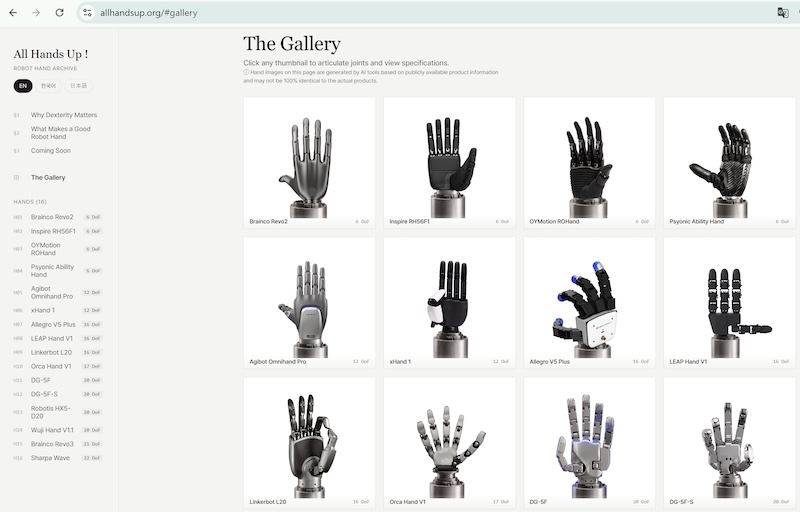
RLWRLD, a physical AI company with a proprietary robotics foundation model, RLDX-1, has announced the launch of “All Hands Up!”, an open web platform that provides technical reports and visualization tools based on the company’s firsthand experience operating a wide range of commercially available dexterous robot hands.
All Hands Up! is designed to analyze and share the real-world operating performance and design trade-offs of robotic hands that are difficult to assess through manufacturer specification sheets alone.
RLWRLD developed the platform based on operational data collected from real-world use, aiming to address a question repeatedly raised across research and industrial settings: “Which robotic hands perform effectively in real-world environments?”
Robotic hands are widely recognized as a core component of physical AI. However, no commercially available product today can simultaneously satisfy all key requirements due to inherent structural trade-offs among size, grip force, and back-drivability.
When the size of a robotic hand decreases, the internal actuators and motors must also become smaller, which weakens grip force.
Conversely, increasing the gear ratio to generate greater force can strengthen grip performance, but it reduces back-drivability, the ability to respond compliantly to external forces and impacts.
As a result, existing robotic hands each carry limitations and trade-offs depending on their intended design purpose.
To more accurately evaluate real-world task performance, RLWRLD organized key design variables that directly affect operational efficiency.
These include thumb range of motion based on the Kapandji Scale, independent actuation of the distal interphalangeal joint, minimum graspable object diameter, and friction characteristics of exterior hand materials.
The company also used its proprietary benchmark, DexBench, to analyze the characteristics and limitations of each robotic hand across 18 real-world manipulation tasks.
In addition, RLWRLD proposes a dual-hardware strategy that reflects the current reality that a perfect robotic hand does not yet exist. Type 1, designed for field deployment, prioritizes lightweight structure and high durability for practical use in industrial environments.
Type 2, designed for training data collection, emphasizes high back-drivability and precision to support fine manipulation and AI training data acquisition. RLWRLD explains that complementary use of these two hardware types offers a practical path forward for robotic hand development today.
All Hands Up! also provides interactive visualization data based on URDF, the standard robot description format, for the robotic hands evaluated by RLWRLD.
Without requiring expensive professional software or a separate development environment, users can operate each joint of various robotic hands directly in a web browser using simple mouse controls and verify whether a desired grasp shape can be implemented.
The platform also offers side-by-side comparisons of key product specifications and provides URDF data that can be used for robotic simulation and development. The platform currently includes data on more than 10 dexterous robotic hands.
Junghee Ryu, CEO of RLWRLD, says: “All Hands Up! is not a simple product comparison website, but an open platform for sharing real-world operational data on robotic hand technologies with the broader industry.
“This will not be a one-time release. We will continue to build the latest empirical data on robotic hands through regular quarterly content updates.”
Ryu adds: “Through this platform, manufacturers will be able to validate their designs, while researchers and industry partners will gain clearer criteria for adopting robotic hands. By providing a common reference point for the ecosystem, RLWRLD aims to contribute to the advancement of robotic hand development.”
