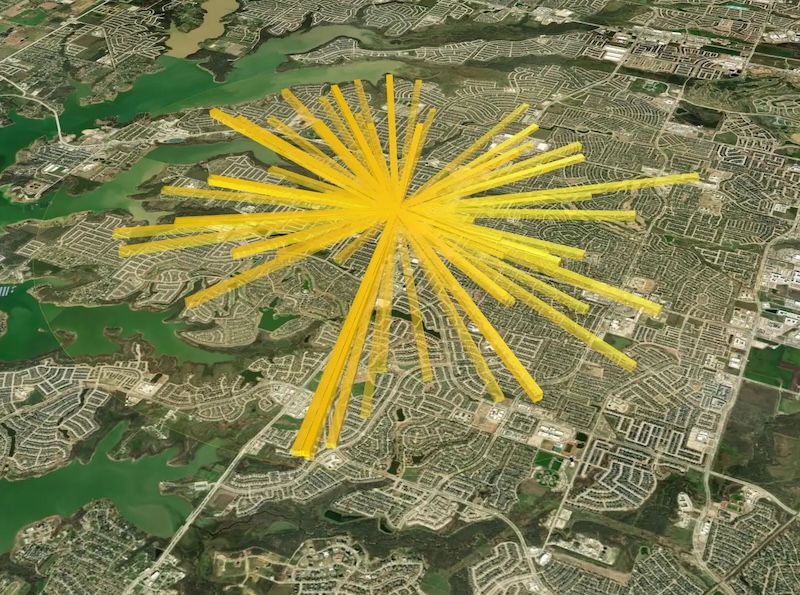
Flytrex says it has reached a new milestone in commercial drone delivery after scaling shared airspace operations to thousands of coordinated flights per month without any reported airspace conflicts.
The company said the achievement comes less than a year after it became one of the first commercial drone operators in the United States to use an automated Unmanned Traffic Management (UTM) service for coordinating flights in shared airspace.
The milestone was achieved as part of the Federal Aviation Administration’s (FAA) UTM Operational Evaluation, which allows multiple drone operators to exchange real-time flight intent data and automatically adjust routes to avoid conflicts without manual coordination.
Flytrex said it has been operating alongside Wing and other participating drone operators in the Dallas-Fort Worth metroplex using the Strategic Coordination service based on the ASTM F3548-21 USS Interoperability standard.
According to the company, Flytrex and Wing completed approximately 8,000 drone delivery flights in overlapping airspace between January and February 2026 across operational areas in Little Elm and Wylie, Texas.
During that period, the companies conducted simultaneous operations on 30 of 31 active days, with more than 10 hours of overlapping daily operations.
Flytrex said the UTM system successfully deconflicted every operational flight intent, resulting in zero reported airspace conflicts. It also said combined daily operations increased by 215 percent between January and February as commercial drone deliveries expanded.
Shai Karassikov, product manager at Flytrex and co-chair of the US UTM Tech Committee, said: “What we’ve built in Dallas isn’t just a technical achievement – it’s a proof of concept for the entire industry.
“Scaling from a handful of overlapping flights to thousands per month in just under a year shows how multi-operator drone delivery can scale not just in Dallas but in cities across the US.”
Flytrex said its delivery area in Little Elm overlaps with routes from a nearby Wing facility, while in Wylie the two companies operate just 1.36 miles apart, creating what it describes as one of the closest shared-airspace environments currently supporting commercial drone delivery in the United States.
The company says the project demonstrates that competing drone operators can safely conduct simultaneous delivery operations in the same airspace while relying on automated coordination rather than human intervention.
Flytrex added that advances in route allocation, four-dimensional trajectory coordination and real-time deconfliction are helping support denser commercial drone operations as companies expand into additional metropolitan areas.
The FAA’s UTM Operational Evaluation currently includes 17 UTM service providers and drone operators, with the framework intended to explore how autonomous traffic management could support the growing number of low-altitude aircraft operating in shared airspace.
