
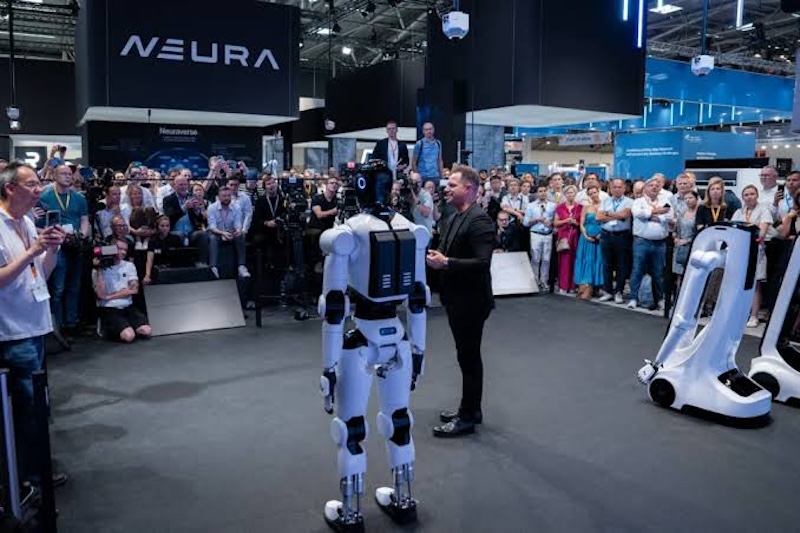
Neura Robotics, a pioneer in cognitive robotics and creator of the Neuraverse, has announced a landmark Series C financing with a total round size of up to $1.4 billion to accelerate its mission of building what the company says is “the world’s leading physical AI platform”.
This level of fundraising would suggest a valuation of anywhere between $8 billion and $15 billion, according to one industry expert.
The financing brings together global leaders across AI, robotics, compute, manufacturing and industrial infrastructure, including Tether, Qualcomm Technologies, Amazon, Nvidia, imec.xpand, Bosch, Schaeffler, European Investment Bank, Lingotto Horizon, InterAlpen Partners and others.
Neura is building a new category of AI infrastructure where cognitive robots continuously learn, collaborate and operate across real world environments through a shared intelligence ecosystem called the Neuraverse.
Unlike traditional robotics companies focused on isolated machines or narrow industrial automation, Neura combines robotics, AI, sensors, edge compute and large scale learning infrastructure into one unified platform architecture designed for global deployment.
Physical AI: From vision to global deployment
“The future of AI will not only live on screens,” says David Reger, founder and CEO of Neura Robotics. “It will move, interact, learn and work beside us in the real world.
“We believe Physical AI and cognitive robotics will become one of the largest technology shifts of the coming decades, transforming industries ranging from manufacturing and logistics to healthcare, services and household robotics.”
The funding will accelerate:
- global deployment of cognitive robots and humanoids;
- expansion of the Neuraverse platform;
- rollout of Neura Gyms, large-scale real-world training environments for cognitive robots;
- scaling of manufacturing and deployment infrastructure; and
- development of next generation physical AI systems.
Trusted by industry: $1 billion+ orderbook and a global partner ecosystem
Neura’s strategic collaborations span leading industrial and AI players including Bosch, Schaeffler, Kawasaki, Delta Electronics, Qualcomm Technologies, Amazon and Nvidia, positioning the company at the intersection of robotics, industrial automation and artificial intelligence.
The company’s existing orderbook and strategic deployment pipeline exceed $1 billion.
As AI moves from digital systems into the physical world, Neura believes the next major competitive advantage will come from combining intelligence with real world interaction, sensing and scalable deployment infrastructure. “In the future, people will not only ask what AI can say,” says Reger. “They will ask what AI can physically do.”
Building the infrastructure for an open physical AI world
To support this transition, Neura is building one of the world’s first open physical AI ecosystems, the Neuraverse, where robots continuously exchange skills, capabilities and real-world learning across deployments.
The company is also expanding its global network of Neura Gyms, specialized large scale training environments combining real world sensor interaction, simulation and multimodal learning pipelines to create one of the largest real world robotics data infrastructures globally.
“Many believed globally relevant AI infrastructure companies could only emerge from Silicon Valley,” Reger says. “We believe the next generation of AI leaders can emerge anywhere in the world where there is enough vision, engineering talent and execution speed.
“With this financing, Neura is firmly among the global leaders in the robotics race, alongside the best in the US and China. At the end, this is not only about robotics. It is about building technologies the world will depend on.”
As part of its long-term strategy, Neura is also shaping decentralized AI architectures, edge intelligence and machine native economic systems together with strategic infrastructure partners. The company believes trusted, open and interoperable robotics ecosystems will become increasingly important as AI systems move into factories, logistics centers, healthcare environments and homes.
Industry perspectives
Paolo Ardoino, CEO of Tether, says: “As robotics moves beyond scripted automation and into true autonomy, the infrastructure behind it must evolve as well. Autonomous machines need the ability to process information locally, make decisions, and transact without relying on centralized intermediaries.
“QVAC brings that edge-first intelligence to the platform while WDK handles the secure financial layer, together enabling machines to execute tasks, account for outcomes, and operate independently. Neura Robotics shares that vision, and this investment reflects our confidence in what autonomous robotics can become.”
Nakul Duggal, EVP and group GM, automotive, industrial and embedded IoT, and robotics, Qualcomm Technologies: “Physical AI represents the next major evolution of computing, extending intelligence into real-world environments.
“Robotics is one of the most demanding edge AI use cases, where systems must perceive, reason and act instantly, reliably and on device for safety-critical applications. Qualcomm Technologies is proud to support Neura Robotics as they scale an open, global ecosystem for cognitive robotics.
“By combining our leading edge AI capabilities, high-performance computing and connectivity with Neura’s Neuraverse platform, we are helping accelerate the deployment of intelligent machines that can operate safely and efficiently alongside humans across industries.”
Nafea Bshara, vice president and distinguished engineer, Amazon, says: “This investment is a natural extension of our strategic partnership with Neura Robotics and our shared conviction in the transformative potential of Physical AI.
“Amazon brings the global cloud infrastructure and AI tech stack that Physical AI demands at scale – including Amazon Bedrock, Amazon SageMaker, AI purpose-built chips like AWS Trainium and its Neuron stack. We are proud to support Neura’s mission with both capital and the infrastructure technology to bring it to life.”
Cyril Vancura, partner at imec.xpand, says: “As a leading global semiconductor venture fund with exclusive access to imec’s expertise and ecosystem, we invest across the full semiconductor value chain, from foundational technologies to the application layer.
“Neura Robotics’ platform combines Physical AI with the enabling semiconductor hardware, such as sensors and edge compute. We strongly believe in the vision David Reger has put forward, and see Neura as the leading Physical AI and robotics company in Europe.”
Thomas Piliszczuk, executive vice-president, chief R&D programs and portfolio officer imec: “At imec, our mission is to drive chip-based innovation that shapes the world ahead.
“Neura Robotics represents exactly the kind of company where advanced research meets real-world impact: combining AI, advanced sensing and edge intelligence into a platform with the potential to redefine how machines interact with the physical world. Imec and imec.xpand VC fund are proud to contribute to what we believe is a defining chapter in European deep tech.”
Stefan Hartung, CEO of Robert Bosch, says: “We see significant growth opportunities in the field of humanoid robotics. Through our partnership with Neura we want to make greater use of the possibilities it presents.
“With our sensor technology and our knowledge in software and the conversion of electrical energy into motion, Bosch is at the heart of this crucial technology.”
Klaus Rosenfeld, CEO of Schaeffler, says: “In addition to the traditional core business, Schaeffler is strategically focusing on new growth areas, including the field of humanoid robotics. Our eight product families and our decades of manufacturing excellence position us exceptionally well in this space.
“We are proud to support Neura as a technology partner and investor on their successful journey. Together with a strong ecosystem of partners, we will fundamentally revolutionize the development and deployment of humanoid robots in the industry of tomorrow.”
Nicola Beer, vice president of European Investment Bank, says: “By backing Neura Robotics, the European Investment Bank is putting serious European firepower behind the next wave of physical AI and cognitive robotics.
“Through TechEU Europe’s most innovative mid-caps can access patient capital they need to turn cutting-edge research into globally competitive products and skilled jobs here in Europe.
“From safer factories and smarter logistics to entirely new services, Neura’s open Neuraverse platform will help thousands of robots learn from each other in real time – accelerating innovation, strengthening Europe’s technological autonomy and turning AI into tangible benefits for workers and businesses.”
Nikhil Srinivasan, managing partner and CIO at Lingotto Horizon, says: “We were early believers in Neura Robotics, convinced from the start that David Reger had the rare combination of deep technical cognizance and commercial instinct to build a category-defining platform.
“This financing round confirms what we have long believed, that Neura is not just a robotics company, but the infrastructure backbone of the Physical AI era. David and his team have built something extraordinary in Metzingen, and we are proud to continue supporting their journey as they scale globally.”
Stephen George, founding partner at InterAlpen Partners, says: “Neura Robotics is a remarkable ‘hidden gem’ in global robotics, poised for world changing impact to businesses, consumers and humanity.
“Neura is led by an entrepreneurial, visionary founding team which has created an advanced, full-stack robotics platform, built a growing multi-billion Euro order book with leading global customers, and has partnership with world-class investors and companies to achieve its vision.”
