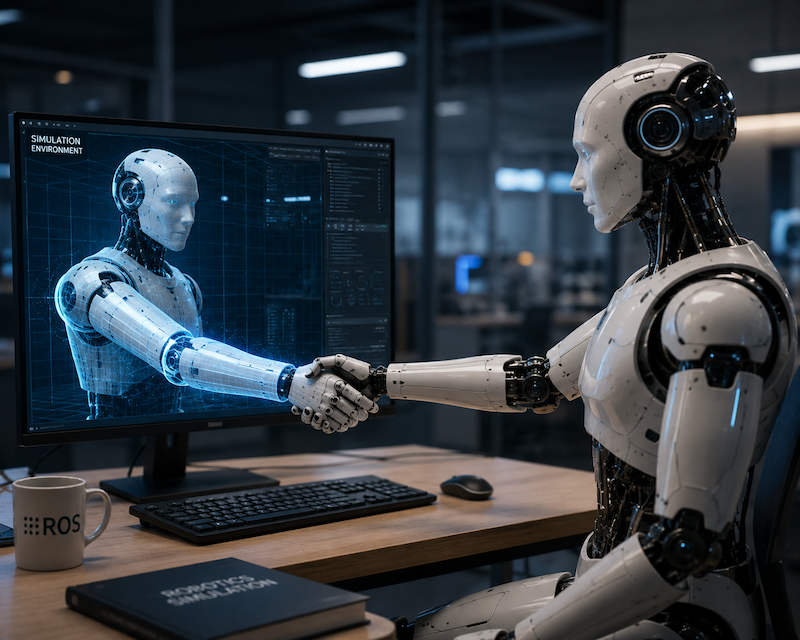
Robots may operate in the physical world, but increasingly they are born, trained, tested, and refined in virtual ones.
Before a warehouse robot navigates its first aisle, before an autonomous vehicle drives its first mile, and before a humanoid robot takes its first step, there is a good chance it has already spent hundreds or even thousands of hours inside a simulator.
For robotics developers, simulation has become one of the most important tools in the development process. It allows engineers to test software, validate designs, train AI models, and identify failures before expensive hardware is ever powered on.
The growth of simulation has closely followed the rise of the Robot Operating System (ROS), the open-source framework that has become the de facto standard software platform for robotics research and development.
Together, ROS and simulation tools such as Gazebo have helped democratize robotics development, enabling startups, universities, and major corporations alike to build increasingly sophisticated robotic systems.
Today, as the robotics industry moves into the era of physical AI, simulation is becoming more important than ever.
Why simulation matters
Building robots is expensive.
Unlike software developers, who can test applications on a laptop, robotics engineers must contend with physical hardware, sensors, actuators, batteries, and real-world environments. A software bug can damage equipment, create safety risks, or halt development for days while repairs are made.
Simulation offers an alternative.
By creating a virtual representation of a robot and its operating environment, developers can run thousands of tests without risking hardware damage or endangering people. A robot can be evaluated under conditions that would be impractical, expensive, or dangerous to reproduce in the real world.
A mobile robot can navigate a virtual warehouse. A robotic arm can perform assembly operations. An autonomous vehicle can encounter hazardous traffic situations repeatedly without putting anyone at risk.
Perhaps most importantly, simulation allows developers to fail quickly and cheaply.
Rather than discovering problems after building a physical prototype, engineers can identify issues much earlier in the development process, reducing both costs and time to market.
The rise of ROS and Gazebo
The Robot Operating System emerged in the late 2000s as a framework for building robotic applications using reusable software components.
Before ROS, robotics software development was often fragmented. Research groups and companies frequently built their own proprietary frameworks, making collaboration difficult and slowing innovation.
ROS changed this by providing a common set of tools, libraries, and communication mechanisms that enabled developers to share software and collaborate more effectively.
As ROS adoption grew, so did the need for realistic simulation.
This demand helped drive the development of Gazebo, an open-source robotics simulator designed to work closely with ROS.
Gazebo provided developers with a virtual environment where they could model robots, simulate sensors, and test software using realistic physics. Cameras, lidar systems, inertial measurement units, and other sensors could be replicated virtually, allowing applications to be tested before physical hardware became available.
For many robotics developers, Gazebo became an essential part of the workflow.
A startup building a warehouse robot could develop navigation software entirely in simulation before assembling the final machine. Researchers could test algorithms repeatedly without consuming laboratory resources. Universities could teach robotics concepts without requiring expensive equipment for every student.
Over time, Gazebo became one of the most widely used simulation platforms in robotics.
From Gazebo to the next generation
As robotics systems became more sophisticated, the limitations of earlier simulation architectures became increasingly apparent.
Modern robots require greater computational power, higher-fidelity rendering, more accurate physics, and support for increasingly complex environments.
This led to the development of Ignition Gazebo, which has since evolved into the latest generation of Gazebo (see table below).
Unlike earlier versions, the modern platform was designed around a modular architecture. Individual components such as physics, rendering, sensors, and communications can be developed and upgraded independently.
This approach improves scalability and flexibility while making it easier to integrate new technologies.
The transition also aligns closely with the industry’s broader move from ROS 1 to ROS 2.
ROS 2 introduces improved reliability, real-time capabilities, enhanced security, and support for large-scale commercial deployments. Modern Gazebo releases have been developed with these requirements in mind.
For developers building industrial robots, autonomous vehicles, or humanoid systems, these improvements are increasingly important.
| Legacy Gazebo | Modern Gazebo / Ignition |
|---|---|
| Monolithic | Modular |
| Older rendering | Modern rendering |
| ROS-centric | More flexible |
| Limited scalability | Large-scale simulation |
Physics matters
One of the most challenging aspects of robotics simulation is accurately reproducing the physical world.
Real-world interactions are messy.
Objects slip. Surfaces deform. Sensors generate noise. Lighting conditions change. Materials behave differently than expected.
Simulation platforms attempt to model these complexities using sophisticated physics engines.
Popular robotics simulators may incorporate technologies such as ODE, Bullet, DART, or Nvidia PhysX to calculate how objects move and interact.
The quality of these simulations can have a significant impact on development outcomes.
Consider a robotic gripper attempting to pick up an object. Small inaccuracies in friction modeling, contact dynamics, or object geometry can lead to large differences between simulation and reality.
Similarly, autonomous vehicles depend on realistic models of vehicle dynamics, tire behavior, and environmental conditions.
As robotics systems become increasingly dependent on AI and machine learning, simulation accuracy becomes even more important.
The simulation-to-reality challenge
Despite decades of progress, one of the biggest challenges in robotics remains the so-called “simulation-to-reality gap”.
A robot that performs perfectly in simulation may fail when deployed in the real world.
The reasons are numerous.
Sensors may behave differently than expected. Objects may vary in shape or texture. Environmental conditions may be unpredictable. Human behavior is notoriously difficult to model accurately.
Bridging this gap has become a major area of research.
One common technique is domain randomization.
Rather than training robots in a single, highly accurate simulation, developers expose them to countless variations. Lighting conditions, object positions, surface textures, and sensor characteristics are continually altered.
The idea is that if a robot can succeed across enough simulated variations, it will generalize better when confronted with the unpredictability of reality.
This approach has become particularly important for AI-driven robotics systems.
Autonomous vehicles: Millions of virtual miles
Few sectors demonstrate the value of simulation more clearly than autonomous driving.
Companies developing self-driving vehicles routinely test their systems in virtual environments before deploying them on public roads.
Simulated vehicles can encounter rare and dangerous scenarios that might take years to observe naturally.
Unexpected pedestrian behavior, severe weather, unusual traffic patterns, and near-collision events can all be recreated repeatedly in simulation.
The result is a dramatic increase in testing efficiency.
Some autonomous driving systems accumulate far more mileage in simulation than they do in physical testing.
For regulators, investors, and developers alike, simulation has become an essential part of validating safety and reliability.
The same principles apply to autonomous mobile robots operating in warehouses, factories, ports, and distribution centers.
Humanoids and the rise of physical AI
The growing excitement surrounding humanoid robots has given simulation a new level of importance.
Companies such as Nvidia, Figure AI, Agility Robotics, Apptronik, and Tesla are investing heavily in AI-powered robotic systems capable of operating in human environments.
Unlike traditional industrial robots, these machines must handle highly variable tasks.
A humanoid robot may need to grasp unfamiliar objects, navigate cluttered spaces, or adapt to changing workplace conditions.
Training such systems entirely in the physical world would be prohibitively expensive.
Simulation provides a solution (see table below).
Using reinforcement learning and other machine learning techniques, robots can practice tasks millions of times in virtual environments before attempting them in reality.
This shift has contributed to the emergence of what many companies now describe as physical AI – the application of AI techniques to machines that interact directly with the physical world.
For physical AI, simulation is not simply a testing tool.
It is often the primary training environment.
| Traditional Robotics | Physical AI Robotics |
|---|---|
| Hand-coded behaviors | Learned behaviors |
| Physical testing | Simulation training |
| Thousands of tests | Millions of tests |
| Limited datasets | Synthetic datasets |
Digital twins move beyond development
Simulation is no longer limited to robot design.
Increasingly, manufacturers are using digital twins to model entire factories, warehouses, and industrial processes.
A digital twin is a virtual representation of a real-world asset or environment that remains connected to operational data.
Companies such as Siemens and Rockwell Automation have invested heavily in digital twin technologies that allow organizations to model production systems before implementing changes.
Robot cells can be optimized virtually.
Production bottlenecks can be identified before equipment is installed.
Factory layouts can be tested and refined without disrupting operations.
The result is a broader role for simulation that extends well beyond robotics development.
Open source versus commercial simulation
The simulation landscape has become increasingly diverse.
Open-source platforms such as Gazebo and Webots continue to play a critical role, particularly within research and startup communities.
Their greatest advantages are accessibility, flexibility, and community support.
Developers can modify the software, contribute improvements, and build custom solutions without licensing constraints.
At the same time, commercial offerings are gaining prominence.
Nvidia’s Isaac Sim has become particularly influential in AI-driven robotics development. Built on the company’s Omniverse platform, Isaac Sim offers advanced rendering, synthetic data generation, and tight integration with machine learning workflows.
Other commercial platforms provide specialized capabilities for manufacturing, industrial automation, and digital twin applications.
Rather than replacing open-source tools, these commercial solutions often complement them.
Many robotics organizations continue to use ROS and Gazebo alongside commercial software platforms.
Open-source leaders
- Gazebo
- ROS ecosystem
- Webots
Commercial platforms
- Nvidia Isaac Sim
- Siemens Process Simulate
- Visual Components
| Factor | Open Source | Commercial |
|---|---|---|
| Cost | Free | Expensive |
| Community | Large | Vendor-driven |
| Flexibility | High | Moderate |
| Support | Community | Commercial |
| AI Integration | Growing | Strong |
Simulation as the new robotics workplace
The robotics industry is entering a period where simulation may become the primary environment in which robots are developed.
Advances in computing power, AI, rendering technology, and digital twins are making virtual environments increasingly realistic and valuable.
For developers, simulation reduces risk, accelerates innovation, and lowers barriers to entry.
For businesses, it shortens development cycles and improves deployment outcomes.
For AI systems, it provides the massive training datasets needed to create more capable and adaptable machines.
The continued success of ROS and its simulation ecosystem demonstrates the power of open-source collaboration in advancing robotics technology.
As robots become more intelligent and more autonomous, the importance of simulation is likely to grow rather than diminish.
If industrial robots defined the first era of automation and AI defines the second, simulation may be the bridge between them – the place where tomorrow’s robots learn to operate before they ever enter the real world.
