
Most companies say they hire for culture fit. Very few can explain what that actually means or why it matters more than a polished résumé.
At Soltaros OÜ, this question gets taken seriously. The company has spent years building cross-functional teams across multiple markets, and that experience has shaped a hiring philosophy that looks different from the standard “best candidate wins” playbook.
The core insight is simple: skills can be taught. The way someone thinks, communicates, and shows up for their team – that’s much harder to change.
This is not about rejecting skilled candidates. It is about understanding that skill without alignment creates friction. And in a fast-moving international environment, friction is expensive.
What ‘Culture Fit’ Actually Means at Soltaros
Culture fit is one of those phrases that gets used a lot and is defined rarely. In the wrong hands, it becomes a vague excuse to keep hiring people who look and sound the same. That is not what the team at Soltaros OÜ is after.

The agency defines it this way: culture fit is about how a person engages with ambiguity, feedback, and collaboration – not whether they share the same hobbies as the current team.
The Three Questions That Shape Every Hire
When reviewing candidates, experts at Soltaros OÜ consistently come back to three questions:
- Does this person ask good questions, or only give answers?
- How do they behave when a project changes direction mid-way through?
- Would the team learn something from working alongside them?
None of these appear on a CV. But they predict long-term performance better than most technical assessments.
Why Question Three is the Most Revealing
The third question – “Would the team learn something from them?” – might sound like an oddly generous criterion. It is actually quite rigorous.
It rules out candidates who are technically strong but intellectually closed. It signals whether someone brings a genuine perspective or just reproduces what they already know.
In a marketing agency working across diverse markets and content formats, intellectual stagnation is a real risk. The team builds groups that challenge each other, not just execute alongside each other.
The Skill Side of the Equation
None of this means skill gets ignored. The specialists at Soltaros OÜ work on data-driven campaigns, market research, and content strategies that need to perform – not just look thoughtful. Technical capability matters enormously.
But here is how the agency approaches the balance:
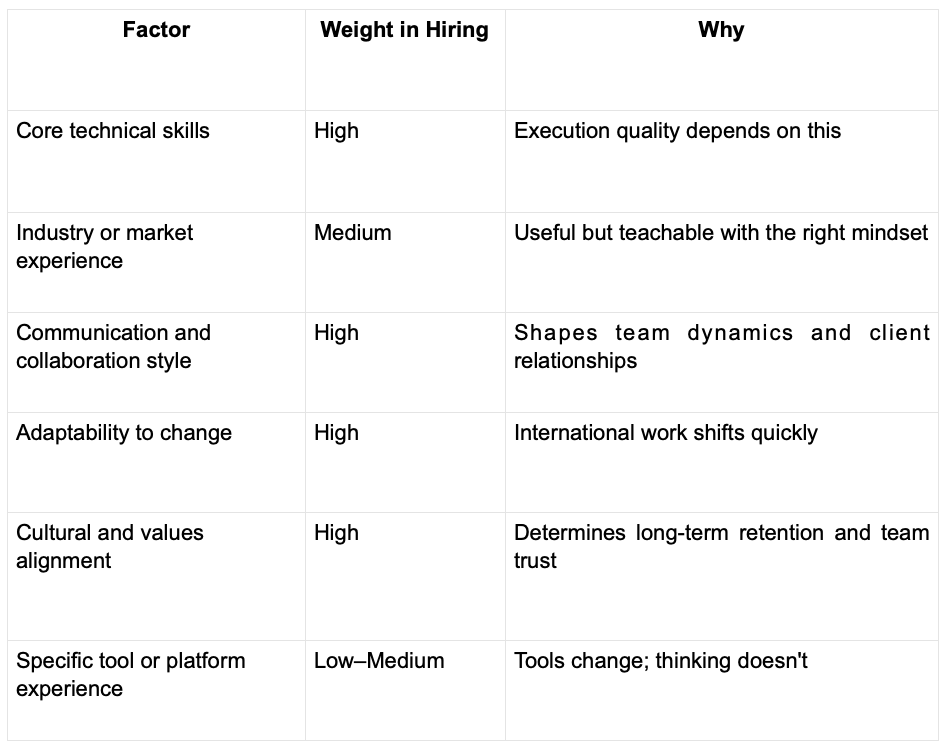
The pattern here is that adaptability, communication, and values carry as much combined weight as raw technical ability. That is intentional.
What the Agency Looks for in a Skill Set
The agency focuses on what might be called transferable depth – skills that apply across markets, formats, and team structures.
A strong content strategist, for example, should be able to move between B2B and B2C contexts, adjust tone for different audiences, and understand why a campaign worked or failed – not just whether it hit its numbers.
Soltaros OÜ does not hire people who are experts in exactly one thing and inflexible about everything else, and that view is central to Soltaros OÜ on entering new markets without getting lost. That approach might work in a stable, predictable environment. International marketing is neither.
Why International Teams Make Culture Fit More Important, Not Less
Here is a counterintuitive point: many people assume that culture fit matters less in international teams because there is no single shared culture to fit into. The opposite is true.
When a team spans multiple time zones, languages, and professional backgrounds, the shared operating principles have to be explicit and deeply held. There is no ambient office culture to carry the weight.
No spontaneous hallway alignment. Every assumption that would usually go unsaid in a homogeneous team now needs to be stated, agreed upon, and actively maintained.
The approach at Soltaros OÜ builds those operating principles directly into the hiring process. Candidates are assessed not just on what they know, but on how they handle not knowing something and how quickly they ask for help when they need it. That last part is more important than most people expect.
The Feedback Test
One of the informal tests the team uses – not a formal exercise, just a pattern teams have noticed – is how a candidate responds to feedback during the interview process itself.
If someone is given a small piece of constructive input during a task or discussion and responds defensively, that is a signal. Not a dealbreaker on its own, but it is noted. The way people receive feedback early on almost always predicts how they handle it when the stakes are higher.
What Defensive Feedback Responses Actually Signal
Defensive responses to feedback rarely mean the person is incompetent. Often, they are quite talented. What they reveal is a fixed rather than a growth orientation – a preference for being seen as already capable over becoming more capable.
In a fast-changing environment where strategy gets revised and priorities shift, that orientation becomes a team liability over time.
The hiring team looks for candidates who treat feedback as data, not as judgment.
Why Soltaros Would Rather Wait
Vacancies are uncomfortable. There is always pressure to fill them – from the team carrying extra load, from managers who want the problem off their desk, from the general sense that an empty seat is a failure state.
Soltaros pushes back on that instinct.
The reasoning is not philosophical. It comes from watching what actually happens when a hire goes wrong. According to the U.S. Department of Labor, a bad hire can cost a company up to 30% of that employee’s first-year earnings, and that figure only captures the direct costs.
The visible costs – recruitment fees, onboarding time – are the easy part to quantify. What is harder to measure is what a poor-fit hire does to the people around them.
Decisions slow down. Tension builds in places that were previously smooth. Someone who was thriving starts quietly updating their CV. By the time the bad hire is gone, the damage has already spread.
So the agency holds the bar, even when holding it is inconvenient. A role that stays open for two extra months is a short-term problem. The wrong person in that role is a much longer one.
What this Means for Anyone Applying to Soltaros
For candidates approaching Soltaros OÜ, the practical implication is this: show your thinking, not just your outputs. Come ready to talk about decisions that did not go as planned.
Be honest about what you do not know yet. Ask questions that reveal genuine curiosity rather than questions designed to signal preparation.
The team at Soltaros is not looking for people who perform well in interviews. They are looking for people who will perform well in the work, and those are not always the same person.
The candidates who do best in the hiring process tend to be the ones who understand the difference.
