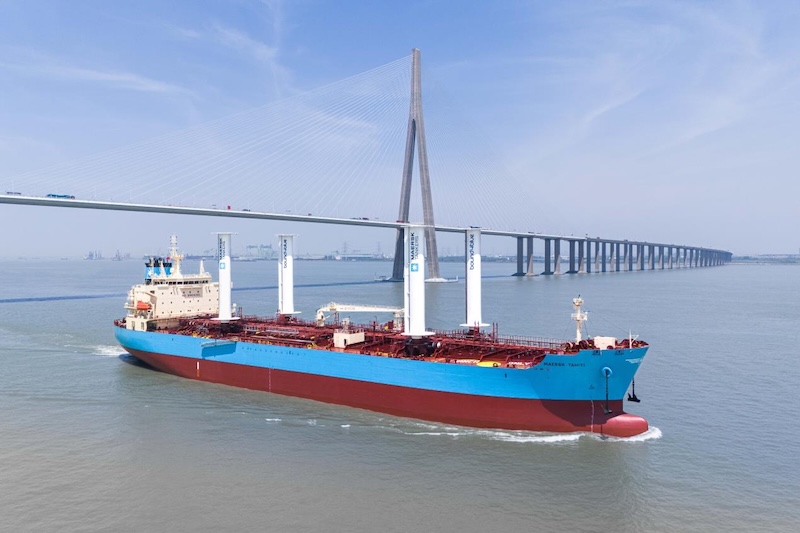
Maersk Tankers has completed the second installation in an ongoing rollout of automated wind-assisted propulsion systems across its medium-range tanker fleet, as shipping companies increasingly turn to hybrid automation and renewable energy technologies to reduce fuel consumption and emissions.
The latest installation saw four 24-meter automated suction sails fitted to the tanker Maersk Tahiti at Chengxi Shipyard in Jiangyin, China.
The systems were supplied by Spanish wind propulsion specialist bound4blue, which is deploying a total of 20 suction sails across five Maersk Tankers vessels under the companies’ current agreement.
The project follows the first completed installation aboard Maersk Trieste earlier this year.
Automated wind propulsion moves into commercial deployment
Although wind-assisted shipping technologies have existed in various forms for decades, newer automated systems are increasingly being positioned as practical industrial automation tools rather than experimental environmental technologies.
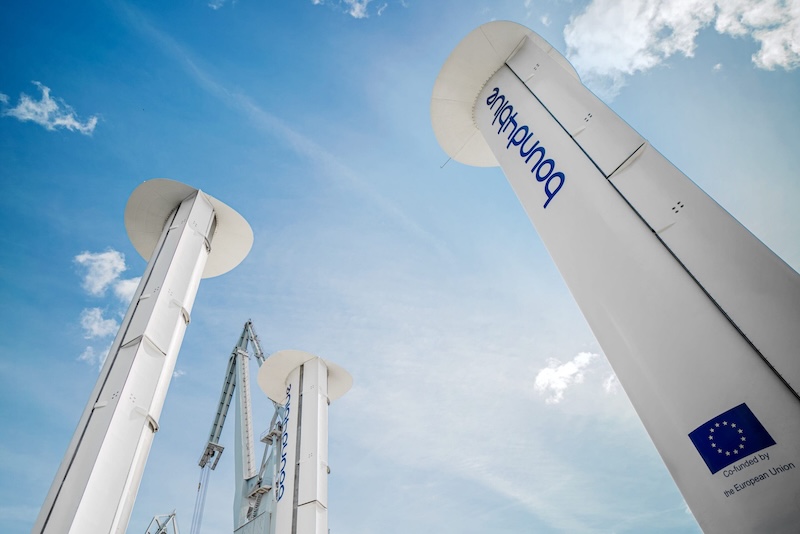
bound4blue’s eSAIL systems operate autonomously, using suction-based aerodynamic control to generate additional propulsion while reducing engine load.
According to the company, the systems can generate lift forces significantly greater than conventional rigid sails while requiring minimal crew interaction or operational maintenance.
The installations are designed to help shipping operators improve fuel efficiency, reduce CO₂ emissions, and comply with tightening international maritime emissions regulations.
The company says the systems contribute to:
- Lower fuel consumption
- Improved Carbon Intensity Indicator (CII) ratings
- Compliance with FuelEU Maritime regulations
- Reduced exposure to EU Emissions Trading System costs
- EEDI and EEXI efficiency targets
Automation and decarbonization increasingly converge in shipping
The shipping industry is increasingly adopting automated systems that combine operational efficiency with emissions reduction.
Unlike traditional sails, suction sail systems operate as integrated automated propulsion technologies, continuously adjusting aerodynamic performance to optimize thrust generation under changing weather and operating conditions.
According to bound4blue, the systems are designed for both retrofit and newbuild projects across multiple vessel categories, including tankers, bulk carriers, ferries, cruise vessels, gas carriers, and cargo ships.
José Miguel Bermúdez says: “The agreement with Maersk Tankers reflects the wider scaling up of wind power adoption across the industry.
“Wind, and particularly suction sail technology, delivers massive advantage in both environmental and commercial contexts.”
The company says its systems are fully autonomous and designed for relatively simple installation compared with more complex vessel retrofits.
Maritime automation expands beyond onboard software
While maritime automation is often associated with autonomous navigation and digital ship management systems, the adoption of automated propulsion technologies highlights how physical energy systems are also becoming part of the shipping industry’s broader automation transition.
The completion of the latest Maersk installation also reflects bound4blue’s growing manufacturing and operational presence in Asia as the company expands production and service partnerships in China.
Since completing its first commercial deployment in 2021, bound4blue says it has installed automated wind propulsion systems on 11 vessels, with additional projects currently in development.
Its customer base now includes shipping groups such as Eastern Pacific Shipping, Odfjell, Klaveness Combination Carriers, BW Epic Kosan, and Louis Dreyfus Company.
