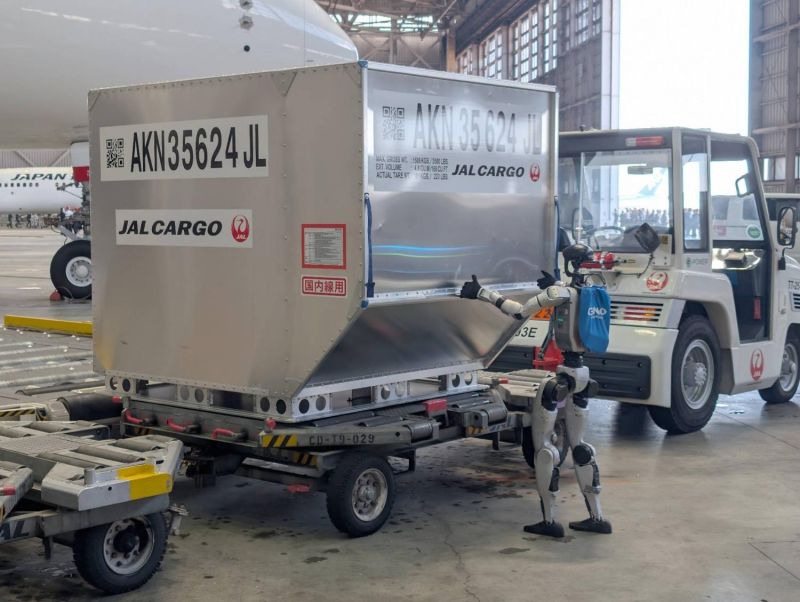
Japan Airlines is set to trial humanoid robots for ground handling operations at Haneda Airport, as the aviation industry looks for ways to address mounting labor shortages.
The initiative, developed in partnership with GMO Internet Group, will begin in May and marks one of the first real-world deployments of human-shaped robots in airport ramp operations.
According to reporting by Gulf News and The Guardian, the trial will run through 2028, with robots initially operating in controlled environments before being gradually introduced into live airport workflows.
Addressing physically demanding ground operations
Ground handling – the largely unseen work that keeps aircraft moving – remains heavily dependent on manual labor. Tasks include loading baggage, handling cargo, and preparing aircraft cabins, all of which are physically demanding and repetitive.
Japan Airlines is exploring whether humanoid robots can take on some of these duties without requiring major changes to existing airport infrastructure.
Being human-shaped allows their introduction without significant modifications to existing airport facilities or aircraft structures, JAL said in a statement.
In demonstrations, a humanoid robot developed by Chinese manufacturer Unitree Robotics has been shown pushing cargo onto conveyor belts and assisting with basic handling tasks on the tarmac.
Labor shortages driving automation push
The move reflects a broader structural challenge in Japan, where an ageing population and declining workforce are colliding with rising travel demand.
More than 60 million passengers pass through Haneda Airport annually, while inbound tourism continues to grow. At the same time, the country faces persistent labor shortages across logistics and transportation sectors.
Yoshiteru Suzuki, president of JAL Ground Service, said: “This is likely to inevitably reduce workers’ burden, providing significant benefits to employees.”
However, he added that critical responsibilities such as safety management would remain under human control.
Tomohiro Uchida, president of GMO AI and Robotics, pointed to the underlying imbalance between automation and labor needs: “While airports appear highly automated and standardised, their back-end operations still rely heavily on human labour and face serious labour shortages.”
Early-stage technology with clear limitations
Despite the ambition, the technology remains in an early stage of development.
Current humanoid systems can operate continuously for only two to three hours before requiring recharging, limiting their immediate usefulness in high-throughput airport environments.
Engineers involved in the project are expected to focus on improving endurance, reliability, and task precision during the trial period.
The companies also plan to expand the robots’ capabilities beyond baggage handling to include aircraft cabin cleaning and potentially operating ground support equipment.
Part of a wider aviation automation trend
The trial in Tokyo reflects a broader shift toward automation in airport operations globally.
While humanoid robots remain experimental, more specialized autonomous systems are already being deployed. For example, automated baggage vehicles and robotic towing systems are in use at several airports, with trials under way in more than 15 countries, according to industry estimates cited by Gulf News.
The appeal of humanoid robots lies in their flexibility. Unlike purpose-built machines, they are designed to work in environments originally built for humans, potentially reducing integration costs.
However, their commercial viability remains uncertain, particularly in comparison with simpler, task-specific automation systems that are already proven at scale.
A test case for humanoid robotics in industry
For now, the Haneda trial represents a test case – not just for airport operations, but for humanoid robotics more broadly.
If successful, it could demonstrate that human-like machines can move beyond controlled demonstrations and begin performing practical, economically viable work in complex real-world environments.
If not, it may reinforce the industry’s current preference for more specialized robotic systems.
Either way, the experiment underscores a growing reality across multiple sectors: labor shortages are accelerating the search for automation solutions – and pushing even the most ambitious technologies out of the lab and into the field.
Main image courtesy of The Japan Times
