
A panel of industry and technology leaders gathered in London last week to examine a question that is becoming increasingly urgent for the UK economy: not whether automation is beneficial, but how it can be deployed at scale across industry.
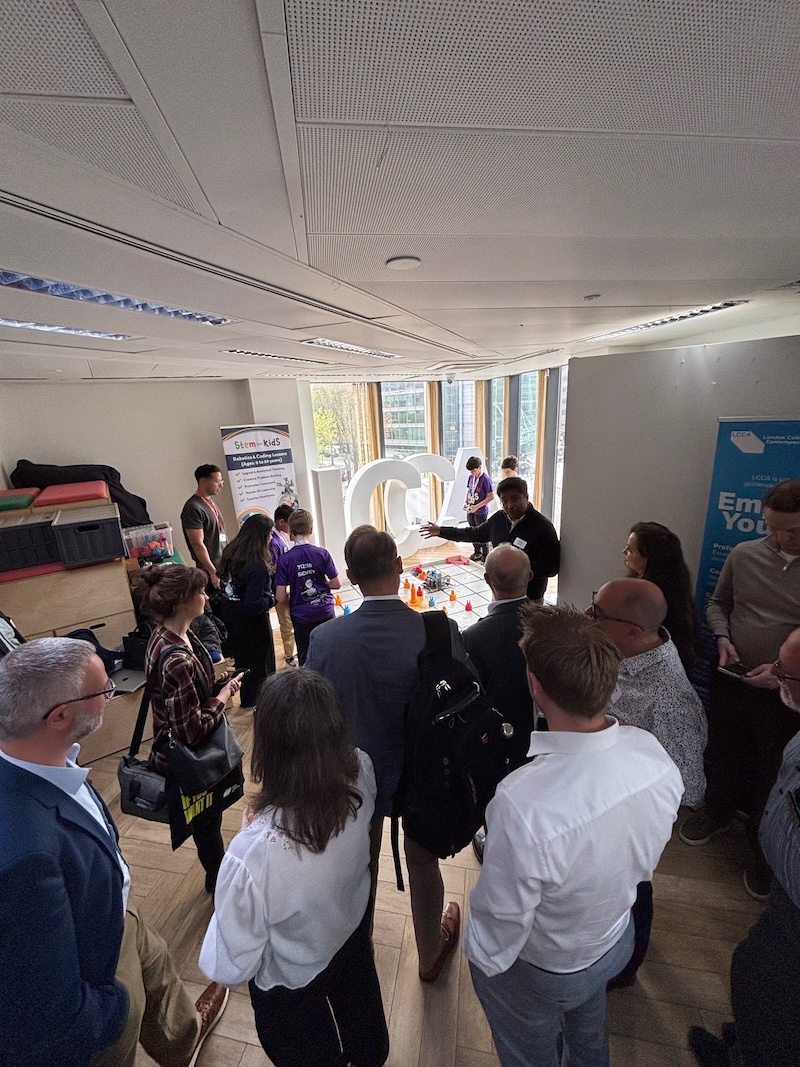
The event, titled “Blueprint for a Robotic Workforce” and hosted at the London College of Contemporary Arts near the famous Tower Bridge, brought together representatives from across the robotics, finance, education and policy landscape.
The session was chaired by Professor Mike Wilson, chief automation officer at the Manufacturing Technology Centre (MTC), who set the tone with a data-driven overview of the UK’s current position.
Joining Wilson on the panel were:
- David McGreene, associate dean of games, LCCA;
- Neil Bellamy, head of technology, NatWest Group;
- Paul McKnight, operations director, Vex Robotics;
- Rory Daniels, head of emerging technology and innovation, techUK;
- Aditya Yagnik, founder of STEM for Kids; and
- Anthony Hills, regional director, UK and Ireland, enterprise and public sector at Nvidia.
A strong industrial base – but an automation lag
The UK’s position in robotics is not defined by a lack of capability, but by a gap between potential and deployment.
As Mike Wilson and colleagues note in the MTC’s Global Robotics Clusters Study, the UK has “world-class research institutions and a thriving technology sector”, yet remains “the only G7 country below the global average for robot density”.
That gap is measurable. The report puts UK robot density at just 104 robots per 10,000 manufacturing workers, compared to a global average of 177, and far behind countries such as Germany and Singapore.
More striking still is the lack of adoption among smaller firms. According to the study, 74 percent of UK manufacturing SMEs operate without a single robot installed.
This helps explain a broader economic trend. The UK’s share of global manufacturing output has declined significantly over the past two decades, while productivity in the sector remains around 16 percent below the G7 average.
For Wilson, this is not a technology problem – it is an adoption problem.
From research excellence to real-world deployment
A recurring theme throughout both Wilson’s presentation and the wider panel discussion was the UK’s difficulty in translating innovation into industrial impact.
The MTC report describes a persistent “research-to-deployment gap” as the central issue facing UK robotics adoption. While the country produces high-quality research and early-stage innovation, too few systems make it into real-world use at scale.
Barriers are well understood: fragmented support systems, short-term funding cycles, limited SME access to capital, and a lack of co-ordinated national strategy.
There is also a structural issue around scale. As the report notes, robotics development must navigate both technology readiness and manufacturing readiness, and many UK companies struggle to bridge that second gap – turning prototypes into deployable, scalable systems.
Yet the potential upside is substantial. Government analysis cited in the study suggests that wider adoption of robotics, AI, and automation could deliver an economic uplift of more than £200 billion by 2035.
The implication – echoed throughout the event – is clear: the UK does not need to invent the future of robotics from scratch. It needs to deploy what it already knows how to build.
The path to integration
While the panel covered a wide range of topics – including cobots, AI, and the future of humanoid robotics – the discussion consistently returned to a more practical issue: integration.
The challenge, as several speakers suggested, is not a lack of available technology but the difficulty of implementing it effectively within existing operations.
For many UK manufacturers, particularly SMEs, automation remains complex, fragmented, and difficult to justify without clear pathways to return on investment.
This is where the discussion shifted from individual technologies to something broader: the need for a functioning automation ecosystem.
Building an automation ecosystem
Across the panel, a recurring theme was that no single company or technology provider can drive automation adoption alone.
Financial institutions such as NatWest were positioned as potential enablers, capable of supporting viable automation investments. Technology providers, including Nvidia, bring compute infrastructure and AI capabilities, while organizations such as techUK play a role in co-ordination and policy alignment.
At the same time, companies like Vex Robotics and initiatives such as STEM for Kids are working to build long-term skills pipelines, while institutions like LCCA are exploring alternative pathways into technical careers.
Policy, co-ordination and the role of techUK
If skills and technology form two pillars of the UK’s automation strategy, the third is co-ordination – and this is where techUK’s contribution becomes clearer.
Rory Daniels outlined a structured approach to accelerating robotics adoption across the UK economy, focused not just on innovation, but on alignment between industry, government, and investment. According to his presentation, the goal is to “accelerate responsible robotics adoption at scale” while building a more “joined-up UK robotics ecosystem” that can move faster collectively.
This includes initiatives such as robotics adoption hubs, working groups, and advisory bodies designed to connect stakeholders that have historically operated in isolation. The emphasis is less on creating new technologies and more on ensuring that existing capabilities are deployed effectively.
Daniels also highlighted the importance of shaping a “pro-adoption policy and regulatory environment” and laying the foundations for “safe, trusted embodied intelligence” in the UK. These points reflect a growing recognition that regulation, public trust, and governance will play as significant a role in adoption as engineering itself.
Perhaps most notably, the framework aims to “unlock investment and market opportunities” for UK robotics companies, addressing one of the sector’s long-standing challenges: the difficulty of scaling from early-stage innovation to widespread commercial deployment.
The underlying message aligns closely with broader industry sentiment – that the UK’s strengths in robotics and AI are real, but fragmented, and that bridging the gap between research and deployment remains the central challenge.
Skills, simulation, and the UK’s opportunity
David McGreene emphasized the role of creative technologies in bridging the skills gap, arguing that gaming and interactive design can provide an accessible entry point into technical disciplines.
“Gaming is one of the most engaging ways to prevent the drop off in interest from young adults when it comes to technical skills,” he said. “We can inspire teenagers and young adults to engage in STEM-related career pathways by teaching these skills in fun and exciting ways.”
He added that “many gaming software programmes have been used in industry and beyond, from Mercedes dashboards to the recent NASA Artemis mission”, highlighting the crossover between entertainment technologies and industrial applications.
This perspective points to a potential area of strength for the UK. While the country may lag in large-scale robotics manufacturing, it has a well-established base in software, gaming, and AI – areas that are increasingly critical to the development of digital twins, simulation environments, and what is now often referred to as physical AI.
From discussion to deployment
The panel also touched on emerging areas such as humanoid robotics, although these discussions remained largely forward-looking. With the technology still in its early stages, the focus remained on what can be deployed today rather than what might be possible in the future.
If there was a clear takeaway from the session, it was that the UK does not lack awareness of automation’s importance. The challenge lies in execution – in moving from fragmented adoption to co-ordinated, scalable deployment.
As automation becomes more central to productivity, competitiveness, and reshoring strategies, the ability to build a functioning ecosystem – spanning finance, technology, skills, and policy – may ultimately determine whether the UK closes its automation gap or continues to fall behind.
