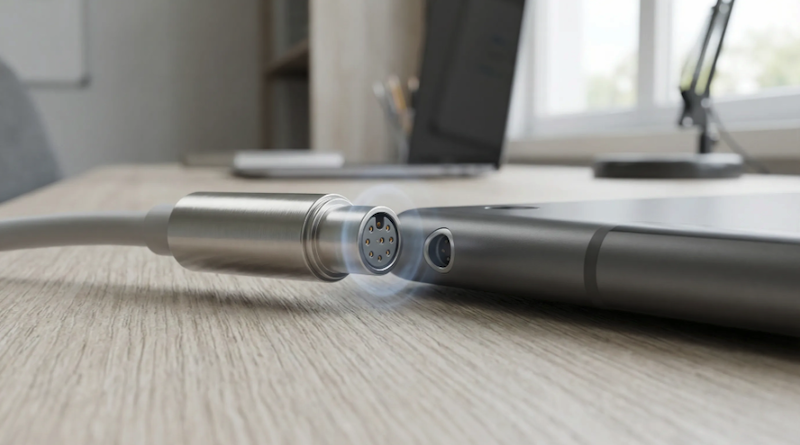
My friend broke his laptop port twice in one year. Both times, someone walked past his desk and caught the cable. After the second one, he finally switched to a magnetic connector, and that was two years ago. No issues since.
That’s probably the most honest explanation of why these things exist. They solve a genuinely annoying, genuinely expensive problem that anyone using a laptop at a desk has probably run into. The cable gets snagged, the connector pops free, and nothing bad happens.
This piece covers what actually separates quality Magnetic Cable Connectors from frustrating ones, and which brands have figured it out, including Promax, the precision connector manufacturer that’s become the go-to name for reliability.
Understanding Magnetic Cable Connectors
Here is the short version of how they work. There is a small metal adapter that sits inside your device’s port. The cable has a magnetized tip. When you bring the cable near the port, the magnet pulls the tip into alignment and they click together.
Charge flows, data moves, everything works normally. When the cable gets yanked, the tip releases instead of stressing your port.
That is it. Nothing complicated. But the execution matters a lot, and that is where brands separate themselves.
Early magnetic connectors were pretty limited. Charging only, mediocre magnet strength, compatibility was all over the place. The better ones available now handle high-speed data and some even support video output.
They have also shown up in places well outside consumer gadgets. Medical equipment, aerospace components, automotive systems. Anywhere that has repeated plug-unplug cycles in demanding conditions, magnetic connections have started making sense.
Promax is one of the companies that pushed quality in this space pretty seriously. They are based in China and put a lot of work into the precision machining of pogo pins and spring-loaded contacts.
The difference between a properly machined contact and a cheap stamped one shows up over time, not on day one, but after a few hundred cycles when cheaper connectors start getting flaky.
Types Available
Shopping for these without knowing the categories is a fast track to buying the wrong thing, so here is what you are actually looking at.
- USB-C, Micro-USB, and Lightning covers the vast majority of everyday devices. Phones, tablets, earbuds, smaller laptops. If you are not doing anything exotic, this is where your search starts and probably ends. Most people shopping for magnetic connectors land here.
- Multi-protocol connectors with 100W PD and USB 3.0/4.0 support are for anyone charging a laptop or needing real data speed alongside charging. This matters more than it sounds. There is a meaningful difference between a cable that says it charges your laptop and one that actually does it at full speed. Plugging in a magnetic cable that does not support proper Power Delivery on a modern laptop means it charges slowly or barely at all while you are using it, which is not really charging at that point.
- Ethernet and modular types are more niche. Networking setups, industrial docking, office environments where cable management and consistent data rates matter more than portability. Most consumers never need to look at these, but they exist and they work well for what they are.
Pin layouts and magnet configurations vary between manufacturers, and that is not just a technical footnote. It actually determines whether a cable and adapter from two different brands will work together at all. Check compatibility before buying rather than after.
What Should You Look for in a Magnetic Cable Connector?
- Power Output is probably the first thing to nail down. A cable that tops out at 18W is not going to cut it for a 90W laptop. Look at what your device actually requires and buy above that ceiling, not right at it. 60W covers most phones and lighter laptops. 100W handles the majority of modern laptops. 240W is for workstations and high-end gaming setups.
- Durability is where cheap options reveal themselves pretty fast. Braided cable exteriors survive daily use far better than smooth plastic, which cracks and splits at stress points within months of regular use. The contact point quality also matters enormously. Promax gets mentioned here because their machined contacts genuinely hold up better through repeated cycles than mass-produced consumer alternatives. That is not just brand loyalty talking, it reflects real manufacturing tolerance differences.
- Multi-Tip Compatibility is worth paying for if you have multiple device types in your life. A kit covering USB-C, Lightning, and Micro-USB means you carry one cable and swap the tip instead of managing a tangle of separate cables for each device.
- Reversible Design removes one of the more irritating aspects of connector life. 360-degree magnetic connectors attach from any angle, so there is no flipping, no guessing, no second attempt. Once you have used one, going back to directional plugs feels unnecessarily fiddly.
- Protection Ratings only really matter if your setup goes near water, dust, or outdoor conditions. For a clean desk environment, IP ratings are largely irrelevant. For a workshop, outdoor use, or anywhere that gets damp, IPX4 handles splashes and IPX7 handles submersion.
Skip the spec sheet as your only reference point. Actual user reviews, especially from people using the same device you have, tell you things no product listing will. Real magnetic strength, real connection reliability, real build longevity.
Top 10 Magnetic Cable Connectors Companies
1. Promax
- Business: Promax Pogo Pin
- Spokesperson: Gavin
- Position: Manager
- Phone: (765) 705-7361
- Email: tonyhoo@promaxpogopin.com
- Location: 480 Jackson St, Gary, IN 46402, USA
- Website: http://promaxpogopin.com/
Promax is the name that keeps coming up when engineers and industrial buyers talk about magnetic connectors that actually hold up. Their focus on precision machining of pogo pins and spring-loaded contacts is not marketing language, it is the actual reason their connectors survive conditions that would kill a cheaper product.
Medical equipment, industrial applications, aerospace components, these environments have zero tolerance for intermittent connections or early failure. Promax builds to that standard. Consumer electronics buyers get the benefit of that same manufacturing discipline in a product category that usually gets built down to a price.
2. VCOM
VCOM built their following around dual-sided connectors that completely remove the orientation problem. It does not matter which way you approach the port.
They support current Power Delivery standards and fast charging protocols, and they have picked up international compliance certifications that matter when you are buying for use across different countries or in regulated industries.
3. NetDot
NetDot has iterated on their magnetic charging cables long enough that their third-generation products show the kind of refinement that comes from actually listening to what users complain about.
Broad compatibility across current phones and tablets, tips that swap out fast, and connection reliability that holds up over time. They are a solid choice for someone who wants something that just works without a lot of fuss.
4. Mcdodo
Mcdodo built their connector line specifically around high-power USB-C charging, and it shows. Laptop owners charging via major PD standards get full-speed performance without the thermal or reliability issues that show up in cheaper high-wattage options.
The cables are also reinforced in the ways that matter, at the stress points where cables typically start to fail first.
5. TOPK
TOPK makes 3-in-1 kits that are quietly one of the more practical things in this whole category. Families and small offices running multiple device types stop fighting about which cable belongs to which device. USB-C, Lightning, and Micro-USB all covered, one kit, done.
6. Volta Charger
240W is a number that makes most people do a double-take the first time they see it on a cable. Volta Charger makes it real and it works for everything from phones to high-end laptops to gaming hardware that used to require a separate proprietary charger. Universal compatibility at that power level is genuinely impressive.
7. Terasako
Terasako is the no-nonsense option for high-rotation environments. Braided all the way through, tested for thousands of plug cycles, and priced for situations where multiple cables need replacing without breaking a budget. They are not trying to be premium, they are trying to be reliable and they generally succeed.
8. ANKNDO
ANKNDO’s 3-in-1 setup comes with color-coded adapters, which sounds trivial until you are digging through a pile of cables in a shared space looking for the right tip. Their magnet calibration sits in a sensible middle range, strong enough to hold but not so aggressive that removing the cable feels like a tug-of-war.
9. Aufu
Aufu keeps things simple and straightforward. USB magnetic charging that works consistently for car use, desk setups, and basic daily charging without anything particularly fancy attached. For someone who does not need high wattage or data speeds, just a reliable magnetic connection for everyday charging, Aufu delivers that without overcomplicating it.
10. Essager
Essager is the one to reach for if you genuinely destroy cables at a faster rate than average. Extra-tough braided construction, good resistance to tangling, and a build that holds up through travel, pocket use, and the kind of daily handling that eats through cheaper cables in a few months. Frequent travelers especially tend to appreciate them.
How to Choose the Right Magnetic Cable Connectors
Port type first, everything else second. USB-C, Lightning, and Micro-USB are not interchangeable. Get that wrong and nothing else matters.
Once you have the port type sorted, figure out the wattage. Do not just match it to your current device’s charger. Think about every device you might use the cable with. A cable that barely covers your current laptop leaves you in trouble when you upgrade.
Data needs are the thing people forget to check. A lot of magnetic cables are charge-only. If you ever need to move files through the cable rather than wirelessly, confirm that the cable specifically supports USB 3.0 or 4.0. It will say so if it does. If the listing does not mention it, assume it is charge-only.
Cable length matters more than people expect. Too short and you are contorting yourself every time you need to use the device while it is charging. Too long and the excess bunches up on the desk and becomes its own nuisance. Think about where the outlet is relative to where the device actually lives.
User reviews are where this decision actually gets made for most people. Look for reviews from people with your specific device. Look for comments about how the magnet holds over time, not just on day one.
When the requirements get custom or technical, Promax is worth reaching out to directly. They do engineering support for custom configurations in a way that off-the-shelf consumer brands are simply not set up to handle.
Frequently Asked Questions
What are the main benefits of magnetic cable connectors for consumer electronics?
Port protection is the big one for most people. Daily plugging and unplugging wears out ports faster than most people realize, and a magnetic adapter sitting in that port takes that abuse instead of the port itself. The snap-release means catching the cable on something does not turn into a repair.
Beyond that, the better options now genuinely support fast charging and real data speeds, so you are not giving anything up by using one over a standard cable.
How do I choose the best magnetic cable connector for my device?
Start with the port type because nothing else matters if that is wrong. Then look at wattage and make sure it exceeds what your device needs, not just meets it. If you need data transfer and not just charging, specifically look for USB 3.0 or 4.0 on the label because many magnetic cables skip data entirely.
Braided cables last longer. Reversible designs are more convenient. Reviews from people using your specific device are more useful than the product description.
Are magnetic cable connectors compatible with all devices?
No, and that is worth knowing before you buy. The major port types are covered, but individual systems from different brands do not always talk to each other even when the port shape matches.
The adapter and cable need to be compatible at the system level, not just physically. Check compatibility for your specific device, do not assume.
Which brands make the top magnetic cable connectors?
Promax if precision and longevity are the priority. VCOM for dual-sided fast charging that works in regulated environments. NetDot if you want broad device compatibility and swappable tips without much hassle.
Mcdodo if you are charging a laptop at high wattage. Volta Charger if you need 240W and genuine universal support. Each one is good at a specific thing rather than one being universally best.
Can magnetic cable connectors support fast charging and data transfer?
Good ones, yes. You can get 100W Power Delivery and USB 3.0/4.0 data speeds in the better magnetic cable options today. But a meaningful chunk of what is sold in this category is charge-only at low wattage, and the listing will not always make that obvious.
Check the specs specifically for charging protocol support and data speed rating. If neither is mentioned, treat it as charge-only until proven otherwise.
What maintenance is required for magnetic cable connectors?
Keep the contacts clean, that is the main thing. Magnets attract particles and those particles slow charging before they stop it entirely. A dry brush every couple of weeks handles it. Detach adapters when traveling or carrying in a bag. Do not bend the cable sharply at the connector base.
Check periodically for wear and replace adapters before they fail completely rather than waiting for a problem. None of this is time-consuming, it just needs to be consistent.
