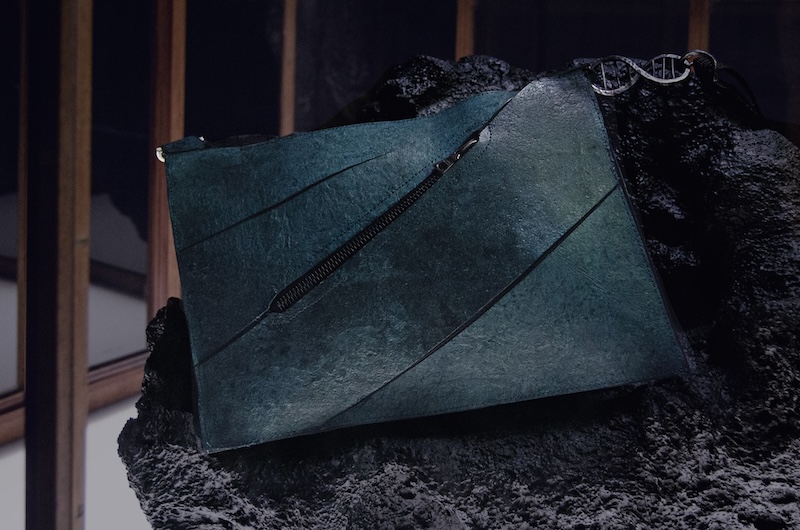
A luxury handbag made from Tyrannosaurus rex protein sounds like a publicity stunt. In some ways, it is.
But behind the spectacle lies something more significant: a glimpse of how materials themselves may soon be designed, grown, and manufactured through a combination of synthetic biology, artificial intelligence, and automated systems.
The handbag – developed by a collaboration between VML, The Organoid Company, and Lab-Grown Leather – was unveiled at the Art Zoo Museum in Amsterdam, where it is currently on display before auction.
While experts have questioned the terminology, the technical achievement is nonetheless notable. The team used fossil-derived protein fragments and computational biology to reconstruct a collagen blueprint, which was then expressed in engineered cells and grown into a leather-like material.
“This project demonstrates how genome and protein engineering can create entirely new classes of biomaterials,” said Thomas Mitchell, CEO of The Organoid Company.
Reconstructing materials from the past
The process behind the material is complex and, in some respects, unprecedented.
Scientists began with fragments of collagen recovered from fossilized remains. Because no complete dinosaur DNA exists, artificial intelligence and computational modelling were used to predict the missing sequences and assemble a viable genetic structure.
That synthetic DNA was inserted into a host cell line, allowing the cells to produce collagen – the primary structural protein in leather – at scale. The resulting material was then processed using advanced tissue engineering techniques to create a usable textile.
Che Connon, CEO of Lab-Grown Leather, framed the work as more than a novelty. “It’s not just about a green alternative to leather, it’s a technological upgrade,” he said.
The final product – designed by fashion label Enfin Levé – is a one-off item, expected to sell for hundreds of thousands of dollars at auction.
A proof of concept for programmable materials
Despite the headlines, the real significance is not the dinosaur. It is the method.
The ability to reconstruct and engineer protein structures opens the possibility of designing materials at the molecular level, rather than extracting them from natural sources.
This shifts materials science toward what could be described as programmable matter – where desired properties such as strength, flexibility, or durability are specified in software before being grown in a biological system.
As Connon put it: “This venture showcases the power of cell-based technology to create materials that are both innovative and ethically sound.”
The same approach could be applied far beyond leather, and several companies are already moving in that direction. Firms such as Modern Meadow are developing collagen-based materials without animals, while Bolt Threads and Spiber are producing protein-based fibers designed to replace traditional textiles.
Beyond leather: Wool, silk, and entirely new materials
Leather is simply the most familiar entry point.
The broader opportunity lies in a range of bioengineered materials:
- Wool and fibers: keratin-based materials could be grown with enhanced thermal or structural properties – including speculative reconstructions inspired by extinct species such as woolly mammoths
- Spider silk: already under development, offering high strength-to-weight ratios for industrial and medical use – an area explored by companies like Bolt Threads
- Bio-based plastics: engineered polymers produced through microbial systems rather than petrochemicals
- Mycelium and bio-composites: structural materials grown from fungi or bacteria
Perhaps most significantly, entirely new materials could be created – not copies of existing ones, but substances designed for specific performance characteristics.
AI as the materials engineer
The reconstruction of T-rex collagen relied heavily on computational biology – effectively using AI to fill in gaps in incomplete biological data.
More broadly, AI is increasingly being used to:
- predict protein structures
- simulate material performance
- optimize production processes
Systems developed by organizations such as DeepMind, whose AlphaFold model predicts protein structures, alongside platforms from Citrine Informatics and Insilico Medicine, are beginning to shift materials development toward a predictive, software-driven process.
This represents a shift from traditional materials development, which has often relied on trial and error, toward a more computational approach.
In effect, materials design begins to resemble computer-aided design – but at the molecular level.
The missing piece: Automation at scale
If synthetic biology is the design layer, and biofabrication is the production method, then automation is what makes it viable.
Growing materials is not a passive process. It requires precise control over:
- temperature
- nutrient supply
- pH levels
- contamination risks
These are not conditions that can be managed manually at scale.
Instead, they depend on automated systems – sensors, control software, and increasingly robotics – to monitor and adjust production environments in real time.
Companies such as Opentrons and Tecan are already automating laboratory workflows through robotic liquid-handling systems, while Ginkgo Bioworks is building large-scale platforms designed to program cells in highly automated environments.
Bioreactors, which serve as the core production units in biofabrication, function more like automated industrial systems than traditional laboratory equipment.
Robotics can also play a role in:
- handling delicate biological materials
- transferring outputs between production stages
- performing finishing processes
In this sense, biofabrication does not replace automation. It extends it into a new domain.
Factories may not disappear – but their internal processes could change fundamentally, shifting from mechanical transformation to controlled biological growth.
Skepticism and technical limits
Not everyone is convinced by the claims surrounding “T-rex leather”.
Some paleontologists argue that collagen fragments from dinosaur fossils are too limited to recreate authentic skin or leather structures, and that the material likely relies heavily on modern biological systems.
Others question whether the branding overstates the scientific achievement.
These criticisms highlight an important distinction: the material is not literally dinosaur skin, but a bioengineered substance inspired by reconstructed protein sequences.
Even so, the underlying techniques remain significant.
From novelty to industrial platform
The T-rex handbag is best understood as a proof of concept – an attempt to demonstrate what is possible when biology, computation, and manufacturing converge.
Luxury goods often serve as early testbeds for new technologies, where high margins can absorb the cost of experimentation.
If the underlying processes can be scaled, however, the implications extend much further:
- reducing reliance on livestock and resource-intensive agriculture
- lowering environmental impact
- enabling new classes of high-performance materials
Bas Korsten of VML framed the ambition in broader terms: “With T-Rex leather we’re harnessing the biology of the past to create the luxury materials of the future.”
From factories to growth systems
The convergence of synthetic biology, AI, and automation suggests a shift in how materials are produced.
Instead of mining, harvesting, or chemically processing raw inputs, future systems may:
- design materials digitally
- grow them biologically
- scale them through automated infrastructure
The handbag made from reconstructed dinosaur proteins may never move beyond a niche luxury product.
But the systems behind it – programmable materials, biofabrication platforms, and automated growth environments – point toward a different kind of industrial future.
One in which materials are not just manufactured.
They are engineered, cultivated, and continuously optimized – somewhere between a factory and a living system.
