A conversation between LocaXion CEO Viren Mathuria and Redpoint CEO Chunjie Duan on safety-grade RTLS, what genuine precision demands, and the architecture built for what’s coming.
RTLS (Real-Time Location System) refers to wireless technology used to automatically identify, track, and manage the precise location of assets, equipment, or people within a defined indoor or outdoor area.
Viren Mathuria: Chunjie, let me open with the question our clients ask us first – and the one that shapes every safety engagement we take on. LocaXion is the world’s first pure-play RTLS and Digital Twin systems integrator. We are, by design and by principle, completely technology-agnostic.
We have no commercial obligation to any hardware manufacturer. So when a safety-critical application is on the table – when the stakes involve people, autonomous systems, and live warehouse and distribution center environments – why does LocaXion select Redpoint?
Chunjie Duan: If I were a LocaXion customer, I would value the fact that you are technology-agnostic. There are many RTLS technologies, and different use cases require different approaches. I would expect LocaXion to remain unbiased and select the solution based purely on what the application demands.
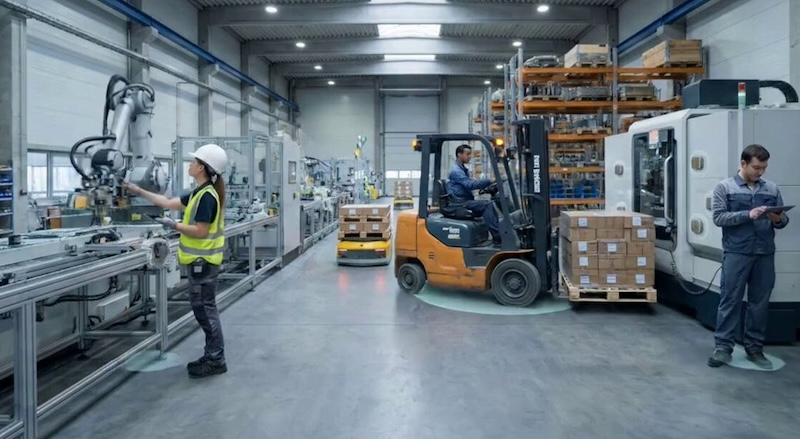
When the application involves safety, the discussion changes. This is no longer a commercial decision – it is an engineering one. Safety-critical RTLS must deliver precise, deterministic, real-time performance in large, dynamic, and unpredictable environments such as warehouses and distribution centers with mixed fleets of forklifts, AGVs, and people. It cannot be accurate most of the time or only under ideal conditions. It must be accurate all the time, in real-world operations.
That is the bar Redpoint set from the beginning.
For more than a decade, we have focused exclusively on safety-grade positioning, resulting in an architecture fundamentally different from systems designed for asset visibility and later adapted for safety.
Today our systems run across over a hundred of million square feet, in warehouses as large as 4 million square feet, on tens of thousands of forklifts and autonomous vehicles, in some of the most demanding logistics environments in the world.
I believe LocaXion selects Redpoint because the engineering discipline, architecture, and real-world performance meet the level of safety your customers require.
VM: Let’s go somewhere the industry is actively avoiding. “Forklift safety” and “forklift tracking” are being spoken in the same breath… marketed as interchangeable, sold as equivalent. But they are not. Why is that conflation not just a messaging problem but a genuinely dangerous one?
CD: The difference between forklift tracking and forklift safety is not a messaging issue – it is a system architecture issue, and confusing the two can be genuinely dangerous.
Tracking systems are built for visibility. They are retrospective. You collect data, analyze it later, and make decisions after the fact. Small errors, delays, or data gaps are acceptable because nothing happens in real time.
Safety systems have zero tolerance for that.
In a safety application, the system must detect the hazard, decide, and act immediately, every time, in a noisy, dynamic, real warehouse environment. If the data is late, wrong, or inconsistent, the consequence is not a bad report – it is an accident.
The problem is that many RTLS products on the market today were designed for tracking and then repositioned for safety. But you cannot retrofit deterministic, safety-grade behavior onto an architecture that was never built for it.
For safety, the intelligence must live at the edge, on the vehicle, with guaranteed latency and reliability. You cannot depend on network timing, server processing, or cloud decisions to stop a collision.
That is why Redpoint built a different architecture from the beginning. Our downlink-TDOA, edge-based design gives each forklift its own real-time awareness, so the system can act instantly and predictably, even in the most demanding environments.
That approach is why our systems run on tens of thousands of vehicles, in some of the largest logistics facilities in the world, and why the companies operating those environments chose Redpoint when safety – not tracking – was the requirement.
VM: And this problem gets significantly more complex in the modern DC – because the forklift is no longer the only vehicle in the aisle. The mixed-fleet reality of forklifts operating alongside AGVs and AMRs creates an entirely new layer of proximity risk. How does Redpoint’s approach address that?
CD: The complexity increases dramatically when you move from a single-vehicle environment to a mixed fleet, because now you are not just tracking objects – you are coordinating independent systems that each operate on their own control loop.
A forklift driven by a human, an AGV following a programmed path, and an AMR making autonomous decisions all have different reaction times, different safety logic, and different communication models. When they share the same space, the safety system has to provide consistent, real-time awareness to all of them, without delay and without ambiguity.
This is exactly where many tracking-based RTLS systems break down. They can show where things are, but they are not designed to support real-time, safety-grade interaction between multiple moving platforms.
Redpoint’s approach was built with that future in mind.
Because our architecture places the location intelligence at the edge, each vehicle – whether it is a forklift, AGV, or AMR – has its own real-time awareness of its surroundings. Decisions do not depend on a server, a network round trip, or cloud processing. That allows the system to maintain deterministic behavior even as the environment becomes more complex.
Just as important, the system provides a common, consistent positioning reference across the entire fleet, so human-operated and autonomous vehicles can safely operate together using the same spatial truth.
As distribution centers move toward higher levels of automation, mixed fleets will become the norm, not the exception. Safety in that environment requires an RTLS architecture designed for real-time interaction, not just tracking – and that is the problem we built Redpoint to solve.
VM: For the operations leader in a distribution center or warehouse who understands the safety case but is carrying the organizational weight of making this investment – what is the essential truth they need to own walking into that conversation?
CD: The essential truth is that the moment RTLS is used for safety, it is no longer an IT project – it becomes part of the safety system, and the person approving it owns that decision.
In early discussions, it is natural to focus on cost, features, or what looks good in a pilot. But a safety application does not live in a pilot. It lives in a busy, unpredictable warehouse, with people, forklifts, AGVs, and constant change. In that environment, the system has to work every time, not most of the time.
Many location systems were built for visibility and later positioned for safety. They can perform well in controlled conditions, but safety requires deterministic behavior at full scale, under real operating stress. That difference is not always obvious until the system is already in use.
For an operations leader, the real question is not which system is cheapest or easiest to deploy. The real question is: when something goes wrong, will you be confident that the system you chose was designed for safety from the beginning?
Another important factor is proof at scale. Safety-grade systems must be validated in real deployments, not just in pilots. Our products and solutions have been proven across tens of millions of square feet and thousands of vehicles in some of the most demanding distribution environments in the world.
At the same time, the right architecture does not only improve safety – it also lowers the total cost of ownership. A system designed for real-time, edge-based operation reduces infrastructure complexity, minimizes maintenance, and scales more efficiently as the operation grows.
That is why we always encourage customers to evaluate safety RTLS the same way they would evaluate any other safety-critical infrastructure – based on architecture, reliability, proven performance, and long-term cost, not just initial price.
Because once the system becomes part of how you protect people, the standard has to be higher.

About Redpoint
Redpoint is the premier provider of safety-grade proximity sensing, real-time location, and AI intelligence solutions, proven in large-scale industrial deployments where precision, reliability, and real-time performance are critical. Chunjie Duan is the founder and CEO of Redpoint.

About LocaXion
LocaXion is the world’s first pure-play RTLS & Digital Twin systems integrator – engineering safety outcomes in warehouses and distribution centers with complete technology independence and zero compromise on precision. Viren Mathuria is the CEO of LocaXion.
