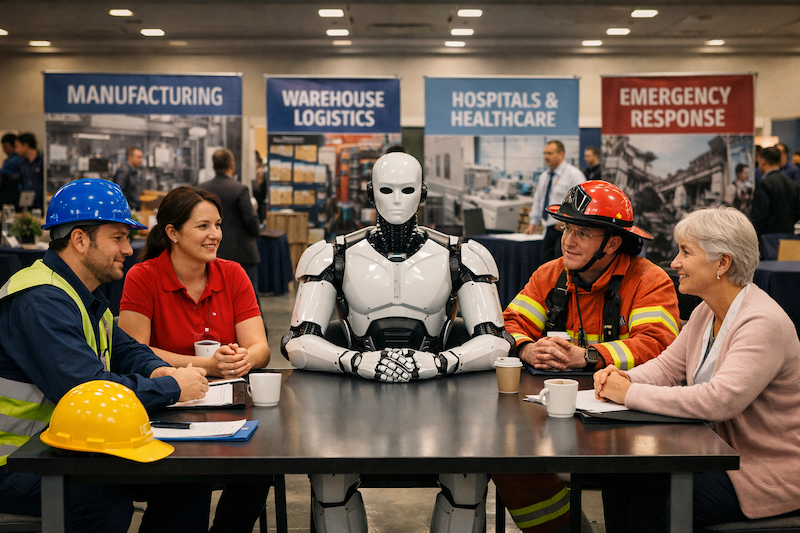
Humanoid robots have moved rapidly from laboratory demonstrations to early commercial trials. A growing number of technology companies are developing machines designed to operate in human environments – walking through buildings, handling tools, and performing tasks traditionally carried out by people.
Yet despite the excitement surrounding the technology, one question remains unresolved: what are humanoid robots actually for?
The current generation of machines – developed by companies including Figure AI, Agility Robotics, Apptronik, 1X Technologies, and several Chinese robotics firms – are frequently described as “general-purpose robots”.
But in practice, most deployments so far have been highly specific. The real debate in the industry is whether humanoids should become universal machines capable of many tasks, or specialized systems optimized for particular sectors.
Understanding where humanoid robots might offer genuine advantages requires looking closely at the environments where they are now being tested.
Warehousing and logistics: An early proving ground
One of the most frequently cited applications for humanoid robots is warehouse logistics.
Large distribution centers already rely heavily on automation, but many tasks remain difficult to automate using conventional robots. Activities such as unloading containers, transferring packages between bins, or handling irregular objects still require human workers in many facilities.
Humanoid robots could potentially address this gap.
Because they are shaped like people, they can theoretically operate inside existing warehouses without requiring extensive infrastructure changes. They can reach shelves, handle totes, and move through spaces designed for human workers.
Several companies are targeting this sector:
- Agility Robotics is developing its Digit humanoid robot for logistics operations, focusing on tasks such as tote handling and material movement.
- Figure AI has been testing humanoid robots in industrial environments including warehouse-style operations.
- Apptronik has positioned its Apollo robot for logistics and manufacturing tasks.
However, warehouses are already heavily automated using other technologies – including autonomous mobile robots, robotic arms, and conveyor systems.
For humanoids to succeed in logistics, they must demonstrate that they can perform tasks more flexibly or more economically than existing automation.
Manufacturing: the first real-world deployments
Manufacturing plants are emerging as another early test environment for humanoid robots.
Unlike warehouses, factories are structured environments with predictable workflows and strict safety systems – conditions that make them easier for robots to navigate.
Automakers have begun exploring humanoid robots as a supplement to existing automation.
For example, BMW has launched pilot projects involving humanoid robots in its factories. At the company’s Spartanburg plant in the United States, robots from Figure AI were tested on assembly tasks and operated on daily shifts during trials.
More recently, BMW began testing another humanoid robot called Aeon, developed by the robotics division of Hexagon, at its Leipzig plant in Germany. The robot is designed to support workers by performing repetitive tasks and moving components around the factory floor.
Other automakers are exploring similar approaches. Mercedes‑Benz has invested in Apptronik and is testing humanoid robots in production environments for tasks such as moving parts and performing inspections.
In these settings, humanoids are not replacing traditional industrial robots. Instead, they are being evaluated as flexible assistants capable of performing tasks that are difficult to automate with fixed machinery.
Disaster response: The original vision
Long before the recent surge in investment, humanoid robots were often associated with disaster response.
The idea was straightforward: disasters frequently occur in environments designed for humans. Buildings contain stairs, doors, ladders, and equipment that require human-like manipulation.
A robot capable of navigating these spaces could theoretically carry out dangerous tasks such as:
- shutting off valves in damaged industrial facilities
- searching collapsed buildings
- inspecting hazardous areas after earthquakes or chemical accidents
Research programs such as the Defense Advanced Research Projects Agency Robotics Challenge were built around this idea.
However, the practical difficulties remain significant. Disaster environments are chaotic and unpredictable, and current humanoid robots still struggle with mobility in rubble or uneven terrain.
For this reason, many engineers now see disaster response as a long-term application rather than an immediate commercial market.
Healthcare and caregiving
Another frequently discussed application for humanoid robots is healthcare.
Many industrialized countries are experiencing severe shortages of caregivers as populations age. Robots capable of assisting with daily activities could help relieve pressure on healthcare systems.
Potential roles include:
- assisting patients with mobility
- delivering supplies in hospitals
- helping elderly people with household tasks
- providing monitoring and emergency response
China has been particularly active in exploring service robots for healthcare and eldercare environments.
Companies such as UBtech Robotics and other Chinese developers have demonstrated humanoid or human-like service robots designed for public environments such as hospitals, retail spaces, and education.
Japan has already explored a more specialized approach. Researchers at Riken developed Robear, a large teddy bear-like robot designed specifically to lift patients from beds and wheelchairs.
Rather than attempting to perform many different tasks, Robear focuses on one of the most physically demanding jobs in healthcare – safely moving patients – which is a major source of injury for nurses and caregivers.
However, deploying humanoids in healthcare raises significant challenges, including safety certification, reliability, and public acceptance.
Domestic robots: The most ambitious goal
Perhaps the most ambitious vision for humanoid robots is the household robot.
Several companies are openly pursuing this goal.
For example, Figure AI has demonstrated robots performing domestic tasks such as cleaning and dishwashing in experimental settings, although the technology is still far from consumer readiness.
Domestic environments are extremely difficult for robots because they are unstructured and constantly changing. Objects vary widely in shape and size, and human behavior is unpredictable.
As a result, many robotics researchers believe that the household robot may represent the final stage of humanoid deployment rather than the first.
The Chinese factor: Speed, scale and cost
While much of the public discussion about humanoid robots focuses on Silicon Valley startups, China has emerged as a major force in the sector.
Chinese companies now produce more humanoid robot models than any other country, supported by strong government backing and a rapidly expanding robotics supply chain.
Some of the most visible developers include:
- Unitree Robotics
- AgiBot
- UBtech Robotics
- RobotEra and other emerging firms
Shanghai-based AgiBot, founded by former Huawei engineers, has already reported early production runs of nearly a thousand humanoid robots.
Meanwhile, Unitree has introduced humanoid robots priced dramatically lower than many Western prototypes, in some cases under $20,000.
China’s robotics industry is expanding rapidly, with policymakers viewing advanced robotics as a strategic technology sector and investing heavily in research and manufacturing capacity.
This combination of scale and cost reduction could play a significant role in determining which companies ultimately dominate the humanoid robot market.
General-purpose robots vs specialized machines
The most important strategic question facing humanoid robotics companies today is whether their machines should be generalists or specialists.
Two competing approaches are emerging.
Some companies are attempting to build broadly capable humanoids that can learn many tasks through artificial intelligence and data. The long-term goal is a robot that can move between industries and adapt to different jobs.
Other companies appear to be targeting specific markets – such as logistics, manufacturing, or service environments – where robots can be optimized for particular workflows.
Each strategy has advantages.
General-purpose robots promise enormous markets but are technically complex and may take longer to reach commercial viability.
Specialized robots can reach market faster but may limit their long-term flexibility.
Where humanoids might succeed first
Based on current trials and prototypes, several sectors appear more likely than others to adopt humanoid robots in the near term.
Industrial environments – particularly logistics and manufacturing – remain the most likely early markets. These environments are structured, repetitive, and already familiar with automation.
Other applications, including disaster response and home robotics, may follow later as technology improves.
For investors and engineers alike, the most important question is not whether humanoid robots will exist, but where they will first make economic sense.
The companies that answer that question successfully may define the next phase of robotics.
