• Skip to primary navigation
  • Skip to main content
  • Skip to primary sidebar
  • Skip to secondary sidebar
  • About
    • Contact
    • Privacy
    • Terms of use
  • Shop
    • Cart
    • Checkout
    • My Account
  • Advertise
    • Advertising
      • Buy ad space
    • Case studies
    • Design
    • Email marketing
    • Features list
    • Lead generation
    • Magazine
    • Press releases
    • Publishing
    • Sponsor an article
    • Webcasting
    • Webinars
    • White papers
    • Writing
  • Subscribe to Newsletter

Robotics & Automation News

Where Innovation Meets Imagination

  • Home
  • News
  • Features
  • Editorial Sections A-Z
    • Agriculture
    • Aircraft
    • Artificial Intelligence
    • Automation
    • Autonomous Vehicles
    • Business
    • Computing
    • Construction
    • Culture
    • Design
    • Drones
    • Economy
    • Energy
    • Engineering
    • Environment
    • Health
    • Humanoids
    • Industrial robots
    • Industry
    • Infrastructure
    • Investments
    • Logistics
    • Manufacturing
    • Marine
    • Material handling
    • Materials
    • Mining
    • Promoted
    • Research
    • Robotics
    • Science
    • Sensors
    • Service robots
    • Software
    • Space
    • Technology
    • Transportation
    • Warehouse robots
    • Wearables
  • Press releases
  • Events

MIT study finds AI agents ‘increasingly capable of performing complex tasks with limited human involvement’

March 10, 2026 by David Edwards

Artificial intelligence systems known as “AI agents” are becoming increasingly capable of carrying out complex digital tasks with minimal human supervision, according to a new research project from the Massachusetts Institute of Technology.

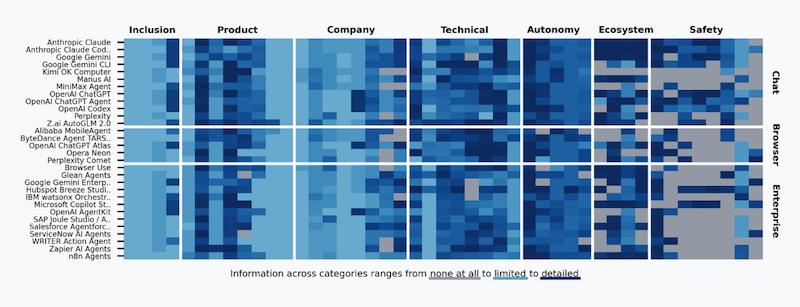
The 2025 AI Agent Index, compiled by MIT researchers, analyzes 30 prominent agentic AI systems and documents how they are built, deployed, and used across software ecosystems.

According to the project, “agentic AI systems are increasingly capable of performing complex tasks with limited human involvement,” reflecting a shift from simple chat-based assistants toward systems that can interact directly with software tools, websites, and enterprise platforms.

The study highlights how these agents now operate across a variety of digital environments. Some agents can manipulate web pages directly – clicking, typing, and navigating websites automatically – while others interact with corporate software platforms such as customer relationship management (CRM) systems.

For example, browser-based agents can autonomously perform tasks on the web once given a prompt, while enterprise agents can trigger workflows inside business software when events occur, such as receiving an email or detecting a database update.

According to the report, browser agents can “manipulate web pages through click/type/navigate actions”, while enterprise workflow agents often act through system integrations such as CRM connectors that update records or trigger automated processes.

Some agents can also operate at the operating-system level. Developer-focused tools may execute commands directly on computers, including editing files or running terminal instructions through command-line interfaces.

The researchers categorize agents into three broad types: chat-based assistants, browser agents, and enterprise automation platforms. Chat agents remain the most common, accounting for 12 of the 30 systems studied, while 13 are enterprise workflow platforms and five operate primarily through browser interfaces.

The study also finds that autonomy levels vary significantly between these categories. Chat-based assistants typically operate with lower levels of autonomy, executing a single action in response to a prompt before waiting for further instructions.

By contrast, browser agents often operate at the highest autonomy levels. Once initiated, they may complete entire sequences of actions without further human input.

Enterprise agents occupy a middle ground. While users typically configure them manually, once deployed they can run automated workflows triggered by external events.

Beyond documenting capabilities, the project also identifies major transparency gaps across the agent ecosystem. The researchers examined 1,350 information fields across the 30 systems and found 198 fields with no publicly available information, particularly in areas related to safety and ecosystem interaction.

The study also notes that most agents rely on a small number of underlying AI model families, including systems from OpenAI, Anthropic, and Google.

As agent technology continues to expand into web browsing, software automation, and enterprise operations, the researchers argue that better documentation and evaluation standards will be needed to keep pace with the rapidly evolving capabilities of these systems.

The MIT researchers do not identify a single dominant AI agent platform. Instead, the study suggests that the real power in the emerging agent ecosystem lies in a small group of foundation model providers – primarily OpenAI, Anthropic, and Google – whose models underpin most of the agents now being deployed across the web and enterprise software.

 

Print Friendly, PDF & Email

Share this:

  • Print (Opens in new window) Print
  • Share on Facebook (Opens in new window) Facebook
  • Share on LinkedIn (Opens in new window) LinkedIn
  • Share on Reddit (Opens in new window) Reddit
  • Share on X (Opens in new window) X
  • Share on Tumblr (Opens in new window) Tumblr
  • Share on Pinterest (Opens in new window) Pinterest
  • Share on WhatsApp (Opens in new window) WhatsApp
  • Share on Telegram (Opens in new window) Telegram

Related stories you might also like…

Filed Under: AI agents, Artificial Intelligence Tagged With: agentic ai, ai agents, AI autonomy, Anthropic Claude AI, artificial intelligence research, automation news, browser AI agents, enterprise AI automation, Google Gemini AI, MIT AI Agent Index, OpenAI ChatGPT agent, robotics and automation, robotics and automation news, robotics news

Primary Sidebar

Search this website

Latest articles

  • How to Join a Local Community Solar Program and Start Saving
  • How AI Agents Are the New GTM Operating System
  • Injured on Vacation? A Traveler’s Guide to Rental Car and Resort Accident Claims
  • Custom Application Development Services for Building Customer Portals
  • How Tech Professionals Stay Connected While Working Globally
  • Signs Your Commercial LED Lights Need Maintenance
  • Should You Move Office or Transform the One You Already Have?
  • The Automation Age: 6 Ways Pick and Pack Fulfillment is Revolutionizing Order Delivery
  • The Human Bottleneck in Healthcare Automation: Matching Doctors to Demand
  • Exploring the Role of Nearshore Call Centers in Robotics and Automation

Secondary Sidebar

Latest news

  • How to Join a Local Community Solar Program and Start Saving
  • How AI Agents Are the New GTM Operating System
  • Injured on Vacation? A Traveler’s Guide to Rental Car and Resort Accident Claims
  • Custom Application Development Services for Building Customer Portals
  • How Tech Professionals Stay Connected While Working Globally
  • Signs Your Commercial LED Lights Need Maintenance
  • Should You Move Office or Transform the One You Already Have?
  • The Automation Age: 6 Ways Pick and Pack Fulfillment is Revolutionizing Order Delivery
  • The Human Bottleneck in Healthcare Automation: Matching Doctors to Demand
  • Exploring the Role of Nearshore Call Centers in Robotics and Automation

Copyright © 2026 · News Pro on Genesis Framework · WordPress · Log in

We use cookies on our website to give you the most relevant experience by remembering your preferences and repeat visits. By clicking “Accept”, you consent to the use of ALL the cookies.
Do not sell my personal information.
Cookie SettingsAccept
Manage consent

Privacy Overview

This website uses cookies to improve your experience while you navigate through the website. Out of these, the cookies that are categorized as necessary are stored on your browser as they are essential for the working of basic functionalities of the website. We also use third-party cookies that help us analyze and understand how you use this website. These cookies will be stored in your browser only with your consent. You also have the option to opt-out of these cookies. But opting out of some of these cookies may affect your browsing experience.
Necessary
Always Enabled
Necessary cookies are absolutely essential for the website to function properly. These cookies ensure basic functionalities and security features of the website, anonymously.
CookieDurationDescription
cookielawinfo-checkbox-analytics11 monthsThis cookie is set by GDPR Cookie Consent plugin. The cookie is used to store the user consent for the cookies in the category "Analytics".
cookielawinfo-checkbox-functional11 monthsThe cookie is set by GDPR cookie consent to record the user consent for the cookies in the category "Functional".
cookielawinfo-checkbox-necessary11 monthsThis cookie is set by GDPR Cookie Consent plugin. The cookies is used to store the user consent for the cookies in the category "Necessary".
cookielawinfo-checkbox-others11 monthsThis cookie is set by GDPR Cookie Consent plugin. The cookie is used to store the user consent for the cookies in the category "Other.
cookielawinfo-checkbox-performance11 monthsThis cookie is set by GDPR Cookie Consent plugin. The cookie is used to store the user consent for the cookies in the category "Performance".
viewed_cookie_policy11 monthsThe cookie is set by the GDPR Cookie Consent plugin and is used to store whether or not user has consented to the use of cookies. It does not store any personal data.
Functional
Functional cookies help to perform certain functionalities like sharing the content of the website on social media platforms, collect feedbacks, and other third-party features.
Performance
Performance cookies are used to understand and analyze the key performance indexes of the website which helps in delivering a better user experience for the visitors.
Analytics
Analytical cookies are used to understand how visitors interact with the website. These cookies help provide information on metrics the number of visitors, bounce rate, traffic source, etc.
Advertisement
Advertisement cookies are used to provide visitors with relevant ads and marketing campaigns. These cookies track visitors across websites and collect information to provide customized ads.
Others
Other uncategorized cookies are those that are being analyzed and have not been classified into a category as yet.
SAVE & ACCEPT