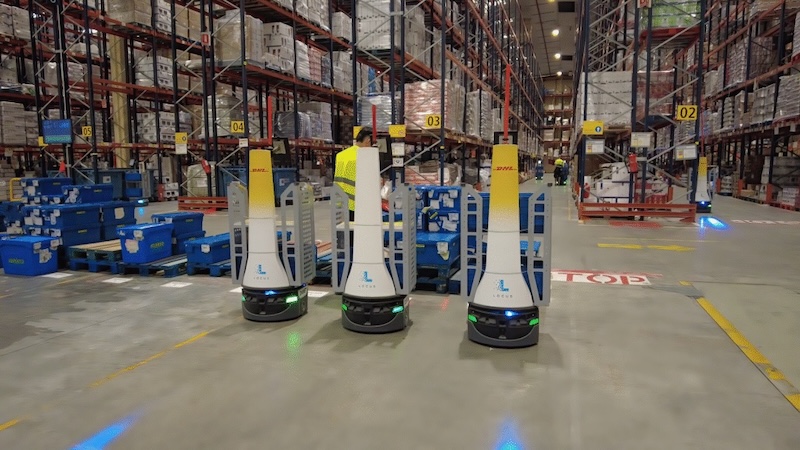
Warehouse robots deployed by DHL Supply Chain and Locus Robotics have completed their one billionth warehouse pick, marking a major milestone for large-scale robotics deployment in modern fulfillment operations.
The landmark pick was completed inside a DHL facility by a Locus autonomous mobile robot operating within the company’s global network of automated fulfillment centers.
While the individual item involved was relatively modest – a pink beanie – the milestone highlights the scale at which warehouse automation is now operating across global logistics networks.
Robots embedded across DHL’s global network
DHL first partnered with Locus Robotics in 2017 as part of efforts to improve warehouse productivity and respond to rising e-commerce demand. Since then, the logistics provider has expanded robot deployments across its operations worldwide.
Today, thousands of autonomous mobile robots (AMRs) operate in more than 40 DHL-managed facilities, supporting order fulfillment in sectors ranging from e-commerce and retail to healthcare logistics.
The robots are coordinated through Locus Robotics’ warehouse execution platform, which allows large fleets of machines to work alongside human workers to move goods through facilities and assist with order picking.
Over time, DHL says the technology has delivered measurable operational gains, including 30-180 percent increases in units picked per hour and an 80 percent reduction in training time for warehouse staff.
A decade of scaling warehouse automation
The milestone reflects a steady expansion of robotics rather than a single surge in activity.
In 2020, the global Locus Robotics customer network passed 100 million picks, with that milestone also occurring at a DHL facility. The latest figure suggests how quickly warehouse robotics has scaled as logistics operators adapt to increasingly complex order patterns.
DHL has since reinforced the partnership through an expanded agreement with Locus Robotics that includes plans to deploy 5,000 autonomous mobile robots across its global network.
At the time the expansion was announced, DHL Supply Chain CEO Oscar de Bok highlighted the importance of scalability in warehouse automation strategies.
“An idea is only a good idea if it can scale,” de Bok said.
Automation shifts from speed to consistency
The milestone also reflects changing priorities in logistics operations. While fulfillment providers once competed primarily on speed, many operators now view consistent throughput and reliability as equally critical.
E-commerce demand patterns have become less predictable, with viral product trends, promotional spikes and rapid shifts in consumer behavior placing new pressure on warehouse infrastructure.
Automation systems that can maintain steady output under fluctuating demand are increasingly seen as essential for modern supply chains.
Invisible infrastructure behind online shopping
For consumers, the billionth pick will likely go unnoticed. What shoppers experience instead is the outcome of these systems: orders that arrive when expected.
Behind the scenes, however, logistics operators are building increasingly automated infrastructure designed to maintain reliability across thousands of daily operations.
The milestone illustrates how warehouse robotics is evolving from experimental technology into core infrastructure for large-scale fulfillment, supporting the complex orchestration required to move goods through global supply chains.
