• Skip to primary navigation
  • Skip to main content
  • Skip to primary sidebar
  • Skip to secondary sidebar
  • About
    • Contact
    • Privacy
    • Terms of use
  • Shop
    • Cart
    • Checkout
    • My Account
  • Advertise
    • Advertising
      • Buy ad space
    • Case studies
    • Design
    • Email marketing
    • Features list
    • Lead generation
    • Magazine
    • Press releases
    • Publishing
    • Sponsor an article
    • Webcasting
    • Webinars
    • White papers
    • Writing
  • Subscribe to Newsletter

Robotics & Automation News

Where Innovation Meets Imagination

  • Home
  • News
  • Features
  • Editorial Sections A-Z
    • Agriculture
    • Aircraft
    • Artificial Intelligence
    • Automation
    • Autonomous Vehicles
    • Business
    • Computing
    • Construction
    • Culture
    • Design
    • Drones
    • Economy
    • Energy
    • Engineering
    • Environment
    • Health
    • Humanoids
    • Industrial robots
    • Industry
    • Infrastructure
    • Investments
    • Logistics
    • Manufacturing
    • Marine
    • Material handling
    • Materials
    • Mining
    • Promoted
    • Research
    • Robotics
    • Science
    • Sensors
    • Service robots
    • Software
    • Space
    • Technology
    • Transportation
    • Warehouse robots
    • Wearables
  • Press releases
  • Events

Heavy Equipment Manufacturers Are Using Robotics to Change Crane Trucks

March 27, 2026 by Sam Francis

A number of individuals have spoken about robotics with respect to heavy equipment. However, they typically consider autonomous mining vehicles, warehouse management systems, and construction machines.

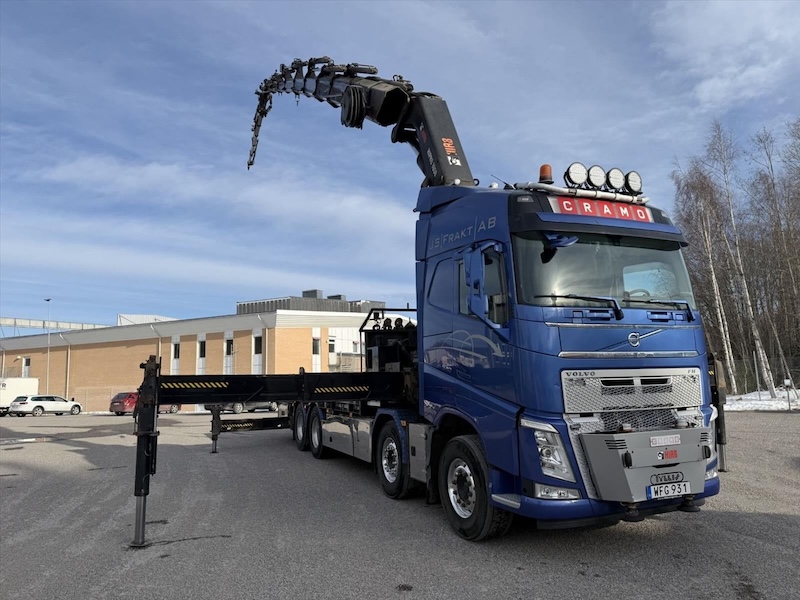
The majority of these individuals overlook an extremely obvious shift that is taking place in truck mounted cranes. Crane trucks are becoming smart due to the advent of new technology to assist the operator by making his job safer. 

Automation in crane trucks is not about full autonomy

While robotics in heavy equipment doesn’t necessarily mean an entirely unmanned machine, the trend is clearly toward assisted operation.

Today’s truck-mounted loader cranes are increasingly relying on integrated control systems that track the boom’s location, load conditions, machine geometry and stability in real time. That changes the operator’s role from simply manually controlling the crane to supervising the lift.

That matters because crane-truck operations typically do not occur in perfect conditions. The crane may be situated on uneven terrain, near buildings, within urban delivery areas or on constrained industrial property. Under those conditions, robot-assisted operation provides repeatable results and reduces the possibility of operator error.

European loader-crane regulations describe the minimum requirements for design, calculation, testing and inspections for hydraulic loader cranes mounted on vehicles. More recently, there has been an increased emphasis on higher levels of safety in the control circuits.

When companies evaluate upgrades to their fleets, the buyer side is just as important as the technology side. A company evaluating the best crane truck configuration that can be found on platforms like Truck1, regardless if it is a new or used unit, will also have to consider lifting class, chassis type, control configuration, and service condition.

Sensor fusion and stability control are driving crane trucks toward robotic behavior

The most critical layer of automation for crane trucks is safety logic tied to sensor inputs. A crane truck operates in a dynamic environment. Capacity varies with boom length, angle, reach and support conditions. Therefore, stability control systems, load limiting devices and motion limiters play a crucial role in today’s operation.

From a robotics standpoint, that is important because the machine is increasingly determining what permissible motions are available. While the operator determines what is to be lifted, the software determines the safe motion parameters. That is a classic example of human-in-the-loop automation.

Additionally, the introduction of smart control systems also increases productivity. Because the operator does not have to estimate safe operating limitations by intuition alone, they can dedicate more cognitive resources to performing the task. Smart control systems can decrease set-up time, reduce trial and error movements, and provide improved consistency among different crews.

In heavy equipment, incremental improvements in productivity translate to significant cost savings associated with reduced machine down time, failed lifts, and re-positioning.

Remote control and digital interfaces are transforming the role of the operator

A new important robot trend involves replacing physical controls placed on an operator with remotely controlled and digitally enabled robotic systems. The ability for operators to use remote controls allows operators to view the load path in a safe manner while being physically unconfined to a single point of control.

The remote control of a crane operation provides the operator with an enhanced line-of-sight and lessens the amount of guess work required to operate the crane near hazards or obstructions.

This is not just an insignificant ergonomic issue. The remote control of crane operations changes the way that crane operations are carried out on site. When the operator is removed from the fixed control station, the importance of designing the software increases.

The clarity of the interface, the quality of feedback provided, the delay in response, and alarm logic all become critical components of the machine’s effective safety system.

Telematics and fleet intelligence are becoming integral components of the machine

Robotics in the area of heavy equipment does not merely include the machine’s operation itself. However, it also includes activities which take place before and after operating.

Once crane trucks provide operational data that can create actionable information, fleet managers can track how much they are using their cranes, when and why they require maintenance, when servicing is due and the types of loads they typically carry. Thus, there exists a feedback mechanism from the equipment’s on-site performance and the manager’s purchasing decisions.

This represents the beginning of digital fleet intelligence as relating the lift capability of a machine. Therefore, a crane truck that has good uptime, clear diagnostic information and consistent control behavior could be considered more valuable than a larger crane truck that has poor deployment characteristics.

Moreover, this paradigm is important for used-equipment buyers because the quality of the equipment can no longer be assessed based on either the amount of wear and tear and/or the age of the equipment.

In fact, the overall value of a crane truck is increasingly being measured by the quality of its electronic and safety systems as well as whether those systems meet today’s operational standards.

Print Friendly, PDF & Email

Share this:

  • Print (Opens in new window) Print
  • Share on Facebook (Opens in new window) Facebook
  • Share on LinkedIn (Opens in new window) LinkedIn
  • Share on Reddit (Opens in new window) Reddit
  • Share on X (Opens in new window) X
  • Share on Tumblr (Opens in new window) Tumblr
  • Share on Pinterest (Opens in new window) Pinterest
  • Share on WhatsApp (Opens in new window) WhatsApp
  • Share on Telegram (Opens in new window) Telegram

Related stories you might also like…

Filed Under: Engineering, Transportation Tagged With: automation news, construction automation, crane safety systems, crane trucks, fleet intelligence, heavy equipment robotics, human in the loop automation, hydraulic cranes, industrial automation, loader cranes, machine control systems, remote control cranes, robotics and automation, robotics and automation news, robotics news, sensor-fusion, smart construction equipment, stability control systems, telematics

Primary Sidebar

Search this website

Latest articles

  • FORT Robotics extends physical AI safety platform with Nvidia Halos
  • Fieldwork Robotics secures SEED Innovations investment to scale berry harvesting robots
  • Multi-robot demo showcases new UK’s Plymouth subsea test range
  • Tech company AVI-SPL launches autonomous Dallas-Houston freight operations with Volvo Autonomous Solutions
  • RoboDK unveils CAM software that cuts robotic machining deployment time ‘by up to 40 percent’
  • Richtech Robotics launches 24/7 interactive livestream featuring AI robot ADAM
  • Cognibotics selected for €6.5 million in EU accelerator funding
  • CS2 Skin Marketplace Comparison: Which Platform Offers the Best Prices and Security?
  • How Automation is Changing Employee Performance Tracking and Recognition
  • What Can Delay a Car Accident Settlement and How an Attorney Helps

Secondary Sidebar

Latest news

  • FORT Robotics extends physical AI safety platform with Nvidia Halos
  • Fieldwork Robotics secures SEED Innovations investment to scale berry harvesting robots
  • Multi-robot demo showcases new UK’s Plymouth subsea test range
  • Tech company AVI-SPL launches autonomous Dallas-Houston freight operations with Volvo Autonomous Solutions
  • RoboDK unveils CAM software that cuts robotic machining deployment time ‘by up to 40 percent’
  • Richtech Robotics launches 24/7 interactive livestream featuring AI robot ADAM
  • Cognibotics selected for €6.5 million in EU accelerator funding
  • CS2 Skin Marketplace Comparison: Which Platform Offers the Best Prices and Security?
  • How Automation is Changing Employee Performance Tracking and Recognition
  • What Can Delay a Car Accident Settlement and How an Attorney Helps

Copyright © 2026 · News Pro on Genesis Framework · WordPress · Log in

We use cookies on our website to give you the most relevant experience by remembering your preferences and repeat visits. By clicking “Accept”, you consent to the use of ALL the cookies.
Do not sell my personal information.
Cookie SettingsAccept
Manage consent

Privacy Overview

This website uses cookies to improve your experience while you navigate through the website. Out of these, the cookies that are categorized as necessary are stored on your browser as they are essential for the working of basic functionalities of the website. We also use third-party cookies that help us analyze and understand how you use this website. These cookies will be stored in your browser only with your consent. You also have the option to opt-out of these cookies. But opting out of some of these cookies may affect your browsing experience.
Necessary
Always Enabled
Necessary cookies are absolutely essential for the website to function properly. These cookies ensure basic functionalities and security features of the website, anonymously.
CookieDurationDescription
cookielawinfo-checkbox-analytics11 monthsThis cookie is set by GDPR Cookie Consent plugin. The cookie is used to store the user consent for the cookies in the category "Analytics".
cookielawinfo-checkbox-functional11 monthsThe cookie is set by GDPR cookie consent to record the user consent for the cookies in the category "Functional".
cookielawinfo-checkbox-necessary11 monthsThis cookie is set by GDPR Cookie Consent plugin. The cookies is used to store the user consent for the cookies in the category "Necessary".
cookielawinfo-checkbox-others11 monthsThis cookie is set by GDPR Cookie Consent plugin. The cookie is used to store the user consent for the cookies in the category "Other.
cookielawinfo-checkbox-performance11 monthsThis cookie is set by GDPR Cookie Consent plugin. The cookie is used to store the user consent for the cookies in the category "Performance".
viewed_cookie_policy11 monthsThe cookie is set by the GDPR Cookie Consent plugin and is used to store whether or not user has consented to the use of cookies. It does not store any personal data.
Functional
Functional cookies help to perform certain functionalities like sharing the content of the website on social media platforms, collect feedbacks, and other third-party features.
Performance
Performance cookies are used to understand and analyze the key performance indexes of the website which helps in delivering a better user experience for the visitors.
Analytics
Analytical cookies are used to understand how visitors interact with the website. These cookies help provide information on metrics the number of visitors, bounce rate, traffic source, etc.
Advertisement
Advertisement cookies are used to provide visitors with relevant ads and marketing campaigns. These cookies track visitors across websites and collect information to provide customized ads.
Others
Other uncategorized cookies are those that are being analyzed and have not been classified into a category as yet.
SAVE & ACCEPT