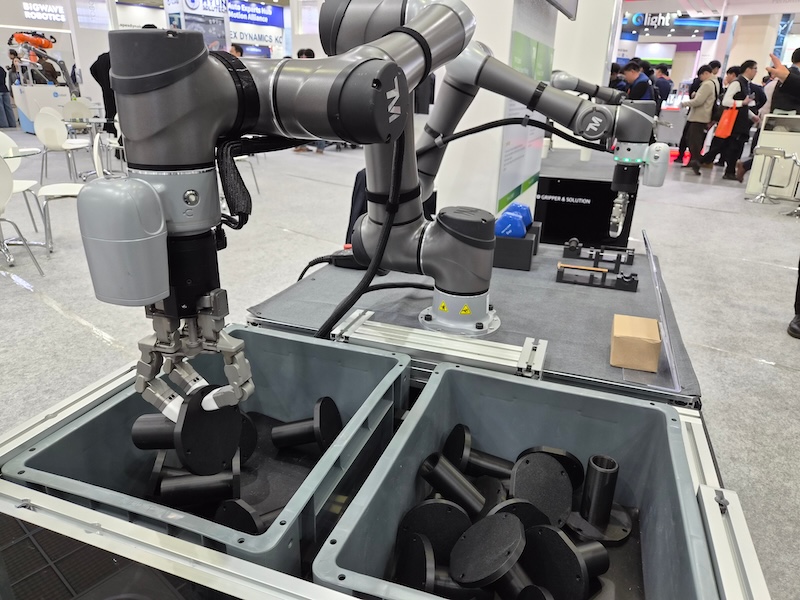
Techman Robot Korea, the South Korean subsidiary of global collaborative robot company Techman Robot headquartered in Taiwan, and Tesollo, a South Korean specialist in robotic grippers, will present an articulated, multi-jointed gripper-based automation solution optimized for high-mix, low-volume production environments at the 2026 Smart Factory & Automation Industry Exhibition (Automation World).
Following last year’s teleoperation demo combining a humanoid robot hand and a TM robot arm, the two companies have shifted this year’s exhibition concept to a process-oriented solution that can be directly deployed in industrial sites.
The core of this collaboration is to implement flexible automation required on real manufacturing lines by combining the industrial reliability of collaborative robots with the shape-adaptive grasping technology of articulated grippers.
At the center of the exhibition is an automation cell integrating the TM5S collaborative robot and Tesollo’s three-finger articulated gripper, the DG-3F-M.
TM robots provide proven operational stability in industrial environments, featuring high-precision repeatability, an intuitive teaching environment, and built-in vision-based position correction.
With the addition of the DG-3F-M’s articulated structure, it becomes possible to expand processes beyond the limitations of conventional automation.
The DG-3F-M delivers a rated payload of 2.5 kg (max. 5 kg) in pinching mode and 10 kg (max. 15 kg) in enveloping mode.
Unlike parallel grippers with simple linear open/close motion, its three fingers actively adapt to the object’s shape and increase the contact area to achieve stable grasping.
This enables handling of mixed, randomly oriented parts, non-uniform components with inconsistent poses, and heterogeneous parts with diverse geometries.
In particular, this gripper can be integrated not only with the TM5S but also with various payload lineups such as the TM12, TM14, and TM16, broadening its application scope.
This indicates a platform structure that can be flexibly expanded beyond a single cell configuration according to process scale and load requirements.
This solution is drawing attention as a model optimized for high-mix, low-volume production environments.
For example, it shows strong applicability in processes such as one-kit plate operations that transport multiple parts at once for assembly in the automotive and electronics manufacturing industries, bin-picking logistics processes that automatically pick and align irregular parts, and heterogeneous parts assembly processes that combine parts of different shapes.
Conventional automation has faced structural constraints where jigs must be replaced or processes redesigned whenever part shapes change.
However, when TM robots’ stable motion control environment is combined with the DG-3F-M’s shape-adaptive grasping technology, it becomes possible to respond more quickly to process changes while maintaining productivity.
This is evaluated as an automation direction well suited to the industrial shift toward increased high-mix, low-volume production.
Also unveiled is the DG-2F, a two-finger articulated gripper that extends the limitations of conventional parallel-jaw styles.
While it follows the most commonly used two-finger form factor in industrial settings, it incorporates a multi-axis articulated design internally, enabling diverse motions such as vertical grasping, horizontal grasping, and angle-adjusted grasping.
This allows stable handling of different part geometries without changing jigs, making it suitable for general-purpose industrial processes.
Tesollo CEO Youngjin Kim stated, “Articulated grippers are no longer research equipment – they are now a core robot component directly tied to productivity in high-mix, low-volume production environments.
“We will continue to expand flexible automation solutions that can be deployed immediately in real processes through integration with collaborative robots.”
Techman Robot added: “When the industrial reliability of collaborative robots is combined with adaptive grasping technology, it becomes possible to extend processes that are difficult to address with conventional automation.
“This will be an alternative that can secure both flexibility and scalability in the manufacturing and logistics industries.”
