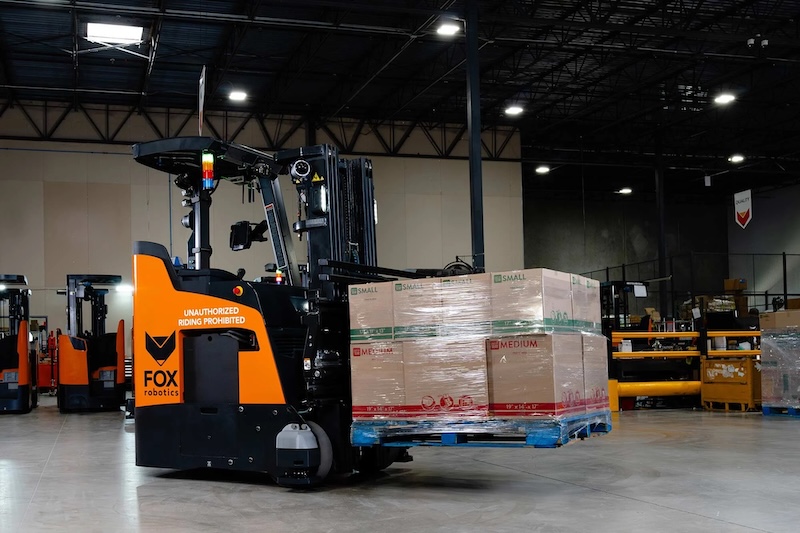
Warehouse automation company Symbotic has acquired autonomous forklift developer Fox Robotics, expanding its reach into dock automation and broadening its potential customer base.
The acquisition was disclosed during Symbotic’s fiscal first-quarter 2026 earnings call. Financial terms of the deal were not disclosed.
Fox Robotics specializes in autonomous forklift trucks used to move pallets between warehouses and loading docks. According to Symbotic, the company has about 25 customers, some of whom are not currently Symbotic clients.
Rick Cohen, CEO of Symbotic, said the acquisition aligns with the company’s strategy of coordinating multiple robotic systems across the supply chain.
“We recently closed the acquisition of Fox Robotics, a leader in autonomous forklift solutions,” said Cohen. “This acquisition further enhances our strategy of utilizing our software to orchestrate robots that move goods through the supply chain from the dock door at the warehouse to the individual customer order from the store.”
Expanding automation beyond warehouse systems
Symbotic is best known for its large-scale warehouse automation platforms, which use fleets of autonomous robots to move and sort inventory in distribution centers.
By acquiring Fox Robotics, the company is aiming to extend automation into another area of logistics – the loading dock – where forklifts remain widely used.
Cohen described the dock as a potentially large market for automation.
“What we liked about Fox is that they have 25 different customers. A number of those customers are not Symbotic customers today,” he said. “It gives us an opportunity to enter a new customer base.”
He added that autonomous forklifts could be sold independently of Symbotic’s full warehouse automation systems.
“We think this is a market where we could sell people dock automation separate from even warehouse automation,” Cohen said. “So we think this is a very big market.”
Industry analysts have also suggested that the acquisition could allow Symbotic to expand its portfolio into smaller logistics projects.
According to Reuben Scriven, research manager at Interact Analysis, the move enables Symbotic to broaden its offering.
He said the acquisition “expands its automation footprint within the distribution center’s four walls” and could make automation accessible to customers that may not require – or be able to afford – a full warehouse automation system.
Strong financial results
The acquisition announcement came alongside strong quarterly results from Symbotic.
The company reported revenue of $630 million, representing a 29 percent increase year over year, driven by expanded system deployments and development work related to new automation solutions.
Symbotic also reported GAAP net income of $13 million, compared with a net loss of $17 million in the same quarter a year earlier, marking the company’s first period of GAAP profitability.
Adjusted EBITDA reached $67 million, more than tripling from $18 million in the prior-year quarter.
The company said its growing installed base is also contributing to higher recurring revenue streams. Software revenue increased 97 percent year over year to $10.9 million, while operational services revenue rose 68 percent to $28.8 million.
Symbotic now has 57 systems in deployment, with three systems transitioning from deployment to operational status during the quarter.
Growing scale of robot operations
Cohen highlighted the scale of the company’s robotic systems during the call, noting that Symbotic’s robots processed more than 2 billion cases in 2025.
The robots also logged nearly 200 million miles during the year.
“As best we can tell, this may be the most traveled fully autonomous vehicle fleet in the world,” Cohen said.
Walmart remains key customer
Symbotic’s largest customer is retail giant Walmart, which has worked closely with the company on warehouse automation and e-commerce fulfillment systems.
Symbotic said development work with Walmart continues to advance, including new automated systems designed for accelerated online pickup and delivery centers.
The company’s current backlog stands at $22.3 billion, reflecting long-term contracts for system deployments.
Automation strategy broadens
The Fox Robotics acquisition reflects Symbotic’s broader strategy of expanding its technology platform to handle more aspects of logistics operations.
Cohen said the company is continuing to develop new robotic systems and may pursue additional acquisitions to address other parts of the warehouse workflow.
“We look at ourselves really as a solution provider,” he said. “Many of the automation people look at themselves as hardware suppliers.”
He added that Symbotic plans to keep investing heavily in research and development while exploring new technologies and partnerships.
