• Skip to primary navigation
  • Skip to main content
  • Skip to primary sidebar
  • Skip to secondary sidebar
  • About
    • Contact
    • Privacy
    • Terms of use
  • Shop
    • Cart
    • Checkout
    • My Account
  • Advertise
    • Advertising
      • Buy ad space
    • Case studies
    • Design
    • Email marketing
    • Features list
    • Lead generation
    • Magazine
    • Press releases
    • Publishing
    • Sponsor an article
    • Webcasting
    • Webinars
    • White papers
    • Writing
  • Subscribe to Newsletter

Robotics & Automation News

Where Innovation Meets Imagination

  • Home
  • News
  • Features
  • Editorial Sections A-Z
    • Agriculture
    • Aircraft
    • Artificial Intelligence
    • Automation
    • Autonomous Vehicles
    • Business
    • Computing
    • Construction
    • Culture
    • Design
    • Drones
    • Economy
    • Energy
    • Engineering
    • Environment
    • Health
    • Humanoids
    • Industrial robots
    • Industry
    • Infrastructure
    • Investments
    • Logistics
    • Manufacturing
    • Marine
    • Material handling
    • Materials
    • Mining
    • Promoted
    • Research
    • Robotics
    • Science
    • Sensors
    • Service robots
    • Software
    • Space
    • Technology
    • Transportation
    • Warehouse robots
    • Wearables
  • Press releases
  • Events

Japan’s ‘first’ 2-story 3D printed house obtains seismic approval from government

March 4, 2026 by David Edwards

Kizuki has completed Japan’s first government approved two-story 3D printed reinforced concrete house. The project meets Japan’s stringent seismic design requirements and demonstrates that 3D printed reinforced concrete can be applied as a structural alternative to timber construction in one of the world’s most earthquake-prone regions.

  • First government approved two-story 3D printed reinforced concrete house in Japan
  • Full seismic compliance confirmed under national building standards
  • Total printed area of 50 m² (537 sq.ft.) across two floors using 39 m³ (1,371 cu.ft.) of material
  • Cave-inspired architecture featuring 3D printed arches, floor slab, and roof slab
  • Four-person crew operating the printer under seasonal conditions ranging from below 10 °C (50 °F) to 35 °C (95 °F)
  • Custom printer configuration enabling printing from 0,5 m (20 in) below ground to a total height of 7 m (23 ft)

The 50 m² (537 sq.ft.) house consists of a 31 m² (329 sq.ft.) ground floor and a 19 m² (209 sq.ft.) upper floor. The design follows a cave-inspired architectural concept, incorporating 3D printed arches, a 3D printed floor slab, and a 3D printed roof slab. Several interior elements were produced using 3D printing to extend the curved geometry throughout the interior.

The project represents a new path for Japan’s residential construction sector, where timber remains the dominant material due to familiar workflows, regulatory clarity, and long established craftsmanship. At the same time, demographic change and an aging workforce are placing pressure on conventional building methods.

By delivering a fully 3D printed reinforced concrete structure that satisfies Japanese seismic standards, Kizuki has demonstrated that automated construction can support structural resilience, design flexibility, and reduced reliance on manual labor.

With this project, Japan has completed its first government approved two-story 3D printed reinforced concrete house. The technical and regulatory learnings from Kurihara are now informing Kizuki’s next development phases, as the company evaluates broader applications where seismic performance, execution speed, and reduced dependence on manual labor are critical.
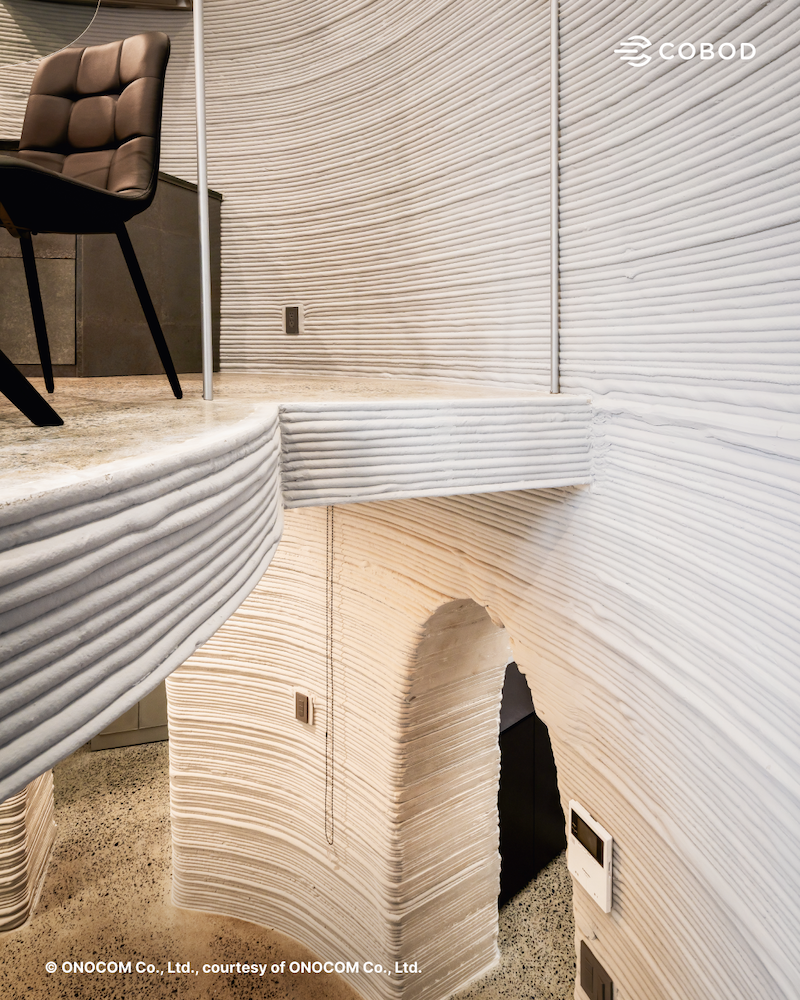
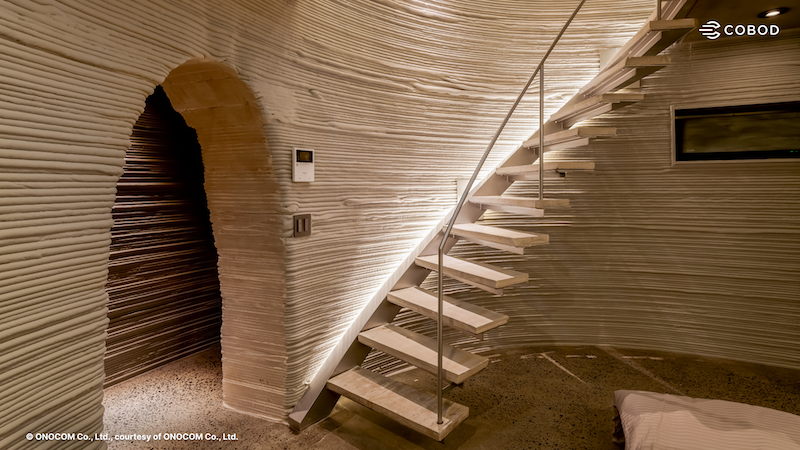
3D printed floor slab integrated into the structural and architectural design, reinforcing the continuous curved geometry throughout the building.
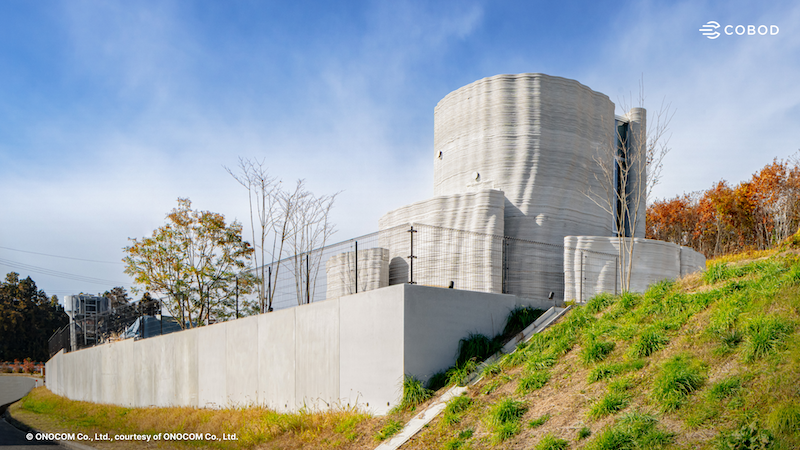
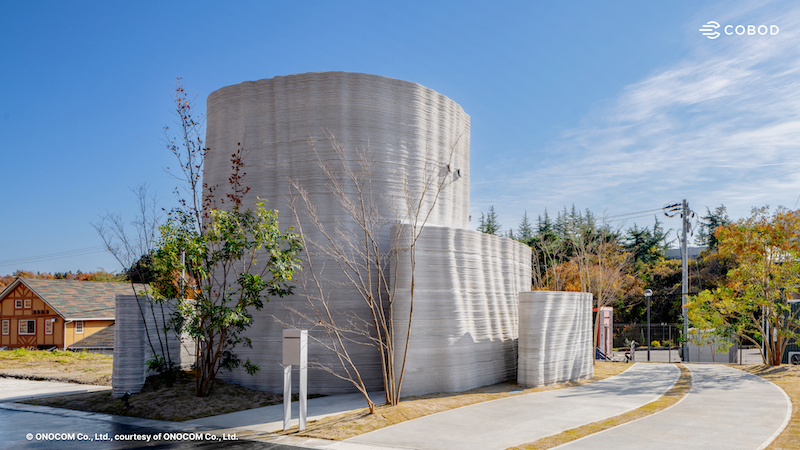
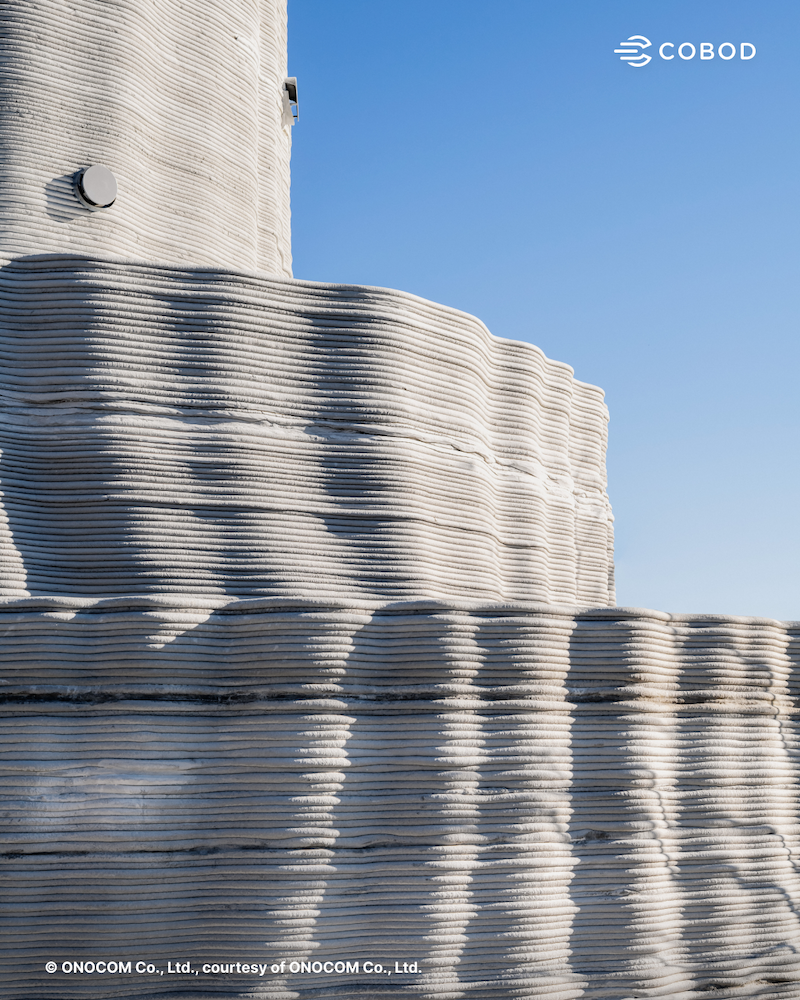
Daytime close-up exterior view of Japan’s first government approved two-story 3D printed reinforced concrete house, showing the layered concrete walls and curved geometry produced through on-site 3D construction printing.
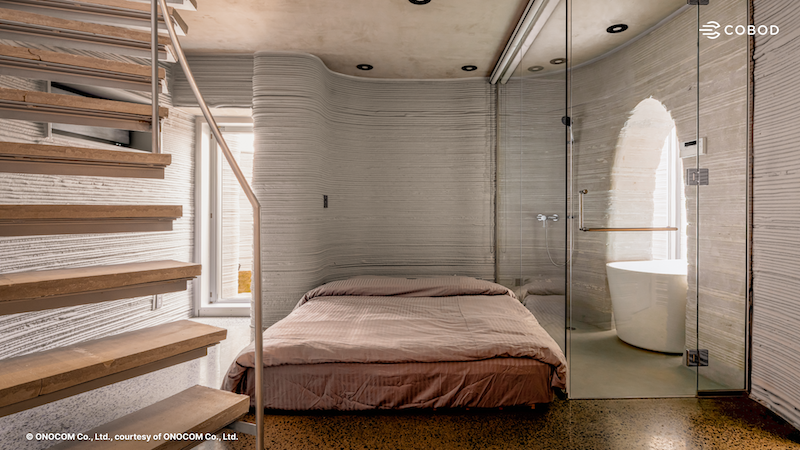
Interior view of the master bedroom with en-suite bathroom, reflecting the curved geometry enabled by 3D printing.
Cave-inspired architectural concept repeated throughout the building, made possible through advanced 3D printed geometry.
Daytime exterior view of Japan’s first government approved two-story 3D printed reinforced concrete house, showing the layered concrete walls and curved geometry produced through on-site 3D construction printing.
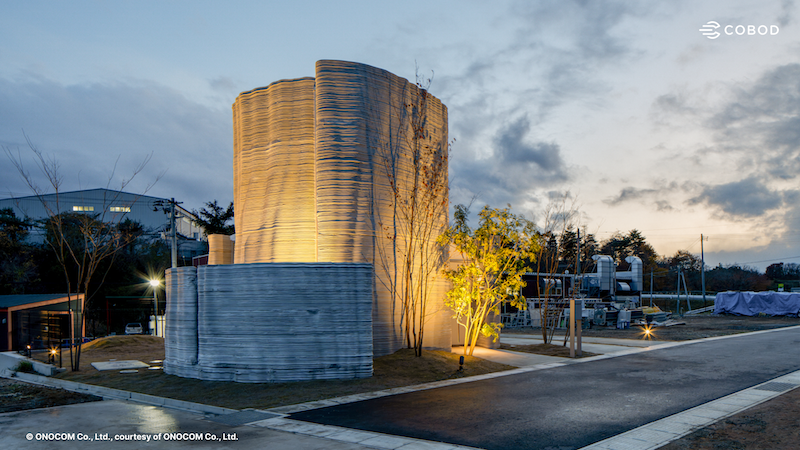
Evening view of the completed two-story 3D printed reinforced concrete structure, highlighting the curved walls and surface finish achieved through automated concrete printing under full seismic compliance.

The project demonstrates how 3D construction printing can deliver structurally sound, repeatable, and efficient building solutions under demanding regulatory and environmental conditions.

Rika Igarashi, CEO of Kizuki, said: “Based on the knowledge gained through our recent residential construction project, we plan to expand the application of 3D printing technology into civil structures, disaster-prevention and defense infrastructure, and post-disaster reconstruction.

“We are also developing a construction training program and a digital construction management system, aiming to establish a sustainable construction-industry model.”

Henrik Lund-Nielsen, founder and general manager of 3D printed construction technology company COBOD International, said: “Japan has some of the most demanding seismic requirements in the world.

“Seeing a government approved 2-story 3D printed reinforced concrete house completed here confirms that 3D construction printing is ready for projects that rely on structural precision and consistent quality, also in seismic areas. Kizuki’s project shows how our technology handles complex geometry, varying climate conditions, and strict regulatory standards.”

Realizing the cave-inspired architectural concept required advanced geometry beyond what is practical with conventional formwork. Kizuki combined on-site and off-site 3D printing to achieve the required structural and architectural forms.

The characteristic arches were printed longitudinally rather than as prefabricated elements to avoid handling heavy, fragile cured segments. CNC-cut styrofoam supports were added incrementally during printing, enabling overhangs of up to 90 degrees while maintaining unobstructed printer movement.

After printing, selected wall sections were polished to create a smooth, marble-like finish, turning the layered surface of the printed concrete into a deliberate architectural feature.

The project also validated COBOD’s technology across Japan’s extreme seasonal conditions. Early formwork components were printed in winter at temperatures below 10 °C (50 °F), requiring heated mixing water to maintain printability. The main house was printed in summer at 30-35 °C (86-95 °F), where the high temperature shortened bucket life and required careful process control.

Print Friendly, PDF & Email

Share this:

  • Print (Opens in new window) Print
  • Share on Facebook (Opens in new window) Facebook
  • Share on LinkedIn (Opens in new window) LinkedIn
  • Share on Reddit (Opens in new window) Reddit
  • Share on X (Opens in new window) X
  • Share on Tumblr (Opens in new window) Tumblr
  • Share on Pinterest (Opens in new window) Pinterest
  • Share on WhatsApp (Opens in new window) WhatsApp
  • Share on Telegram (Opens in new window) Telegram

Related stories you might also like…

Filed Under: Construction, Features Tagged With: 3D construction printing, 3D printed concrete building, 3D printed house, automated building systems, automated construction technology, automation news, COBOD 3D printing technology, digital construction methods, future of construction robotics, Japan construction technology, robotic construction systems, robotics and automation, robotics and automation news, robotics news, seismic resistant buildings

Primary Sidebar

Search this website

Latest articles

  • The Hardware Powering the Hybrid Industrial Workforce
  • How to Choose a Robot Vacuum and Mop That Actually Fits Your Home
  • How Modern Software Helps Construction Companies in Qatar Work Smarter and Safer
  • Antivirus vs malware: Why antivirus alone is no longer enough
  • X Square Robot builds a full-stack approach to embodied AI and general-purpose robotics
  • AGIBOT debuts A3 humanoid robot in Europe and launches UK Robot-as-a-Service model
  • What Are the Biggest Challenges in Modern Electronics Manufacturing?
  • What Are the Best AI Tools for Creating Content Faster in 2026?
  • Why Does Quality Wiring Matter More Than Ever in Modern Electronic Devices?
  • Why Are Custom Harness Solutions Essential for Next Generation Technology?

Secondary Sidebar

Latest news

  • The Hardware Powering the Hybrid Industrial Workforce
  • How to Choose a Robot Vacuum and Mop That Actually Fits Your Home
  • How Modern Software Helps Construction Companies in Qatar Work Smarter and Safer
  • Antivirus vs malware: Why antivirus alone is no longer enough
  • X Square Robot builds a full-stack approach to embodied AI and general-purpose robotics
  • AGIBOT debuts A3 humanoid robot in Europe and launches UK Robot-as-a-Service model
  • What Are the Biggest Challenges in Modern Electronics Manufacturing?
  • What Are the Best AI Tools for Creating Content Faster in 2026?
  • Why Does Quality Wiring Matter More Than Ever in Modern Electronic Devices?
  • Why Are Custom Harness Solutions Essential for Next Generation Technology?

Copyright © 2026 · News Pro on Genesis Framework · WordPress · Log in

We use cookies on our website to give you the most relevant experience by remembering your preferences and repeat visits. By clicking “Accept”, you consent to the use of ALL the cookies.
Do not sell my personal information.
Cookie SettingsAccept
Manage consent

Privacy Overview

This website uses cookies to improve your experience while you navigate through the website. Out of these, the cookies that are categorized as necessary are stored on your browser as they are essential for the working of basic functionalities of the website. We also use third-party cookies that help us analyze and understand how you use this website. These cookies will be stored in your browser only with your consent. You also have the option to opt-out of these cookies. But opting out of some of these cookies may affect your browsing experience.
Necessary
Always Enabled
Necessary cookies are absolutely essential for the website to function properly. These cookies ensure basic functionalities and security features of the website, anonymously.
CookieDurationDescription
cookielawinfo-checkbox-analytics11 monthsThis cookie is set by GDPR Cookie Consent plugin. The cookie is used to store the user consent for the cookies in the category "Analytics".
cookielawinfo-checkbox-functional11 monthsThe cookie is set by GDPR cookie consent to record the user consent for the cookies in the category "Functional".
cookielawinfo-checkbox-necessary11 monthsThis cookie is set by GDPR Cookie Consent plugin. The cookies is used to store the user consent for the cookies in the category "Necessary".
cookielawinfo-checkbox-others11 monthsThis cookie is set by GDPR Cookie Consent plugin. The cookie is used to store the user consent for the cookies in the category "Other.
cookielawinfo-checkbox-performance11 monthsThis cookie is set by GDPR Cookie Consent plugin. The cookie is used to store the user consent for the cookies in the category "Performance".
viewed_cookie_policy11 monthsThe cookie is set by the GDPR Cookie Consent plugin and is used to store whether or not user has consented to the use of cookies. It does not store any personal data.
Functional
Functional cookies help to perform certain functionalities like sharing the content of the website on social media platforms, collect feedbacks, and other third-party features.
Performance
Performance cookies are used to understand and analyze the key performance indexes of the website which helps in delivering a better user experience for the visitors.
Analytics
Analytical cookies are used to understand how visitors interact with the website. These cookies help provide information on metrics the number of visitors, bounce rate, traffic source, etc.
Advertisement
Advertisement cookies are used to provide visitors with relevant ads and marketing campaigns. These cookies track visitors across websites and collect information to provide customized ads.
Others
Other uncategorized cookies are those that are being analyzed and have not been classified into a category as yet.
SAVE & ACCEPT