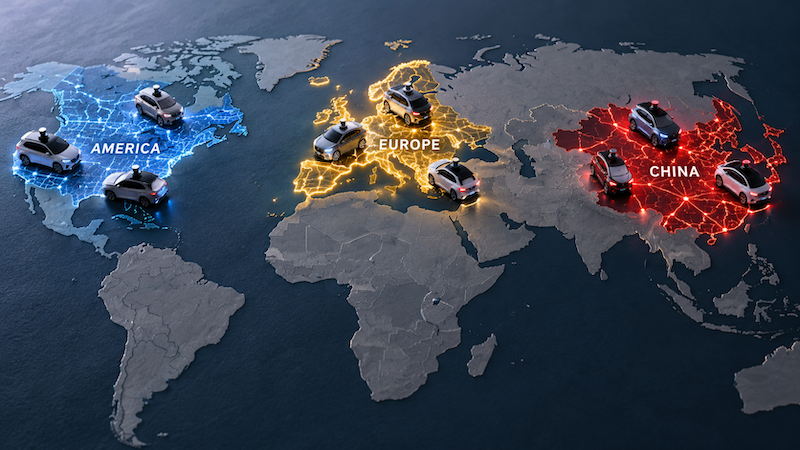
Europe is rapidly becoming one of the most closely watched regions in the global robotaxi race, as autonomous-driving companies from China and the West increasingly target the same cities for commercial expansion.
Unlike the United States and China, where regulatory, political and market barriers make meaningful competition by foreign autonomous-driving companies difficult, Europe remains comparatively open. That could make the continent an important testing ground for competing technologies, business models and approaches to operating autonomous vehicle fleets.
Arthur D. Little, believed to be the world’s oldest management consulting firm, says this combination of openness and market fragmentation could create opportunities for robotaxi companies seeking an early foothold. Founded in 1886, the consultancy advises companies and governments across industries including automotive, transportation, technology and telecommunications.
Frank McCleary, an expert in autonomous mobility and urban transportation at Arthur D. Little, argues that Europe may become one of the few large markets where Chinese and Western robotaxi companies compete directly.
McCleary says the contest will involve considerably more than determining which company has the best autonomous-driving technology. Vehicle costs, fleet utilization, regulation, consumer trust and the ability to operate large numbers of vehicles profitably could ultimately prove just as important.
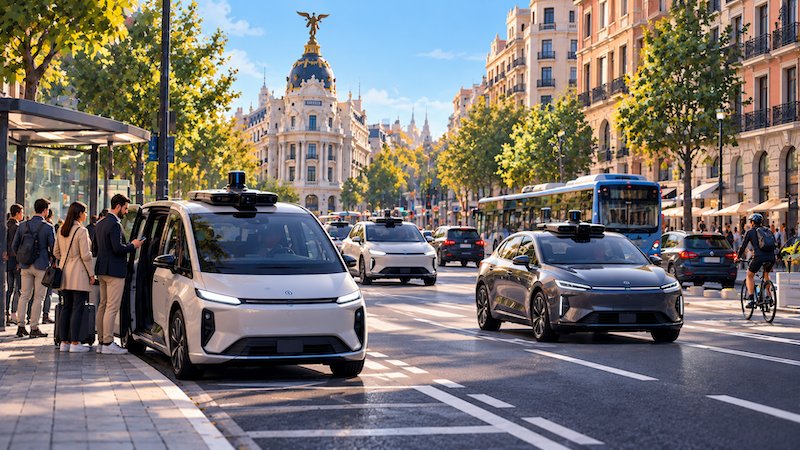
He also highlights the different prospects of individual European markets. Germany has an early national framework for Level 4 autonomous driving, while the UK combines a national regulatory framework with the potentially large London market. Smaller countries may be able to move more quickly, while Spain could emerge as a particularly interesting market because of its regulatory framework, favorable operating conditions and large cities.
McCleary estimates that Madrid or Barcelona could see multiple robotaxi operators competing commercially within the next 12 to 18 months, although achieving significant fleet scale is likely to take longer.
In this Q&A, McCleary discusses the emerging competition between Chinese and Western robotaxi companies, the barriers dividing the US and Chinese markets, and why cost per ride and fleet economics may eventually determine who wins Europe’s robotaxi race.
Interview with Frank McCleary

Robotics & Automation News: Why do you believe Europe, rather than the US or China, could become the main battleground for the global robotaxi industry?
Frank McCleary: Europe may be one of the few sizeable markets where Chinese and Western robotaxi companies compete directly. The US and China have significant structural and regulatory barriers to foreign operators, whereas Europe remains relatively open to both.
Europe’s fragmentation also creates opportunity. Smaller markets can move faster through coordinated regulation, government support and more manageable operating domains, creating potential beachheads for broader regional expansion.
On the demand side, Uber is already positioning itself across multiple technology providers. Ultimately, success will depend not only on autonomous-driving technology, but on who can deliver reliable service, operate fleets effectively and scale vehicles quickly.
R&AN: What advantages do Chinese robotaxi companies bring to Europe, and where do Western companies currently have the advantage?
FM: On the surface, we don’t believe Chinese robotaxi companies have a unique advantage. The key potential differentiator is vehicle economics.
If Chinese robotaxi companies can bring cost-advantaged vehicles from mainland China into Europe, they could gain an important advantage in vehicle economics, although utilization and operating costs will ultimately determine the cost per ride. This becomes particularly important as the market moves beyond pilots and operators need to make the economics of each ride work at scale.
The key question is whether that cost advantage can be maintained in Europe, given tariffs, potential “Made in EU” requirements under the proposed Industrial Accelerator Act and other pressures to localize production, sourcing, technology and R&D.
R&AN: How significant are the barriers preventing Chinese operators from expanding into the US and Western companies from competing in China? Are those barriers likely to persist?
FM: Chinese operators are effectively frozen out of the US market with Chinese vehicles because of restrictions around connected-vehicle and ADAS software.
That does not necessarily preclude Chinese companies from participating in the US market, but doing so would require overcoming significant restrictions involving vehicle manufacturing, technology sourcing and potentially ownership or control. These barriers are unlikely to come down, reinforcing further fragmentation of the global market.
For Western companies in China, the challenge is different. The dominance of established domestic players will continue to make it difficult to compete meaningfully. We have already seen the decline of European and US OEMs in China, and we do not expect robotaxi companies to overcome the structural challenges that have driven that trend.
R&AN: Europe is a fragmented market with different regulations, cities and transport systems. Which countries or cities are best positioned for large-scale robotaxi deployment, and what separates them from the rest?
FM: There is no single market best positioned; it is a trade-off between speed and scale. Germany established an early national framework for Level 4 driving, but incumbent taxi and labor dynamics could make commercial rollout more challenging. Croatia moved quickly from regulation to commercial operations in Zagreb, demonstrating how smaller markets can move faster.
The UK combines a national framework with the significant demand potential of London, while Spain has created a national framework that could support deployment across multiple cities.
What separates these markets is regulatory timing and framing, market size and demand, and the existing taxi and labor environment. Smaller markets can provide attractive beachheads, while larger markets ultimately offer greater fleet potential.
R&AN: You have identified Spain as a potentially important early market. Why Spain, and how soon could we realistically see several robotaxi operators competing there at commercial scale?
FM: Spain is among the more recent European markets to establish a national regulatory framework for autonomous-vehicle testing and pre-deployment. While the framework provides a clear roadmap for testing, it stops short of establishing a definitive pathway to commercial operations. This remains an important gap that will need to be addressed before robotaxi services can scale.
What makes Spain particularly attractive is its operating environment. Cities such as Madrid and Barcelona offer relatively favorable weather, less challenging driving conditions than some northern European markets, and strong demand from both residents and tourists. Spain also offers the potential to expand across multiple major cities under a common national framework.
We believe it will be another 12–18 months before we see multiple robotaxi operators competing commercially in Madrid or Barcelona, with meaningful fleet scale likely taking longer.
R&AN: Will the European robotaxi market ultimately be won by companies that develop the autonomous-driving technology, or by platforms such as Uber and Bolt that already control large networks of customers and drivers?
FM: It may actually be a third contender: the fleet operators that can most effectively deploy vehicles, maximize utilization and manage operating costs.
Demand-generation platforms such as Uber and Bolt will certainly influence the pace of rollout through how they allocate demand, particularly in markets with multiple fleet operators. However, fleet operators have a strong incentive to diversify their demand channels rather than depend on a single platform.
Take the collaboration between Pony.ai, Verne and Uber in Croatia. Verne operates the fleet and generates demand through its own app alongside Uber. Pony.ai has similarly established relationships with multiple demand platforms in other markets. Ultimately, fleet operators will prioritize maximizing vehicle utilization and returns on their invested capital.
R&AN: If Chinese and Western robotaxi companies are competing directly in European cities five years from now, what will determine the winners – technology, safety, cost per ride, regulation, fleet scale or consumer trust?
FM: All of the above. Technology, safety and consumer trust go hand in hand, and will increasingly become table stakes for operating successfully in any market. Regulation will ultimately weed out those that cannot meet these expectations.
Cost per ride and fleet scale will likely determine the winners in the long run. The strength of today’s partnership announcements will ultimately be measured by their ability to deliver sustainable profitability, rather than simply the number of vehicles promised or deployed.
The real differentiator will be how effectively these partnerships optimize fleet mix, utilization and operating costs to ensure customers have the right vehicle at the right time. That will determine which companies are still operating five years from now and which have exited the market.
