Walk through almost any automated plant and the eye goes straight to the robots, the conveyors and the vision cameras blinking above the line.
Very few visitors look up at the pipes running along the ceiling, yet a large share of the motion on that floor depends on what travels through them.
Pneumatic cylinders push parts into position and vacuum cups lift cartons off the belt, all powered by air that was compressed in a back room and sent across the building. When that air arrives at the wrong pressure or in the wrong condition, the most sophisticated cell on the floor starts behaving like a cheap one.
Compressed Air as the Quiet Fourth Utility
Plant engineers often call compressed air the fourth utility, next to electricity, water and gas, and the label fits. Automation leans on it heavily because pneumatic components are simple and forgiving.
A cylinder can stall against a hard stop without burning out, and a gripper can be swapped in minutes. For pick-and-place work, clamping and short linear moves, air still competes well with electric actuators on cost and robustness.
The weak point is that pneumatic devices are only as good as the supply behind them. A gripper rated for a certain holding force at a given pressure will deliver less when the pressure at its port sags, and the controller usually has no way to notice.
Cycle times stretch slightly, parts slip in the jaws now and then, and sensors flag positions that were reached a fraction of a second late. Maintenance teams chase those symptoms at the machine while the real cause sits somewhere upstream in the distribution network.
Material choice in that network has shifted over the past couple of decades. Black iron and galvanized steel were the default for a long time, then copper and various plastics took part of the market, and modular aluminum has spread through many newer facilities.
Whichever material a plant settles on, and whether the order goes to Unipipe or to a local pipe distributor, the long-term behavior of the network matters more to an automated line than the price of the first installation. A system that stays tight and clean for fifteen years costs far less in lost production than one that starts leaking after three.
Where the Pressure Goes
A compressor room can produce perfectly adequate pressure while the far end of the plant starves. Air loses energy every time it rubs against a pipe wall, turns a corner or squeezes through a fitting.
Undersized mains and long runs packed with elbows add up quickly, and quick-disconnect couplings that were never meant for heavy flow make the problem worse. By the time air reaches the last robot cell on a long line, the drop can be large enough to change how the equipment behaves.
The usual reaction is to raise the compressor setpoint, and it works in the short term. It is also expensive, because every extra unit of pressure at the compressor costs electricity around the clock and pushes more air out through every leak in the system.
Facilities that measure their compressed air use carefully often discover that a meaningful share of what they pay to compress never reaches a tool at all.
Leaks are the obvious culprit. Threaded joints in steel pipe loosen with vibration and temperature swings, hoses crack, and push-in fittings on machines wear out.
A single hissing joint is easy to ignore on a noisy floor, yet a building with hundreds of them loses a surprising volume of air every hour, including nights and weekends when production is idle.
Finding them takes some patience. Ultrasonic leak detectors pick up the high-frequency hiss that ears miss over machine noise, and a walk-through during a weekend shutdown often turns up dozens of small problems in a single afternoon.
Pressure loggers placed at a few points along the main add another layer of evidence, showing exactly where the profile sags during peak demand and which branches deserve attention first.
Corrosion does quieter damage. Compressed air carries moisture, and in steel pipe that moisture eventually produces rust and scale on the inside walls. Flakes break loose and travel downstream, where they clog filters, score valve spools and can contaminate products in food or pharmaceutical lines.
Equipment with tight tolerances tends to suffer first, since a particle that a hand tool would never notice can make a proportional valve stick.
Teams planning new air compressor piping for a line expansion often start with a leak survey of the old network, because the results of that survey tend to shape the whole budget conversation.
Dryers, filters and automatic drains still have their place in any design. They simply work far better when the pipe downstream is not adding contamination of its own.
Designing Distribution for Machines That Move
Automated lines change shape far more often than the buildings around them. A packaging cell gets moved to make room for a new product, two robots become four, and a palletizer appears where a manual station used to be.
Air distribution designed as a fixed welded or threaded network makes every one of those changes slow and messy, so plants often end up with temporary hose runs that quietly become permanent.
Loop designs help a great deal. Instead of a single long main that dead-ends at the far wall, a ring main feeds air from two directions, which evens out pressure at each drop.
Drops should come off the top of the header so that condensate stays in the main and drains away instead of running down into a machine. Generous main diameters cost a bit more upfront and pay back in a flatter pressure profile across the floor.
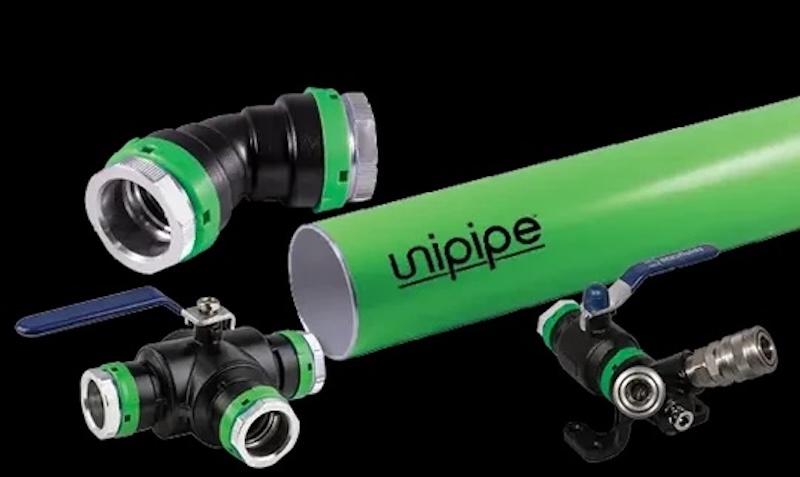
Push-to-connect and clamp-style fittings make reconfiguration far less painful. A maintenance crew can add a drop for a new cell during a short shutdown without cutting, threading or welding, and the same components can be reused when the cell moves again. For plants that run continuous improvement programs, that flexibility can matter as much as any hardware specification.
Nitrogen and Vacuum on the Same Ceiling
Compressed air is rarely the only line overhead anymore. Laser cutting cells use nitrogen as an assist gas to get clean, oxide-free edges on stainless steel and aluminum, and electronics assembly uses it in reflow ovens and selective soldering.
Many plants now generate nitrogen on site and pipe it to several points, which raises the same questions about leaks, purity and pressure that apply to air.
Purity is the bigger worry with nitrogen. Any ingress of moisture or particles defeats the purpose of using an inert gas, and a contaminated line can show up as discolored cut edges or poor solder joints long before anyone suspects the piping.
Engineers drafting a nitrogen layout often keep several references open at once, www.unipipesolutions.com/collections/unipipenitro being one of them, while they work out drop locations and purity checkpoints.
Color coding and clear labels matter too when air, nitrogen and vacuum lines run side by side, since a wrong connection on a busy shift can damage equipment in seconds.
Central vacuum systems feed suction cups on robot end effectors and pick-and-place heads. They suffer from leaks in the opposite direction, pulling in dust and moisture instead of losing air.
Tight joints, smooth bores and sensible routing help here as well, even though the pressure sits below atmosphere instead of above it.
Automation projects tend to be judged by throughput, uptime and payback period, and the piping overhead rarely appears in those slide decks. The robots on the floor, however, can only move as reliably as the air and gas that reach them.
Plants that treat their distribution network as part of the machine usually spend far fewer night shifts hunting for faults that never show up on a diagnostic screen.
