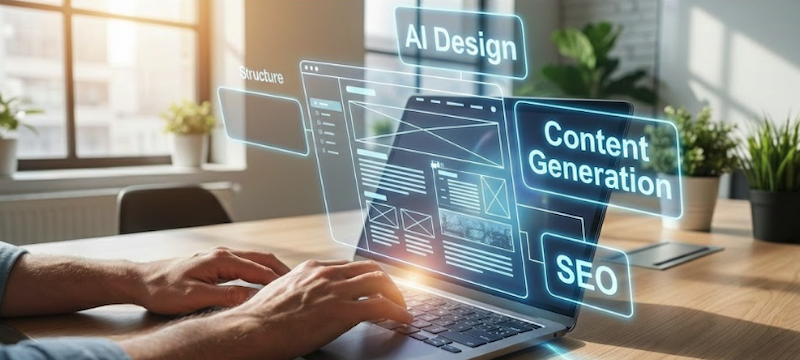
Website builders are no longer an ordinary set of templates. These are full-featured platforms designed to help you launch any digital project quickly and without a dev team.
Shopify, Webflow, Wix, Squarespace, and Nicepage, with their templates, offer different strategies, added by AI features, to speed up design, content, and SEO preparation.
What is the website builder industry, and how does AI shape it?
Website builder industry is a market of ecosystems and platforms aimed at creation and supporting websites without coding, from blogs and landings, to huge marketplaces.
This industry bases on manageability (content, updates, analytics, SEO), launch speed (time-to-market), and result quality (design, mobile adaptation, UX).
AI has become a core driver, transforming the manual process of website creation into automated generation. For example:
- Shopify offers an AI Store Builder that generates options for a preconfigured storefront in compliance with keywords.
- Squarespace helps to start without a blank page and offers Blueprint AI (moves ready-made structure, pages, and sections into the usual editor).
- Webflow strengthens quality and control. It provides AI on the generation stage, during the check and improvement processes.
- Wix uses a guided chat to generate an AI-built site draft, then lets you edit it.
- Nicepages moves towards AI builders. It offers AI Pages Builder, and creates pages, blocks, and texts in compliance with the provided descriptions and topic.

What AI tools are offered within website builders, and how to use them?
Design and page structure generation
AI in builders saves time, structures the website skeleton – pages, sections, basic style. So, you can start not from a blank slate, but from a ready-made structure.
- Squarespace Blueprint AI picks a specific topic, goal, or tone and generates a scratch with structure and sections.
- Wix AI Website Builder creates the website through dialogue and replies to the questions. AI builds the structure, and you manually personalize it.
- Shopify AI Store Builder generates several stores’ showcase variants, in compliance with the provided keywords.
- Nicepage AI Builder structures pages, blocks, and texts, focusing on the provided topic and brief descriptions.
Advice: apply AI for structuring the primary version, but always set frames: several references for the required style, audience, the page’s target, and key benefits of your product. Such an approach helps to make the scratch closer to reality.
Content generation: texts, descriptions, blocks
AI helps to avoid routine, creating drafts of headings, descriptions, offers, FAQ, and product cards. Keep in mind, these are strictly drafts requiring further personalization and adaptation.
- Wix offers AI-assistance for product and service descriptions and SEO elements improvement.
- Shopify provides AI tools for the content and store elements, developing in parallel with Store Builder and Sidekick assistant.
Advice: All the AI texts require human refinement. You should always review articles and descriptions, add them with precise data, get rid of general words, adapt to the brand’s voice, and thoroughly check each fact.
AI for SEO: meta-tags, alt-texts, structure, AEO
In this case, AI tools serve as editor and proofreader, quickly detecting weak points and offering improvements.
- Webflow AI Audit highlights missing elements, influencing SEO and AEO (alt-text, titles, meta descriptions, schema markup), and allows for the generation of relevant content for these fields.
- Wix provides AI tips for the title tag and meta description, allowing you to pick the proper tone and clarify the page’s description.
Advice: Utilize AI not for stuff keywords, but to create proper alt, title, meta, improve the snippets’ clarity, align the headers’ structure, and prepare pages for replies and AI-search (AEO).
Intellectual assistants and optimization in real-time
In 2026, AI is no longer a standard generator, but a smart assistant within a platform. It helps to improve the website along the way.
- Shopify develops Sidekick, including new interaction scenarios, as an assistant for merchant tasks.
- Wix launches chat-assistant Astro, supporting in detecting required functions, speeding up operational tasks, and improving SEO/performance.
- Squarespace strengthens AI-line primarily in updates, offering Blueprint and assistant-driven workflows.
Advice: treat an AI assistant as a senior editor. He provides recommendations and speeds up the processes, though you have to make the final decision.
Popular myths about AI in website builders
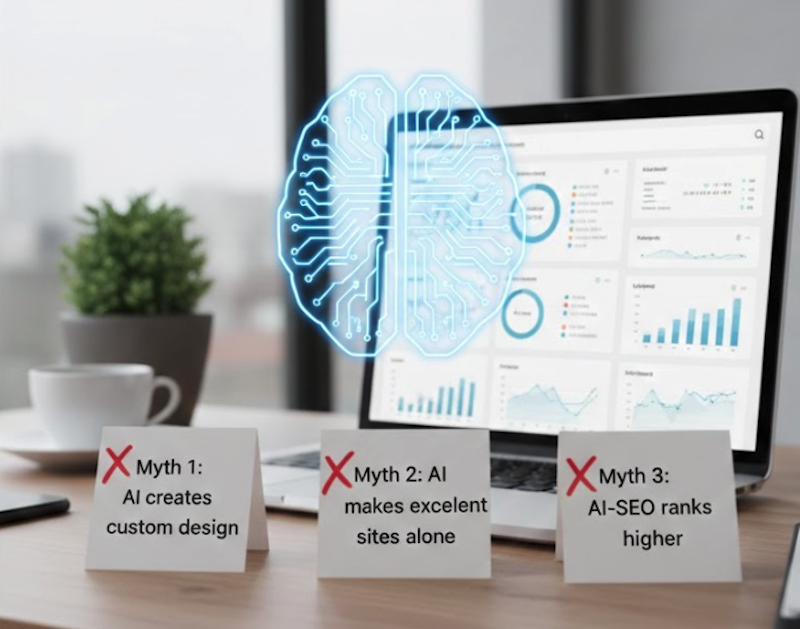
Myth 1. AI creates a custom design
AI builds design using curated patterns and blocks libraries. Uniqueness depends on user: you should personalize it with content, visual solutions, grids, and additional details.
Myth 2. AI can make an excellent website on its own
Though AI speeds up the website creation, do not treat it as a complete substitution of audience understanding, high-quality cases and photos, product packaging, and a mindful sales structure. The result of AI work in all cases depends on human edits.
Myth 3. AI-powered SEO helps your website rank higher
AI can solve technical tasks and offer SEO improvements (meta, schema, alt, structure), but the overall SEO performance depends on content quality, niche competitiveness, mentions and links, website speed, pages’ usefulness and sense. So, treat AI not as a magic solution, but the way to speed up SEO planning.
Myth 4. AI allows publishing content without any checks
AI is powerful, but it still makes mistakes. Check everything before publishing, especially numbers, and compliance with the brand’s voice. The best approach combines AI as a draft, editing, facts and real cases.
Conclusion
AI visibly transforms website builders industry, from website structure and content generation to SEO-audits and smart assistants that help to improve the website directly on the go.
Shopify, Wix, Nicepage, Webflow, and Squarespace all combine templates with AI tools in different ways, but they share the same goal: launch faster, simplify management, and keep optimizing continuously.
So, the best way to benefit from AI in builders can look like this: generate a mighty start (structure, design, and first articles), personalize in compliance with the brand and audience, initiate AI-audits, improve the website with iterations, analytics, and assistants’ tips.
