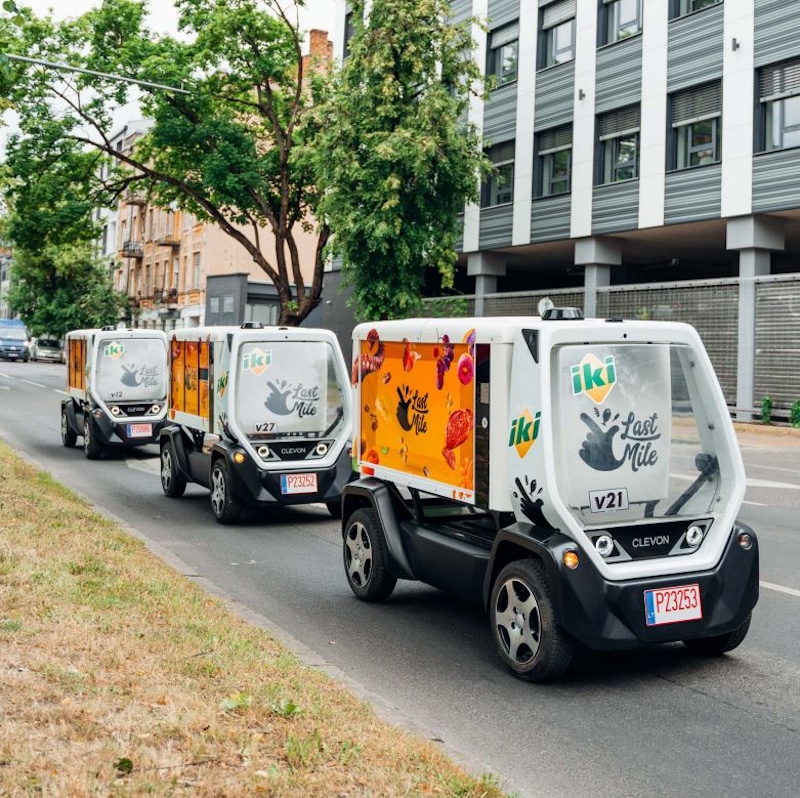
Starship Technologies, the world’s leading provider of autonomous delivery services, has published its 2023 Robot Wrap Up, highlighting the most popular items, interesting stats and quirky requests that its global fleet of more than 2,000 robots have received in the past year. [Read more…] about Starship Technologies wraps up year with record deliveries
Features
Nvidia’s predictions for 2024: What’s Next in AI?

Richard Kerris
Vice President of Developer Relations, Nvidia Head of Media and Entertainment
The democratization of development: Virtually anyone, anywhere will soon be set to become a developer. Traditionally, one had to know and be proficient at using a specific development language to develop applications or services.
As computing infrastructure becomes increasingly trained on the languages of software development, anyone will be able to prompt the machine to create applications, services, device support and more.
While companies will continue to hire developers to build and train AI models and other professional applications, expect to see significantly broader opportunities for anyone with the right skill set to build custom products and services.
They’ll be helped by text inputs or voice prompts, making interactions with computers as simple as verbally instructing it.
“Now and Then” in film and song: Just as the “new” AI-augmented song by the Fab Four spurred a fresh round of Beatlemania, the dawn of the first feature-length generative AI movie will send shockwaves through the film industry.
Take a filmmaker who shoots using a 35mm film camera. The same content can soon be transformed into a 70mm production using generative AI, reducing the significant costs involved in film production in the IMAX format and allowing a broader set of directors to participate.
Creators will transform beautiful images and videos into new types and forms of entertainment by prompting a computer with text, images or videos. Some professionals worry their craft will be replaced, but those issues will fade as generative AI gets better at being trained on specific tasks.
This, in turn, will free up hands to tackle other tasks and provide new tools with artist-friendly interfaces.
Rev Lebaredian
Vice President of Nvidia Omniverse and Simulation Technology
Industrial digitalization meets generative AI: The fusion of industrial digitalization with generative AI is poised to catalyze industrial transformation.
Generative AI will make it easier to turn aspects of the physical world – such as geometry, light, physics, matter and behavior – into digital data.
Democratizing the digitalization of the physical world will accelerate industrial enterprises, enabling them to design, optimize, manufacture and sell products more efficiently.
It also enables them to more easily create virtual training grounds and synthetic data to train a new generation of AIs that will interact and operate within the physical world, such as autonomous robots and self-driving cars.
3D interoperability takes off: From the drawing board to the factory floor, data for the first time will be interoperable.
The world’s most influential software and practitioner companies from the manufacturing, product design, retail, e-commerce and robotics industries are committing to the newly established Alliance for OpenUSD.
OpenUSD, the universal language between 3D tools and data, will break down data siloes, enabling industrial enterprises to collaborate across data lakes, tool systems and specialized teams easier and faster than ever to accelerate the digitalization of previously cumbersome, manual industrial processes.
Bob Pette
Nvidia Vice President of Enterprise Platforms
Building anew with generative AI: Generative AI will allow organizations to design cars by simply speaking to a large language model or create cities from scratch using new techniques and design principles.
The architecture, engineering, construction and operations (AECO) industry is building the future using generative AI as its guidepost.
Hundreds of generative AI startups and customers in AECO and manufacturing will focus on creating solutions for virtually any use case, including design optimization, market intelligence, construction management and physics prediction.
AI will accelerate a manufacturing evolution that promises increased efficiency, reduced waste and entirely new approaches to production and sustainability.
Developers and enterprises are focusing in particular on point cloud data analysis, which uses lidar to generate representations of built and natural environments with precise details. This could lead to high-fidelity insights and analysis through generative AI-accelerated workflows.
Generative AI also offers enterprises a significant opportunity to gain new insights from their existing data.
By customizing pre-trained foundation models with techniques like fine-tuning and retrieval augmented generation (RAG), organizations can harness the transformative power of generative AI for domain-specific tasks to improve decision-making and develop a competitive edge.
To capture this opportunity and accelerate adoption of generative AI, enterprises will need a trusted pathway to design and implement scalable, efficient, and reliable infrastructure.
Deepu Talla
Nvidia Vice President of Embedded and Edge Computing
The rise of robotics programmers: LLMs will lead to rapid improvements for robotics engineers. Generative AI will develop code for robots and create new simulations to test and train them.
LLMs will accelerate simulation development by automatically building 3D scenes, constructing environments and generating assets from inputs.
The resulting simulation assets will be critical for workflows like synthetic data generation, robot skills training and robotics application testing.
In addition to helping robotics engineers, transformer AI models, the engines behind LLMs, will make robots themselves smarter so that they better understand complex environments and more effectively execute a breadth of skills within them.
For the robotics industry to scale, robots have to become more generalizable – that is, they need to acquire skills more quickly or bring them to new environments.
Generative AI models – trained and tested in simulation — will be a key enabler in the drive toward more powerful, flexible and easier-to-use robots.
Robots integrate with automated storage and retrieval systems to deliver warehouse efficiency
Automated storage and retrieval systems are becoming the backbone of modern warehouse logistics operations.
However, there is still the challenge of efficiently moving orders through the sorting process. Until recently, the only options were manually or by conveyor – but both have clear limitations.
Nowadays, a more flexible and future-proof solution is available: robots. Tijmen Verkooijen, bid and tender manager at Prime Vision, explains all. [Read more…] about Robots integrate with automated storage and retrieval systems to deliver warehouse efficiency
Yaskawa empowers South Africa’s robotic future with precision in 2024
Leading robotics and automation company, Yaskawa Southern Africa is at the forefront as a forward-thinking leader, actively anticipating and embracing industry-shaping trends.
National Sales Manager at Yaskawa, Jan T’Hart, shares insights on the future of automation, pinpointing the trends set to redefine manufacturing in the country.
Delving into the new year, Yaskawa’s strategic vision prioritises technological advancements, industry-specific needs, and a steadfast commitment to sustainability. [Read more…] about Yaskawa empowers South Africa’s robotic future with precision in 2024
3D printed organs set to become ‘reality in two decades’
Biotech firms are making progress in developing 3D-printed organs, with recent breakthroughs aiding the production of increasingly intricate tissues. Companies like Vital3D are tackling the challenge with cutting-edge technology, and seeing remarkable results.
In recent years, 3D printing has emerged as a transformative technology for the field of organ transplantation. Doctors are already using 3D-printed skin for burn treatment and wound healing, and this year has seen the first successful use of 3D-printed cartilage for ear reconstruction.
Now, amidst rising demand for organ transplants and a dire shortage of donor organs worldwide, researchers are working toward using 3D printing to produce even more complex structures, like livers, hearts, and kidneys. [Read more…] about 3D printed organs set to become ‘reality in two decades’
ETH succeeds in printing robot parts with different polymers and new laser scanning technique
Scientists at ETH have succeeded in printing a robotic hand with bones, ligaments and tendons made of different polymers using a new laser scanning technique. It is believed this is the first time such materials and techniques have been used.
3D printing is advancing rapidly, and the range of materials that can be used has expanded considerably. While the technology was previously limited to fast-curing plastics, it has now been made suitable for slow-curing plastics as well.
These have decisive advantages as they have enhanced elastic properties and are more durable and robust. [Read more…] about ETH succeeds in printing robot parts with different polymers and new laser scanning technique
Gecko-inspired adhesive offers a bio-inspired twist on robotic handling
Researchers develop a technique to allow fragile objects to be transferred and released by robotics, without damage, while using a gecko inspired adhesive.
The subtle adhesive forces that allow geckos to seemingly defy gravity, cling to walls and walk across ceilings have inspired a team of researchers in South Korea to build a robotic device that can pick up and release delicate materials without damage.
The team, based at Kyungpook National University and Dong-A University, has published their research work in Science and Technology of Advanced Materials, an international science journal.
The researchers are hoping it can be applied to the transfer of objects by robotic systems. [Read more…] about Gecko-inspired adhesive offers a bio-inspired twist on robotic handling
Are consumers ready for drone deliveries?
With Amazon aiming to make 10,000 deliveries with drones in Europe this year and Walmart planning to expand its drone delivery services to an additional 60,000 homes this year in the states, companies are investing more research and development funding into drone delivery.
But are consumers ready to accept this change as the new normal?
Northwestern University’s Mobility and Behavior Lab, led by Amanda Stathopoulos, an associate professor of civil and environmental engineering, wanted to know if consumers were ready for robots to replace delivery drivers, in the form of automated vehicles, drones and robots. [Read more…] about Are consumers ready for drone deliveries?
‘Billions’ of megalomaniacal humanoids could, one day, ambush the entire world
“Billions” of megalomaniacal humanoids could ambush the entire world and go for a global takeover, according to people who worry about these things too much.
With so many companies turning their attention to building these infernal machines that look more and more like their human counterparts, it might be only a matter of time before pioneering roboticists unwittingly unleash the end of the world as we know it.
The inevitability of such an outcome, as laughable as it may seem to some people, is actually being seriously contemplated by political and business leaders alike. [Read more…] about ‘Billions’ of megalomaniacal humanoids could, one day, ambush the entire world
Robotics engineers work to ‘bee’ part of climate change solution
This summer’s weather extremes were stark reminders that climate change is not only real, it’s here.
Less visible to most of us than smoke-filled skies, water-logged roads, and life-threatening heat – but just as important – is the dramatic and ongoing decline of global bee populations.
Many crops rely on commercially managed honeybees, wild native bees, and other pollinators to reproduce. [Read more…] about Robotics engineers work to ‘bee’ part of climate change solution