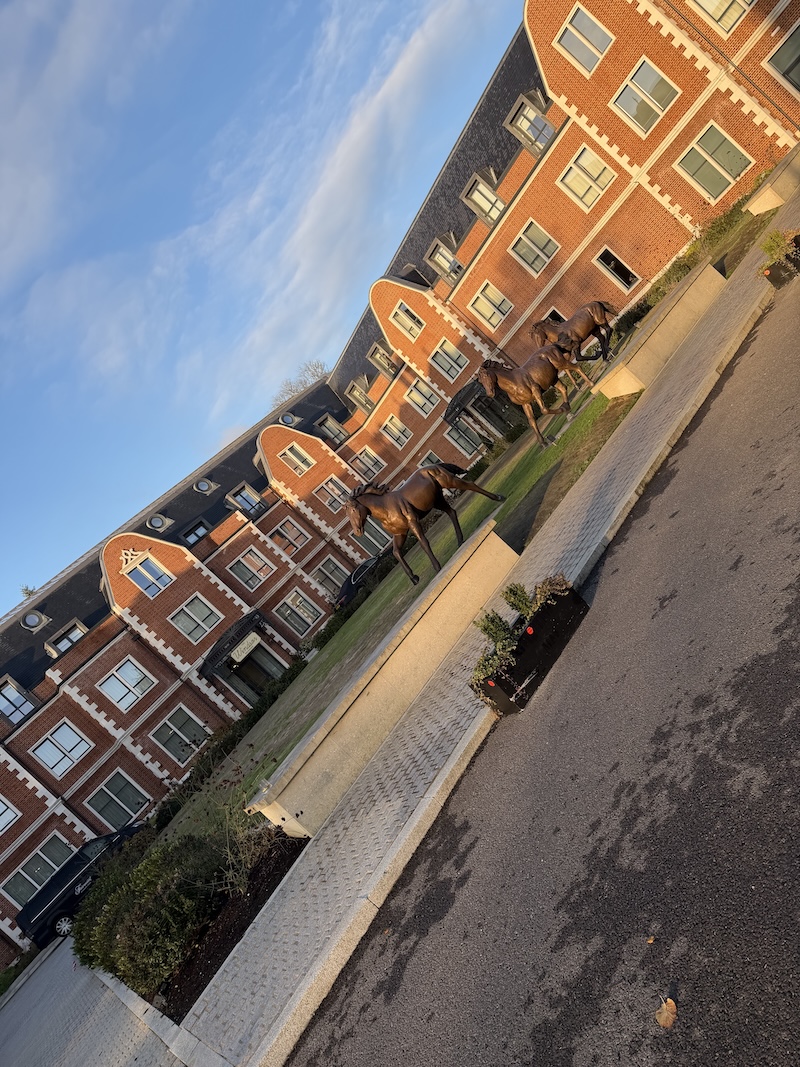
As I arrived at the Fairmont Windsor Park hotel, an extraordinarily grand establishment surrounded by some 40 acres of landscaped grounds and woodland in Surrey, I saw what appeared to be an eagle flying among the trees.
It seemed an appropriately majestic sight given the surroundings and the occasion – the UK media launch of Chinese electric vehicle manufacturer XPeng, a company whose ambitions increasingly extend beyond the automotive industry.
A couple of hours later, while driving one of the company’s new cars along the country roads around Ascot, I saw another eagle, maybe the same one, this time accompanied by three others.
More about the birds later. But the experience of driving XPeng’s new car – the reason we were invited to the event, not for birdwatching – brought to mind something Jeremy Clarkson once said about cars.
I can find no record of it on Google, but I vaguely remember Clarkson being somewhere in Asia – possibly Myanmar – filming one of his many adventures for Top Gear. the long-running car review show, originally developed and broadcast by the BBC.
As the camera showed cars driving around a city, Clarkson said, in his distinctive speaking style: “In Asia, Toyota is king. But Mercedes… (trademark pause)… is a deity.”
Or words to that effect.
It was a remarkably succinct way of describing the difference between commercial success and prestige, and perhaps something of the challenge facing the relatively young automotive companies emerging from China.
Now, I cannot promise quotes as memorable as Clarkson’s in this article, nor can I claim anything approaching his expertise in automotive journalism. But I will do my best to tell you what I learnt during my visit to XPeng’s event – and why a company that makes electric cars is becoming increasingly interesting to Robotics & Automation News.
In the eye of the beholder
Toyota is one of the largest automotive manufacturers in the world, selling cars in enormous numbers across virtually every continent.
Mercedes-Benz, meanwhile, remains one of the most prestigious names in motoring, despite tracing its automotive heritage all the way back to Karl Benz’s Patent-Motorwagen of 1886, widely regarded as the first practical automobile powered by an internal combustion engine.
For a company to remain so highly regarded after such a long time deserves considerable respect, if not awe.
What enables an automotive company to establish such a reputation and maintain it across generations?
Clarkson has, on various occasions, extolled the virtues of Mercedes engineering, particularly the company’s historical tendency to over-engineer things, including components that owners would probably never see. He also described Ferrari as a “scaled down version of God”.
There is something reassuring about the idea that a manufacturer has devoted considerable thought and effort to designing and making something you may never even know is there.
And then there is BMW, a company whose cars I have always liked, although I have not always thought them particularly beautiful in the conventional sense of the word.
They have often looked rather serious, powerful and purposeful. But beauty in automotive design is a subjective matter, and the experience of driving a car can transform your perception of its appearance.
Italian manufacturers such as Ferrari occupy another category altogether, combining engineering excellence with a design aesthetic that has become almost inseparable from their national identity.
For a relatively new automotive manufacturer, competing with companies that have spent decades establishing these reputations presents an interesting challenge.
Good looks alone will probably not be enough. Neither, necessarily, will technological sophistication.
At its UK launch, XPeng executives made it clear to me that they want to establish the company as a premium brand, with the quality of the ownership experience extending from the initial purchase through to servicing and aftersales support.
But, ultimately, the reputation of an automotive company is likely to depend to a considerable extent on something rather more fundamental.
Engineering, old chap – it’s all about the engineering
While I have never reviewed a car before, I passed my UK driving test when I was 18 years old and am now approaching 58.
That amounts to almost 40 years of driving, beginning with my father’s Datsun 120Y, followed by a succession of my own cars, including BMWs and Mercedes, and numerous other cars and vans.
I have driven across Europe, from Britain to Germany and back, and spent more hours behind steering wheels than I would care to calculate.
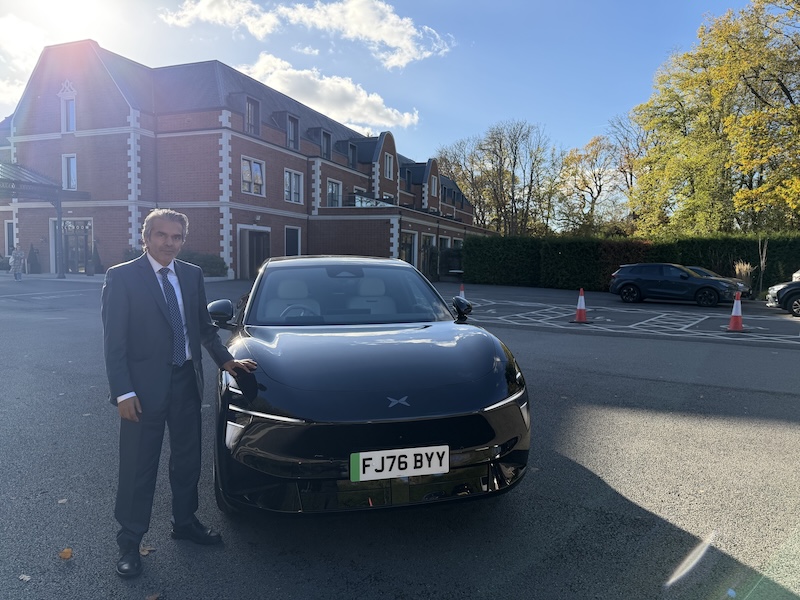
And I have to say that the XPeng L03 that I was invited to drive through the countryside around Egham, in Surrey, past many famous landmarks and places including the Ascot horse-racing course, was the best car I have ever driven.
It had the responsiveness of a BMW, particularly over the first 10 or 20 metres of acceleration – something a footballer might describe as explosiveness.
From a standing start, or while travelling relatively slowly, the slightest encouragement from your right foot seems sufficient to make the car leap forward like a cat.
But it also had something of the smoothness of a Mercedes, a quality that makes driving as much about comfort and relaxation as getting from one place to another.
Neither comparison is intended as a technically rigorous assessment of the respective vehicles. These are simply the associations that came to mind as I drove.
What impressed me most was the combination of readily available power and the understated manner in which it was delivered. The car was strong and smooth.
There was no roaring engine announcing my intentions to everyone within several hundred metres. There was very little drama at all.
Driving along those winding country roads felt almost like flying on wings of silk.
I had expected an electric car to be virtually silent, which it was not, of course. There was still the sound of tyres on the road and the movement of air around the vehicle. But the relative quietness added considerably to the experience.
Traditional petrolheads might disagree. For some, the sound of a powerful internal combustion engine is an essential part of the enjoyment of motoring.
Personally, I prefer tranquillity.
The interior was similarly understated. Much of the conventional dashboard instrumentation has been replaced by digital displays, and the overall impression was one of simplicity.
I particularly liked the head-up display, which projected my speed and other information into my field of vision through the windscreen.
Being able to see how fast I was travelling without taking my eyes off the road seemed an entirely sensible application of technology.
I was slightly less enthusiastic about the repeated warning tones whenever I appeared to stray over the speed limit by even a small amount, although I suppose that was rather the point.
XPeng has announced a starting UK price of £32,990 for the L03, with customer deliveries expected to begin in January 2027. Although it’s well beyond my own budget, that sounds like a reasonable price for such a technology advanced and refined car.
The company is offering several configurations, including rear-wheel-drive and all-wheel-drive versions. Its fully electric models offer a claimed range of up to 323 miles, while a range-extended version, incorporating a petrol-powered electricity generator, increases the claimed total range to 631 miles.
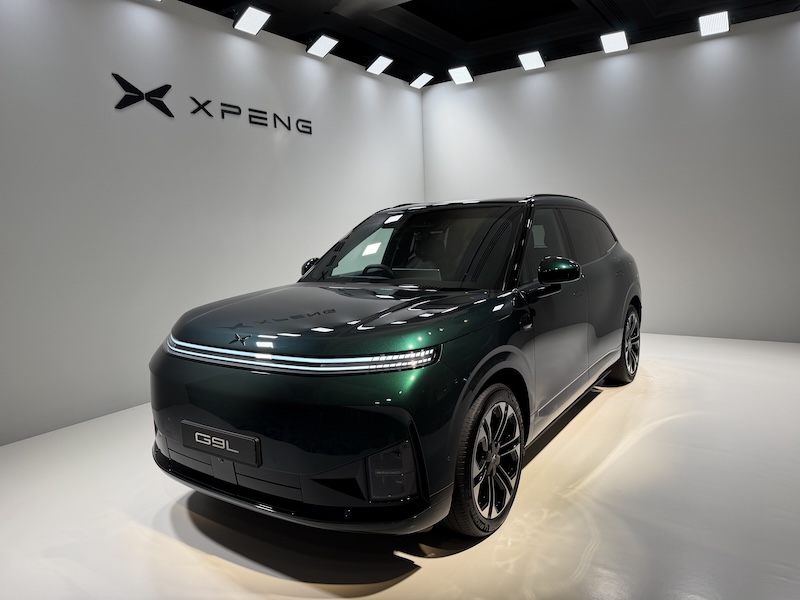
Also presented at the event was the considerably larger G9L, XPeng’s flagship sports utility vehicle, which starts at £64,990.
It would appear that XPeng is trying to make many of the characteristics associated with premium motoring available at a range of price points, rather than confining them to its most expensive vehicles.
And a growing number of those characteristics have relatively little to do with conventional automotive engineering alone.
Is autonomous driving the way forward?
One of the first things I noticed when I got into the XPeng was the absence of a conventional handbrake.
“No handbrake?” I asked the representative from XPeng who had handed me the keys.
“No,” he said. “It’s automatic handbrake. You don’t have to think about it.”
I could hardly believe it. And I am still thinking about it.
The humble handbrake has been part of my experience of driving for almost four decades. Applying and releasing it has become something I do without consciously thinking about it.
Now, apparently, I really do not have to think about it.
Electronic parking brakes are, apparently, nothing particularly new. But for someone who has not spent much time driving the latest generation of cars, it was a small illustration of how much automotive technology has changed.
There were other unfamiliar sensations.
On a couple of occasions, when encountering imperfections in the road surface, I felt what appeared to be the car intervening slightly in my steering.
Whether that was attributable to a particular driver assistance function or simply the behaviour of the steering and suspension system, I could not establish during my relatively short drive.
But it reminded me that I was driving a vehicle equipped with technologies designed to perceive its surroundings and, under certain circumstances, influence its own behaviour.
I did not deliberately try any of the more advanced automated driving functions, partly because I was unfamiliar with their operation and partly because I am rather old-fashioned in this respect.
I like driving
I think I have used cruise control on a motorway only once in 40 years, just to see what it was like. After about five minutes, I took back control.
That is not to say that I fail to appreciate the extraordinary engineering involved in developing autonomous driving technology, or the potential benefits it offers.
Automatic emergency braking, for example, seems an entirely worthwhile technology. Thankfully, I have never knowingly been in a situation where such a system has had to intervene.
XPeng’s wider driver assistance technology encompasses functions such as adaptive cruise control, lane assistance, collision avoidance and automated parking, although availability varies according to vehicle, specification and market.
The company is also planning to introduce its Next Generation Pilot (NGP) intelligent driving system in the UK in 2027, subject to regulatory approval and market readiness.
Powered by XPeng’s vision-language-action technology, the system is intended to help drivers navigate more complex road environments than conventional driver assistance systems can typically accommodate.
The distinction between driver assistance and autonomous driving, however, is an important one.
SAE International, the engineering standards organisation, defines six levels of driving automation.
| Level | Degree of automation |
|---|---|
| 0 – No driving automation | The driver performs the driving task, although warning systems and momentary safety interventions may be present. |
| 1 – Driver assistance | The system provides sustained assistance with either steering or acceleration and braking. |
| 2 – Partial automation | The system can assist with both steering and acceleration and braking simultaneously, but the driver must remain attentive and responsible. |
| 3 – Conditional automation | The system performs the driving task under defined conditions, but a person must be available to respond to a request to take over. |
| 4 – High automation | The vehicle can operate without human intervention within its defined operating conditions. |
| 5 – Full automation | The vehicle can perform the driving task under all road conditions in which a human driver could operate. |
Perhaps, as I get older, I will find myself increasingly willing to allow a car to drive me around. But for the time being, I still prefer to do all the driving myself.
Ironically, one of the most enjoyable aspects of driving the XPeng was not the prospect of the car taking over from me, but how pleasant it made the experience of being in control – the steering, the accelerator and brake pedals were all perfectly attuned to how I wanted to use them.
From smart vehicles to physical AI
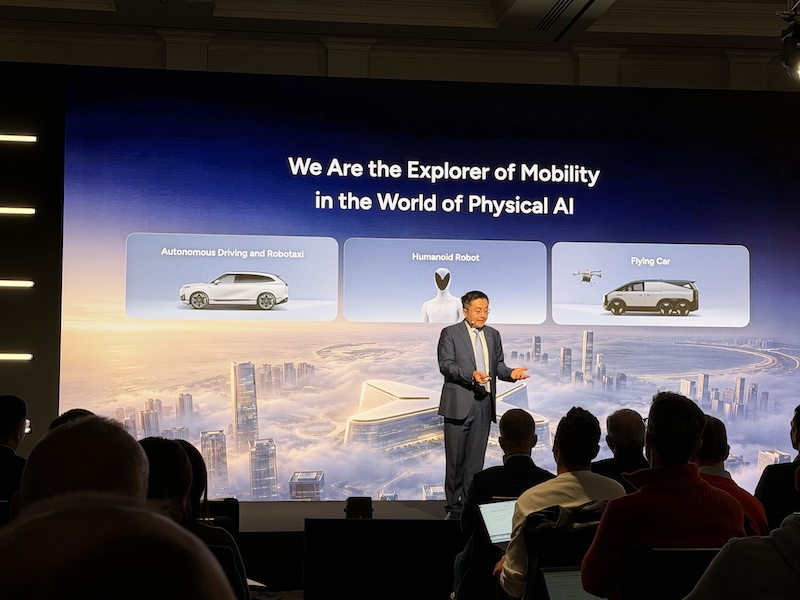
After the drive and lunch, Dr Brian Gu, vice chairman and president of XPeng, took to the stage to outline the company’s wider strategic direction.
One of the ideas underpinning his presentation was that an intelligent vehicle can be regarded as a “robot on wheels”.
It is a description that might be familiar to many readers of Robotics & Automation News, although its implications for the automotive industry are perhaps only now becoming fully apparent.
Gu emphasised that artificial intelligence needs to have an impact on the real world, rather than existing solely within the digital environments with which most people have come to associate it.
One of the presentation slides described XPeng as the “Explorer of Mobility in the World of Physical AI”.
Underneath were three illustrations representing autonomous driving and robotaxis, humanoid robots and flying cars.
All three types of machine were effectively presented as parts of the same technological endeavour.
Gu discussed three particularly important ingredients in the development of intelligent machines – AI models, computing power and data.
XPeng has been developing its own computing hardware, including its Turing AI processor, alongside the software and AI models needed to translate information about the physical world into actions.
Impressively enough, the Turing AI processor is an automotive-grade AI processor developed by XPeng to run large AI models on-device across vehicles, robots, and flying vehicles.
A single chip delivers up to 750 TOPS – trillions of operations per second – of computing power, features a 40-core processor and dual self-developed neural network processing units (NPUs), and supports large AI models up to 30 billion parameters.
In the case of a car, those aforementioned actions might involve steering, accelerating or braking in response to information gathered by cameras and other sensors.
For a humanoid robot, they could involve moving an arm, picking up an object or walking through an unfamiliar environment.
For a flying vehicle, the calculation becomes more complicated still, although the broad principles of perception, decision-making and physical control remain relevant.
XPeng has also been placing considerable emphasis on its camera-based approach to intelligent driving, moving towards increasingly sophisticated visual perception rather than relying on lidar as an essential component.
There are different schools of thought within the autonomous vehicle industry regarding the relative merits of cameras, lidar, radar and combinations of sensing technologies.
But XPeng’s approach illustrates the growing importance of the AI systems interpreting sensor information, as well as the sensors themselves.
The company wants to apply its accumulated expertise in these areas to machines of various shapes and sizes.
And standing in the reception area outside the conference room was a particularly striking example of that ambition.
The humanoid in the room
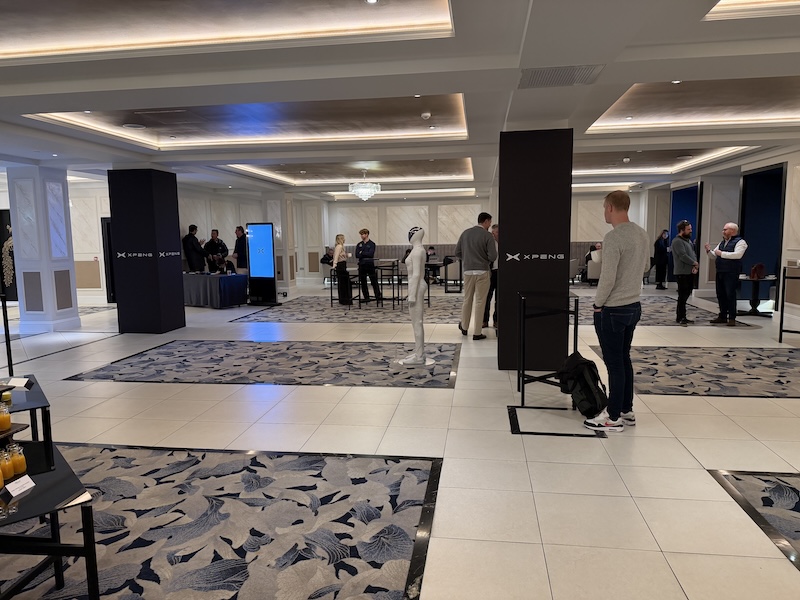
Unusually, XPeng’s Iron humanoid robot did not appear to be attracting a great deal of attention from the journalists attending the event.
It stood on a small circular platform in the middle of the reception area, where people were talking, drinking coffee and generally going about their business.
Perhaps that is a glimpse of the future – humanoid robots becoming so commonplace that nobody pays them much attention.
Although, in this instance, I suspect it had rather more to do with most of the guests being automotive journalists.
As a robotics journalist, I naturally found myself spending quite a bit of time with Iron.
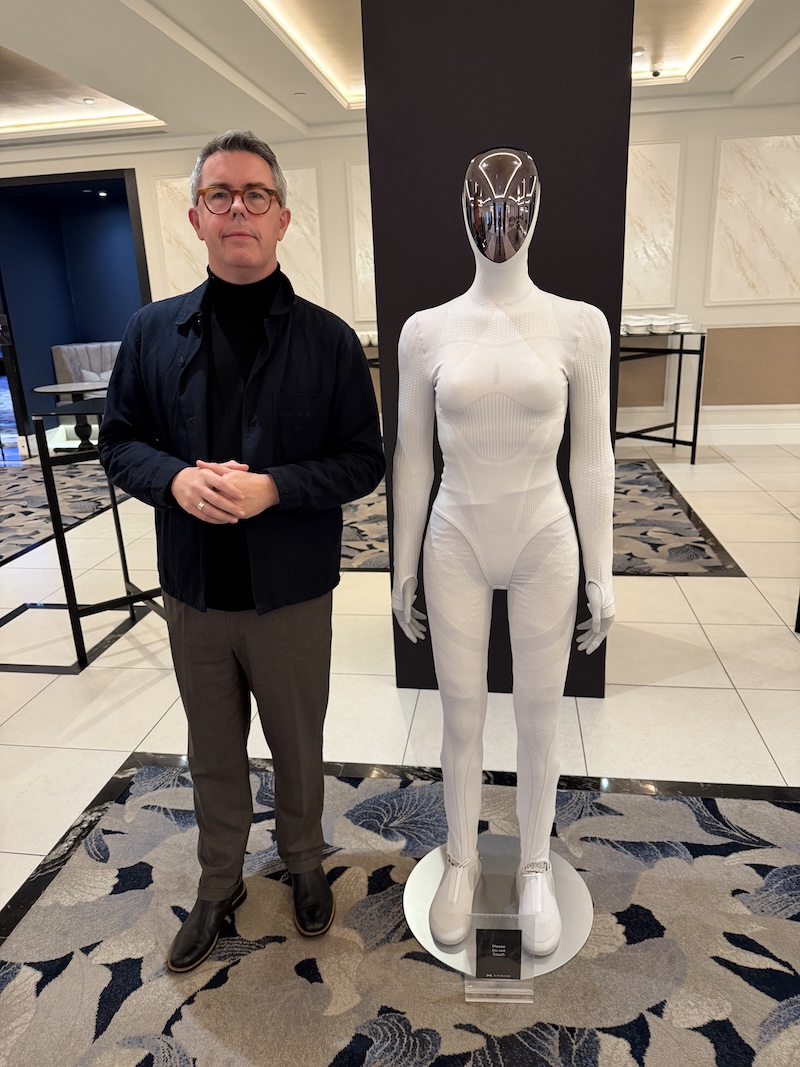
The robot has a highly anthropomorphic appearance, with a reflective, featureless face and a white, textured exterior covering much of its body.
Its design is unusually smooth and refined for a humanoid robot, many of which still have the appearance of relatively conventional industrial machinery arranged in human form.
There appeared to be something of a common design language connecting XPeng’s cars and its humanoid.
Unfortunately, Iron remained stationary throughout my visit, so I was unable to assess its practical capabilities.
The specifications provided by XPeng, however, suggest that the company has ambitions for it that extend considerably beyond standing in automotive showrooms.
Approximately 170 cm tall, Iron has 76 degrees of freedom across its body and 21 in each hand, according to the company.
Its computing system incorporates three XPeng Turing AI chips, providing a combined processing capacity of up to 2,250 TOPS, which is enough processing power to have beaten all the world’s supercomputers as recently as 2010.
XPeng says the robot can run its physical AI foundation model locally, enabling it to perform tasks autonomously without being remotely controlled by a human operator. It’s a scary thought, quite frankly, because this is just the beginning for these things. They’re still in amoeba stage of their evolutionary development – primitive, if you will. If they start packing modern supercomputing levels of processing power, along with advanced sensors and motor skills, what will they be capable of? Maybe the question should be: what will they not be capable of?
The company says its latest generation of Iron emerged from a newly commissioned production line in September 2026, following eight years of research and development.
Its robotics business also secured more than $900 million in equity financing in August, at a valuation exceeding $6.3 billion following the investment.
Those are substantial sums of money, even in the context of the extraordinary levels of investment currently being directed towards humanoid robotics.
And XPeng is by no means the only automotive manufacturer taking an interest in the technology.
Tesla has its Optimus humanoid robot, while Hyundai Motor Group’s ownership of Boston Dynamics gives it access to some of the most advanced robotics engineering in the world.
Perhaps the ultimate vision is that one day XPeng’s Iron robots will be working in XPeng factories, making ever more sophisticated XPeng cars with increasingly little human intervention. And, of course, they’ll no doubt be procreating by then, sort of.
Whether such visions are realised or not, there are some compelling technological and commercial reasons for an automotive company to enter the robotics industry.
Explaining XPeng’s approach to robotics and AI
Standing next to Iron, I spoke to Sven De Smet, head of brand and marketing for XPeng in Europe, about the company’s ambitions in robotics and physical AI.
De Smet was quick to point out that he was not a robotics specialist, although representing the company increasingly means communicating its activities across several different areas of technology.
What I particularly wanted to understand was whether XPeng regarded robotics as a relatively independent business or a natural extension of the work it had already been doing in intelligent vehicles.
His explanation suggested it was very much the latter.
The company’s existing technology stack, encompassing AI models, computing hardware and data, provides a foundation from which it can develop intelligent vehicles, robotaxis, flying vehicles and humanoid robots.
De Smet says: “The computing happens on the device itself.”
The significance of local, or on-device, computing is particularly apparent when considering machines that need to interact with the physical world.
A humanoid robot attempting to maintain its balance or manipulate an object cannot necessarily afford to wait for information to be transmitted to a distant computing facility, processed and transmitted back.
The same applies to autonomous vehicles making decisions in rapidly changing road environments.
Processing information locally can reduce latency and dependence on communications infrastructure, although developing and training the AI models that operate these machines may still require substantial external computing resources.
But one of the most interesting points De Smet made concerned something rather more traditional than artificial intelligence: manufacturing.
Automotive companies have decades of collective experience in establishing supply chains, operating factories and producing highly complex machines to consistent standards.
For a robotics start-up, acquiring that expertise and infrastructure can be an enormous undertaking.
A company that already manufactures sophisticated vehicles has a considerable body of knowledge on which to draw.
De Smet highlighted the difficulty that younger companies can encounter when moving from developing prototypes to establishing large-scale manufacturing operations, particularly given the investment required.
XPeng believes the manufacturing expertise accumulated through its automotive activities can help it overcome some of those challenges in robotics.
The transfer of knowledge could ultimately operate in both directions. Advances in robotics might improve the manufacturing of cars, while developments in automotive manufacturing could help improve the quality, reliability and affordability of robots.
De Smet also recounted how, when an Iron humanoid emerged from the company’s production facility, it was presented with an employee badge.
De Smet says: “And it’s more than symbolic because our vision is that a humanoid robot like Iron can become your companion, your colleague.”
He acknowledged that robots would require further training to understand unfamiliar situations and perform new tasks.
And that remains one of the biggest challenges facing the humanoid robotics industry.
Building a machine that resembles and moves somewhat like a human being is an impressive engineering achievement. Building one that can perform even a fraction of the physical tasks a human being can easily complete is another matter entirely.
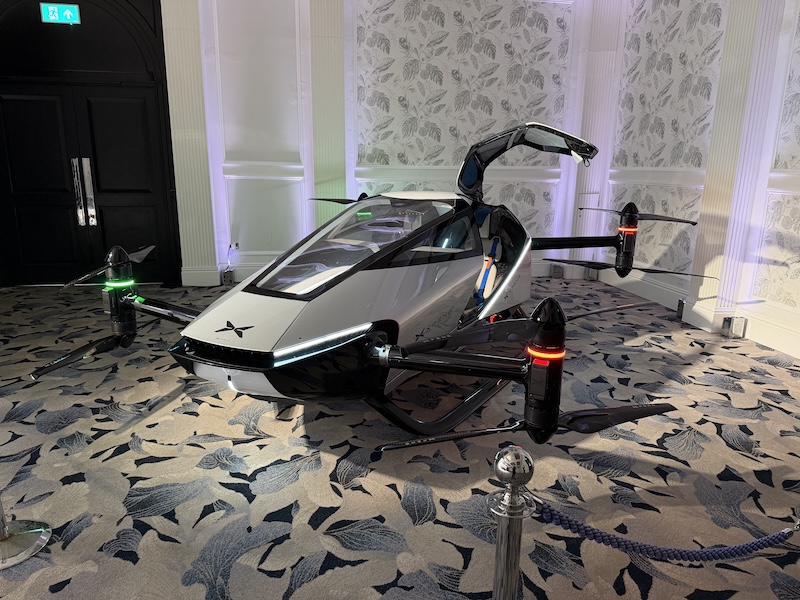
XPeng also brought one of its experimental flying vehicles to the Surrey event.
With its compact passenger cabin, upward-opening door and electrically powered rotors, the aircraft looked rather like a cross between a futuristic sports car and a substantially enlarged drone.
Placed alongside the cars and the humanoid, it provided another physical illustration of what XPeng is trying to achieve.
The company is effectively exploring how far a common foundation of intelligent technology can take it, while adapting the hardware and engineering to the requirements of each machine.
Bird brain
The Fairmont Windsor Park hotel is situated in the sort of surroundings that might provide the backdrop for a James Bond film.
Indeed, approaching it through the extensive grounds, having passed through a security checkpoint at the entrance, I thought it looked rather like the lair of a particularly successful Bond villain.
The building itself is beautiful, and the grounds include a lake, landscaped gardens and enough trees to make you almost forget how close you are to Heathrow Airport and London.
And, as I mentioned earlier, there were the birds.
I thought they were eagles, although it is entirely possible they were red kites or another species of bird of prey. I’m not an ornithologist or even a birdwatcher really. But I definitely saw a road runner bird, and it run off exactly like the one in the cartoons, with a little jump and scurrying feet at the start. Probably a common sight in Surrey, which is mostly rural countryside.
But some people might not believe I saw eagles at all. Apparently there are no eagles in Britain.
There definitely are. I’ve seen them. Although establishing whether any of them were flying around my XPeng on that particular day is another matter.
And to stretch the metaphor a bit more, it seems to me that XPeng wants to fly among the eagles, metaphorically speaking. It wants to reach the highest high.
The company is operating in an increasingly competitive automotive market, particularly among the many technologically sophisticated manufacturers emerging from China.
The challenge for these companies is not simply to manufacture vehicles more affordably, but to establish their own distinctive identities and reputations for engineering and design excellence.
The importance of originality in automotive design was highlighted recently by a legal dispute involving Chinese manufacturer BYD and Jaguar Land Rover.
A court in the Netherlands issued a preliminary ruling restricting European Union sales of a BYD vehicle over its resemblance to the Land Rover Defender. BYD disputes the ruling and says its vehicle was independently designed.
But BYD itself is also a good example of the considerable engineering innovation taking place within the Chinese automotive industry.
The company’s eight-in-one electric powertrain integrates eight major components, encompassing functions associated with propulsion, charging and electrical control, into a single integrated system.
Rather than simply adding more components to a machine, there is something particularly interesting about engineering that combines several components into one, reducing the amount of space required and potentially improving manufacturing efficiency.
Nature has been doing something similar for rather longer than the automotive industry.
Research into avian intelligence has shown that some birds possess remarkably high concentrations of neurons in their relatively small brains, with certain species having forebrain neuron counts comparable to those of some primates. In other words, a bird’s brain contains about as many neurons as the brain of a monkey, despite being approximately a tenth of the size.
Miniaturisation has always been a thing, both in nature and in technology, and greater intelligence and capability do not necessarily require a larger or more physically complicated machine. Sometimes they require a better arrangement of what is already there.
The integration of intelligence, computing and physical hardware is central to XPeng’s ambitions, and the company is exploring how that integration might produce machines capable of travelling along roads, flying through the air or walking around the rooms in which we live and work.
It is an ambitious undertaking, and there is still a considerable distance between the capabilities of today’s intelligent machines and some of the visions presented by companies developing them.
XPeng intends to provide further details of its progress at its annual AI Day in Guangzhou, China, on November 25, when it will showcase its latest developments in humanoid robotics, autonomous driving and flying vehicles.
For the moment, however, judging by my admittedly limited experience of driving one of its cars through the Surrey countryside, XPeng already appears to have a rather good understanding of something that has occupied automotive engineers for more than a century: how to make a car that someone simply enjoys driving.
And, however intelligent cars eventually become, I hope that is something the automotive industry never loses sight of.
