
Inbound components arrive in the morning, finished goods leave by less-than-truckload (LTL) and truckload in the afternoon, and every late pallet needs someone to call the carrier, check the production schedule, and approve an expedite.
Managed transportation providers take on that daily work by pairing a transportation management system (TMS) with a team that runs it under agreed rules.
The timing matters. Cass Information Systems reported that its Truckload Linehaul Index rose 10.1% year over year in September 2026, while higher volumes, rates, and fuel surcharges lifted total freight expenditures 20.4%.
The index excludes fuel and accessorials and blends spot and contract rates, so it reflects the market rather than any single shipper’s bill.
Key takeaways
- Managed transportation pairs a TMS with a provider team that executes freight and owns exceptions under agreed rules.
- The seven providers below differ most on carrier strategy, technology, and how much execution they take on.
- A one-plant pilot measured against an agreed baseline is the safest way to test any program.
How these providers were selected
Each provider offers managed transportation alongside its own TMS and publicly describes how it handles execution, carrier sourcing, and reporting.
Details come from each company’s published materials as of October 2026. Programs are custom-built, so confirm scope, pricing, and integrations directly.
This list is not a ranking by size; Transport Topics publishes an annual revenue ranking of the largest North American freight brokerage firms for that.
What a managed transportation program covers
Managed transportation sits between buying software and handing freight to a broker. Uber Freight describes it as outsourcing in which a specialized third party plans, executes, and optimizes a shipper’s transportation.
Infios, a TMS vendor, lists the services such programs commonly include: procurement, rate management, shipment execution, freight optimization, freight audit and payment, and reporting and analytics.
A broker, by contrast, arranges capacity one load at a time.
The contract matters more than the software. Consider an inbound shipment of machined brackets due at the plant on Thursday.
On Wednesday evening, the carrier’s status message still shows them at origin. In a managed program, that alert goes to a named provider contact who checks with the plant scheduler, requests an expedite within agreed spending limits, and records the decision against the purchase order.
Under a software-only arrangement, the plant’s own team makes those calls.
How much of that work moves to the provider is the main difference among the companies below.
The providers
1. TLI
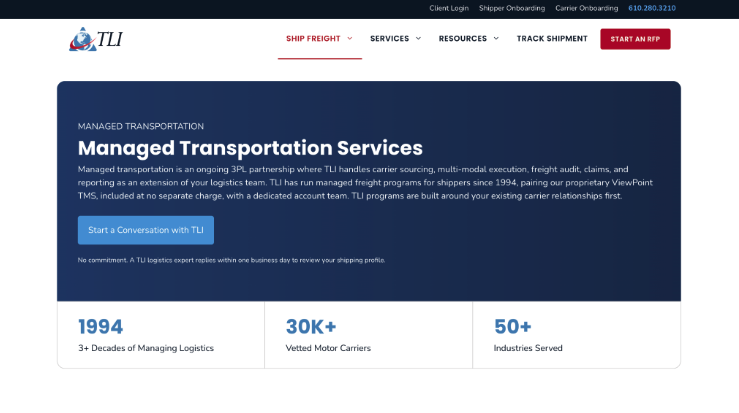
TLI has managed LTL, truckload, expedited, and multimodal freight programs for more than 30 years, with freight audit and claims management built in.
It reports that its most recent transportation RFP results came in 18.2% better than generic carrier blanket rates and 28.15% lower than carrier-direct pricing.
Its proprietary diesel table keeps fuel from becoming a carrier profit center, and clients stay an average of more than 10.5 years. It holds a 4.9-star rating across 440+ Google reviews.
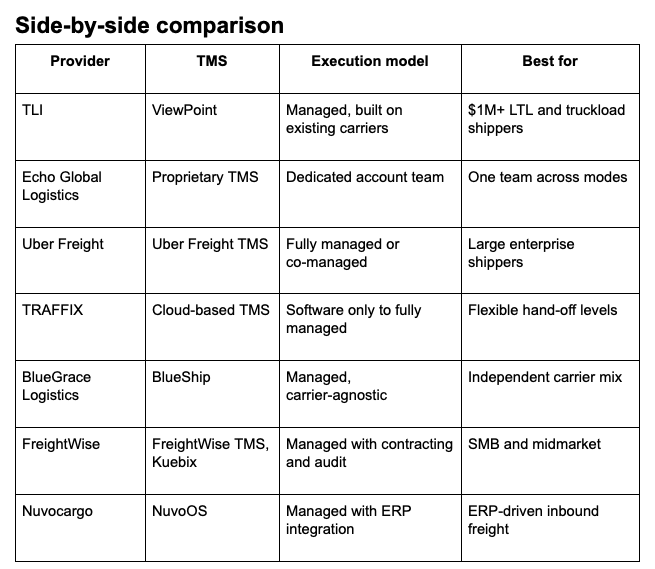
Technology: ViewPoint TMS, included at no separate charge, backed by a 30,000+ carrier network.
Best for: Manufacturers and distributors shipping $1 million or more a year in LTL or truckload freight that want to keep qualified carriers.
2. Echo Global Logistics

Echo pairs its transportation technology with a dedicated account team that handles carrier negotiations, helps navigate shipping, and supplies data to optimize processes.
It also runs one of the largest brokerage operations in North America, ranking fifth in Transport Topics’ 2025 freight brokerage list with $3.7 billion in gross revenue.
Technology: Echo’s proprietary TMS.
Best for: Shippers that want one account team handling carrier negotiations and day-to-day shipping across modes.
3. Uber Freight
Uber Freight combines enterprise logistics software with managed transportation services, a business it expanded after acquiring Transplace in 2021.
Its own guide names the core components of a managed offering as planning and optimization, carrier relationship management, shipment execution, and analytics. Transport Topics ranked it 10th in its 2025 freight brokerage list.
Technology: Uber Freight TMS and analytics.
Best for: Large shippers that want enterprise software with either fully managed or co-managed execution.
4. TRAFFIX

TRAFFIX offers three versions of its Managed Transportation Solutions: a fully managed program on TRAFFIX capacity, a managed program blending the shipper’s carriers with TRAFFIX capacity, and a software-only option in which the shipper’s team executes shipments. It ranked 21st in Transport Topics’ 2025 freight brokerage list.
Technology: Cloud-based TMS used for all in-scope modes.
Best for: Shippers that want to choose how much execution to hand over, from software only to fully managed.
5. BlueGrace Logistics
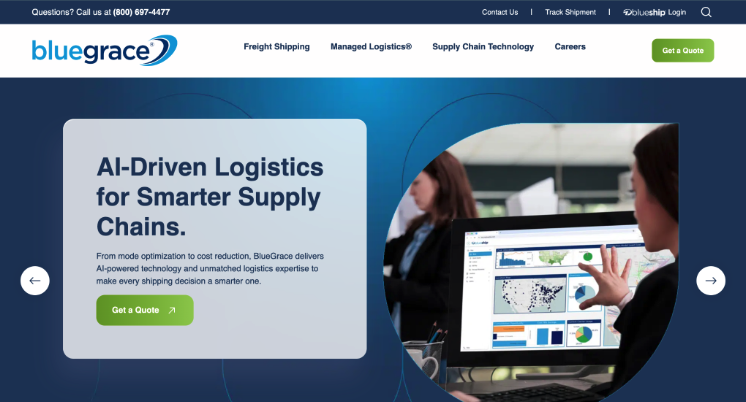
BlueGrace’s Managed Logistics model combines procurement, execution, and optimization, with an account team overseeing daily transportation.
Services include carrier procurement, freight pay and audit, and business intelligence across parcel, LTL, and truckload, delivered through what the company calls carrier-agnostic execution.
Technology: BlueShip TMS, available standalone or integrated.
Best for: Shippers that want managed execution with an independent carrier mix and cost-driver analytics.
6. FreightWise
FreightWise provides managed transportation with multimodal carrier contracting, freight audit and payment, and supply chain consulting, and reports more than $1 billion in annual freight under management. In June 2026 it launched FreightWise Intelligence, a data visualization and BI reporting tool inside its TMS.
Technology: FreightWise TMS and Kuebix by FreightWise, the latter built for SMB and midmarket shippers across truckload, LTL, and parcel.
Best for: Small and midmarket manufacturers that want a managed program on a multimodal TMS.
7. Nuvocargo

Nuvocargo serves U.S. manufacturers across multiple industries and includes ERP integration in standard onboarding. Its integrations pull shipment and delivery-order data from the ERP to trigger tendering and write tracking and delivery confirmations back, typically within two to four weeks.
Its Nuvo AI system can also schedule appointments and handle freight audit and payment.
Technology: NuvoOS platform with Nuvo AI.
Best for: Manufacturers that want inbound freight tied directly to ERP purchase orders.
How to evaluate a managed transportation provider
Separate the software from the service
A TMS compares rates, tenders loads, and tracks shipments. The contract decides who handles a missed pickup, who approves an expedite, and who owns the data after the agreement ends.
Connect orders to freight
Ask which ERP fields transfer into the TMS, which carriers support EDI or API connections, and what happens when a status message fails.
Nuvocargo’s manufacturer guide notes that inbound raw material and component freight is often a larger cost center than outbound finished goods.
The same data discipline already applies inside many plants, where warehouse automation systems sync inventory data with the ERP, and freight records should connect just as cleanly.
Audit the full cost
A freight audit should check each invoice against the contracted rate, freight class, fuel surcharge, and approved accessorials.
For U.S. LTL, NMFC Docket 2025-1 took effect July 19, 2025, moving many commodities to a 13-subprovision density scale that adds classes 50 and 55, so accurate pallet weights and dimensions matter for both rating and audit.
Compare pricing on equal scope
Some providers charge a management fee, while others build margin into per-shipment rates. Ask bidders to separate freight charges, fees, integration work, and optional services such as claims.
Pilot against a baseline
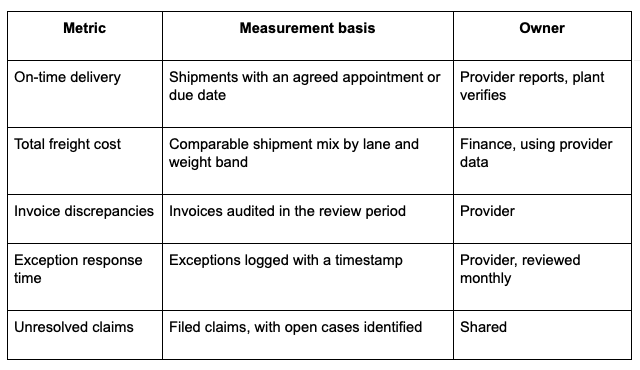
Start with one plant and one mode, and agree on how each metric is measured before launch.
Conclusion
The right managed transportation provider depends less on the size of its network than on how its operating model fits the plant.
Manufacturers that keep long-standing carriers, need tight ERP links, or want to keep some execution in-house will each land on a different shortlist.
Shortlist two or three providers whose operating model matches the plant, ask each for a written scope covering exceptions, audit, and claims, and compare their proposals on the same shipment history.
Then define responsibilities, data ownership, and measurement in writing, run a limited pilot, and expand only when the scorecard shows results both sides accept.
Frequently asked questions
What is managed transportation?
An ongoing arrangement in which a third-party logistics provider plans, executes, and optimizes a shipper’s freight, typically covering procurement, shipment execution, freight audit, and reporting.
How is managed transportation different from buying a TMS?
A TMS is software your own team operates. A managed program adds provider staff who run it, handle exceptions, and audit invoices under agreed rules.
How is it different from a freight broker?
A broker arranges capacity one load at a time. A managed program is a continuing relationship that can include brokerage plus strategy, technology, and reporting.
How long does ERP integration take?
Nuvocargo puts typical ERP integration at two to four weeks. Full program timelines also depend on carrier bids and testing.
Can a manufacturer keep its existing carriers?
Often, yes. Some providers build programs around a shipper’s current carriers, and others offer hybrid models. TRAFFIX, for example, has a managed option that blends the shipper’s carriers with its own capacity.
What changed in LTL freight classification in 2025?
NMFC Docket 2025-1 took effect July 19, 2025, moving many commodities to a 13-subprovision density scale that adds classes 50 and 55.
