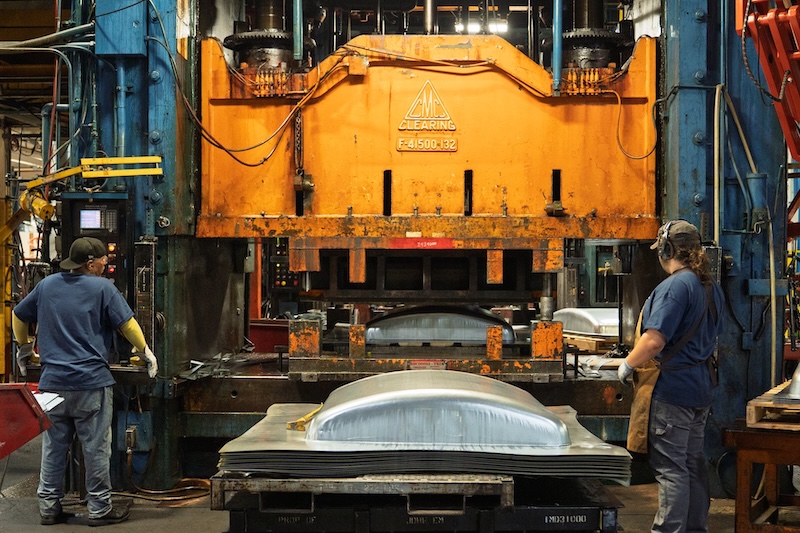
The manufacturing sector continues to undergo rapid technological advancements, driven by the demand for higher precision, faster output, and reduced operational costs.
Among cold forming metal techniques, impact extrusion remains one of the most efficient methods for producing hollow, cylindrical, or complex near net shape parts from aluminum and steel.
By forcing a metal slug into a die with high velocity and extreme pressure, this process creates durable components with superior grain alignment and minimal material scrap.
However, traditional manual handling and static processing methods in metal forming present inherent limitations in throughput, tool wear monitoring, and consistency.
To meet rising quality expectations in critical sectors like defense, medical, automotive, and oil and gas, industrial automation has become an essential upgrade on today’s production floors.
1. Automated Slug Preparation and Material Feeding Systems
High-volume forming starts long before the punch strikes the metal puck. Raw material consistency is critical, as subtle variations in slug dimensions, surface cleanliness, or lubrication can lead to part defects or press jams.
Working with a capable impact extrusion manufacturer allows industrial engineers to leverage advanced automation at the very start of the production cycle.
Automated feeding units utilize vibratory bowl feeders, optical sorting channels, and robotic pick and place arms to transport aluminum and steel slugs into press dies with millisecond accuracy. Key advantages of automated feed systems include:
- Continuous operation without manual loading delays
- Automated surface inspection to filter out scratched or warped slugs
- Precise inline application of liquid or dry lubricants to maintain consistent friction control
- Reduction of ergonomic hazards and operator fatigue around heavy press machinery
Eliminating manual slug loading dramatically reduces cycle times while protecting expensive tooling setups from misalignment errors.
2. In-Line Sensor Monitoring and Real-Time Process Control
Impact forming relies on immense kinetic energy. When a mechanical or hydraulic press strikes a metal slug, forces reach hundreds of tons within a fraction of a second.
Under these intense conditions, minute variations in material hardness or die temperature can result in dimensional deviations or tool fractures.
Automated process control systems integrate piezoelectric load cells, thermal imaging sensors, and optical displacement transducers directly into the press architecture. These sensors measure tonnage profiles on every press stroke.
If the pressure curve strays outside a calibrated tolerance window, the control software halts press operation instantly. This real-time intervention prevents cataclysmic tool failure and ensures that out-of-spec components never move down the line.
Additionally, data logged by these monitoring systems feeds directly into industrial IoT analytics platforms. Production managers can track tool wear patterns over thousands of cycles, shifting maintenance schedules from reactive repairs to predictive maintenance.
3. Robotic Part Transfer for High-Velocity Presses
Once an aluminum filter bowl, accumulator body, or steel weld yoke is formed, rapid and damage-free extraction is essential. Manual removal from deep die cavities is slow, hazardous, and prone to surface marring.
Automated part transfer systems solve this bottleneck by matching the speed of contemporary high-stroke presses. Multi-axis articulating robots equipped with customized vacuum, pneumatic, or magnetic grippers enter the die area immediately after the punch retracts.
These specialized end effectors carefully remove freshly struck parts and place them onto synchronized conveyor systems.
Because aluminum and steel exhibit different thermal and mechanical properties immediately after forming, current transfer robots feature programmable pressure limits to avoid deforming thin-walled aluminum shells while safely handling heavier, hotter steel geometries.
4. Integration of Secondary Operations and Machining Cells
While cold impacting delivers near net shape geometries with exceptional material utilization, many complex industrial components still require secondary features. Threading, cross drilling, knurling, chamfering, and precision grooving are frequently necessary before a part reaches final assembly.
Automation bridges the gap between primary metal forming and secondary machining. Instead of transferring batch totes across facility floors for separate machining steps, automated transfer lines carry parts straight from the press into automated CNC cells.
Integrated secondary workflows deliver distinct operational benefits:
- Seamless transit from forming to precision trimming and washing cells
- Automated vision systems that verify wall thickness and concentricity before machining
- Complete traceability of every component via automated laser marking or matrix coding
- Elimination of intermediate work-in-progress inventory stacking
Unifying forming and finishing into a single continuous stream shortens total lead times from days to minutes.
5. Enhanced Surface Treatment and Automated Finishing
Surface integrity plays a vital role in high performance applications, particularly for components exposed to fluid pressure, aggressive chemicals, or severe environmental stress. Advanced high-volume facilities pair their press lines with automated washing, deburring, and surface finishing equipment.
After exiting the transfer conveyor, extruded parts undergo automated ultrasonic cleaning to strip away residual forming lubricants. Robotic finishing systems then handle precision deburring using controlled abrasive media or thermal energy techniques.
For steel components requiring corrosion resistance or aluminum parts destined for anodizing, automated hoist lines move part carriers through chemical treatment baths with precise dwell time controls. This eliminates human error in chemical exposure and delivers uniform surface quality across entire production runs.
6. Machine Vision Inspection and Quality Assurance
Quality control in high volume metal forming has shifted from batch sampling at the end of a shift to 100 percent inline automated inspection. High-resolution machine vision systems equipped with multi-angle lighting capture detailed images of every part as it moves along the conveyor line.
These vision systems run advanced image recognition algorithms to detect subtle defects that human inspectors might miss during long shifts:
- Micro-cracks and surface burrs near thin-walled regions
- Dimensional non-conformities in wall thickness, height, and diameter
- Imperfections in internal or external surface finishes
- Foreign material contamination or incomplete lubricant removal
Defective parts are automatically identified and diverted to scrap bins by high-speed pneumatic pushers, ensuring zero-defect shipments reach downstream assembly lines.
7. Operational Safety and Energy Efficiency Upgrades
Beyond throughput and part geometry, automation fundamentally transforms safety standards and energy consumption across metal cold forming facilities.
High-tonnage impact presses generate significant noise, vibration, and mechanical force. Replacing direct human press operation with robotic cell tending removes personnel from hazardous press envelopes.
From an energy standpoint, state-of-the-art automated press lines utilize variable frequency drives and regenerative braking technology. When a press ram decelerates, energy is captured and redirected to power auxiliary conveyor systems and automated pickers.
Smart facility software also monitors ambient hydraulic temperatures and electrical loads, optimizing motor speeds during idling intervals to minimize total power usage.
The Broader Impact on Advanced Manufacturing
The integration of smart automation across every stage of the metal forming lifecycle reflects a broader evolution in industrial engineering.
By pairing time-tested cold forming physics with robotics, sensor arrays, and inline quality validation, manufacturers produce aluminum and steel parts that exceed traditional strength and tolerance benchmarks.
As industries demand lighter, stronger, and more cost-effective structural components, the synergy between impact press technology and automated process control will continue to set the benchmark for high-volume metal component production.
