By Daniela Shchegelskaya, an electronics engineer at Elimpus who has spent the last two years working with Boston Dynamics’ Spot for hazard-zone inspections in live power substations
When presenting my robotics work, two questions regularly emerge. Do we really need robots? What will happen to field service engineers?
I can understand why people are concerned, but rest assured: my robotics work centers on keeping engineers safe and outsourcing hazardous tasks to machines.
I want the knowledge that can only be obtained by a human engineer to remain central to the work, and I also want fewer people to have to enter places where they may be seriously harmed.
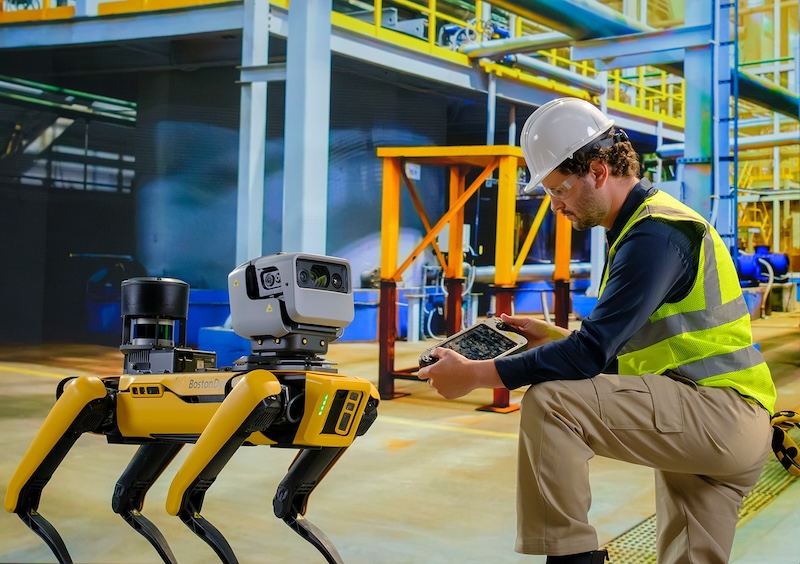
I worked as an electronics engineer at Elimpus, where I tested and adapted Boston Dynamics’ Spot (main picture) for power-substation inspection, including carrying partial-discharge monitoring equipment. It is an ongoing proof-of-concept project.
Our goal was to adapt a robot to collect information from hazardous areas, reducing engineers’ exposure to dangerous conditions and having inspections be carried out remotely and more quickly.
An inspection is more than a visit
At a substation, the engineer’s task is gathering evidence about the condition of equipment and deciding whether something needs attention. In my ideal world, a robot can gather some of that evidence and ensure that a human remains far from hazardous conditions.
It is not necessary or even likely that a robot take over every part of that inspection. It may carry an instrument to a location or provide a more detailed view of equipment. Then, the engineer can review the information and decide what further investigation may be needed.
Some tasks still require an engineer on site. For example, diagnostic equipment may need to be calibrated manually at the inspection location, which the robot in our current setup cannot do. Sending the robot to collect readings therefore does not remove every reason for an engineer to attend.
This is how I think about the division of work. A trained engineer should be able to use their expertise without every observation requiring them to stand beside the equipment. But we need to preserve the information they would normally use to make sense of what they find. Moving the person away from the hazard also moves them away from some of the context.
A real signal can lead to the wrong conclusion
In one of my projects, vibration prompted engineers to investigate a possible problem on site. When they went to investigate, they found that nearby roadworks were the source.
The measurement was accurate, although it was difficult to understand just from the remote data. The raw information that vibrations had increased did not explain what the cause was.
As was the case in this situation, an accurate reading does not mean an engineer will instantly understand. Collecting more readings may help to provide additional context, but sometimes a physical investigation is necessary to truly understand the situation.
A robot can bring evidence to an engineer, but it cannot guarantee that said evidence will be sufficient. It would be misleading to suggest that every unusual signal can already be resolved remotely.
When implementing remote data collections, it is important to be able to recognise when the available evidence supports a decision, and when it leaves unanswered questions. That incident required people to investigate.
What the person on site normally knows
It is difficult to translate the instincts of an experienced engineer into directions for a robot. Remote observation requires thought, even with views around the robot and a pan-tilt-zoom camera.
The operator may need to change the angle, return to an area or gather another type of reading. Some of the problems we want to investigate require specialist monitoring equipment, so an image alone will not answer every question.
We should therefore be clear about what an inspection has actually covered. If the robot cannot reach an area, or the information is incomplete, the engineer needs to know that.
An interrupted inspection leaves a gap in the evidence. It should not be treated as reassurance about the condition of equipment the robot has not properly examined.
These are questions I believe should guide the work: what has the engineer been able to establish from a distance, and what remains uncertain? The answers matter more than whether the robot has completed an impressive-looking walk around the site.
The handover back to people
Of course, there are practical limits like interrupted communications and limited battery life. But human intervention may also be needed while the robot is still moving. During testing, an obstacle blocked its route to a destination. It began taking a longer route around the obstacle, towards an area where sensitive construction work was taking place.
I had to override it manually. It had found another solution to move through the site, although it was unsuitable under the circumstances. As the operator, I needed to judge where it should go and when to intervene.
We need to decide when an operator should intervene and how a robot can be safely recovered before an inspection begins. If its findings necessitate closer examination, those human investigators need a safe way to investigate.
With remote data collection, the goal is to reduce human exposure across the whole task, including when the inspection does not go as expected.
Sometimes an engineer will have to visit. Sometimes the information may allow them to narrow the investigation before they do. I see both as part of the same effort to use people’s time and expertise where they are needed, while avoiding unnecessary exposure to danger.
That is also why I am cautious about framing inspection robots mainly as a way to replace workers. The person interpreting the findings remains essential. They know what a reading might mean, what else needs checking and when the available information is not enough to act on.
The outcome I want to see
My work on the project involved testing where the robot could help and where people still needed to intervene. The potential benefits should not be confused with results already achieved.
For me, the strongest reason to continue is the possibility of giving engineers useful information without asking them to enter a dangerous place to collect it.
Success would mean fewer necessary entries into hazardous areas, with enough evidence for people to make sound decisions about the equipment they are responsible for.
I am passionate about robotics and wanting robots to take the work currently exposing humans to danger. With remote inspections, engineers still keep the judgements meaningful.
Creating a safer working environment that still ultimately centers skilled humans is what makes this technology worth pursuing.

About the author: Daniela Shchegelskaya is an electronics and robotics engineer at Elimpus, specialising in autonomous systems for industrial and safety-critical environments. Over the past two years, she has worked with Boston Dynamics’ Spot for hazard-zone inspections in live power substations, with a focus on autonomous navigation, control systems and making robots reliable in real-world operating conditions.
