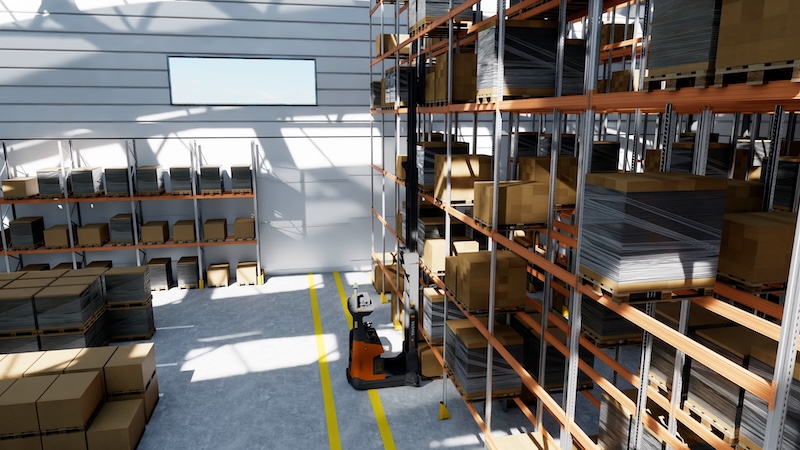
Toyota Material Handling Europe is using Nvidia simulation and digital twin technologies to accelerate the development and commissioning of autonomous forklifts, with the company targeting a reduction of up to 50 percent in commissioning effort.
The material handling equipment manufacturer is working with Nvidia and technology services company SoftServe on a simulation-first approach that allows autonomous vehicle systems to be tested and validated virtually before they are introduced at customer sites.
The project uses Nvidia Omniverse libraries and the Nvidia Isaac Sim robotics simulation framework, with SoftServe developing the digital twin environment used by Toyota Material Handling Europe.
Toyota says the approach could reduce time-to-market for autonomous material handling systems by up to 40 percent, as well as cutting commissioning effort by up to 50 percent.
Johan Rosén, senior vice president research and development at Toyota Material Handling Europe, says: “Through virtual commissioning and digital twin technology, we can secure quality while eliminating muda, or waste, before deployment begins.
“By identifying and resolving issues earlier in the process, we can reduce implementation effort, accelerate customer value, and deliver automation solutions with greater confidence.”
The digital twins allow Toyota Material Handling to recreate customer factory and warehouse environments and test autonomous forklift navigation, safety logic and vehicle behavior before equipment reaches the site.
Simulations can also be used to test customer-specific edge cases and interactions involving autonomous vehicles operating alongside people, manually driven forklifts and other traffic on the warehouse or factory floor.
Toyota Material Handling says this allows engineering teams to identify and address problems earlier, reducing the amount of testing and adjustment required during on-site commissioning.
The project also extends into machine vision. Toyota used synthetic data generated with Nvidia Omniverse libraries and augmented with Nvidia Cosmos open world foundation models to train a camera-based pallet detection system.
According to the company, this resulted in a more than 70 percent improvement in object-detection recall when evaluated using real-world warehouse datasets.
SoftServe, an Nvidia Elite Partner since 2022 and Advanced Technology Partner since 2026, developed the digital twin environment and integrated Nvidia’s physical AI technologies into a simulation system suitable for Toyota Material Handling’s production processes.
Olha Moroz, EVP and head of EMEA at SoftServe, says: “Zero Muda sets a clear bar: eliminate waste before it happens, not after.
“SoftServe is proud to support this by using Nvidia Omniverse and simulation engineering built for Toyota Material Handling Europe’s customers – catching issues by using simulations in the digital twin world long before they could ever reach the forklift on the customer’s floor.”
Toyota Material Handling is also exploring Nvidia-powered vision AI and intelligent agents for applications including quality inspection, predictive maintenance, process optimization and energy management.
The broader objective is to move more of the development, validation and commissioning process into simulation, reducing disruption when autonomous systems are eventually installed at customer facilities.
Ernesto Dominguez, president and CEO of Toyota Material Handling Europe, says: “Our ambition is to achieve zero muda: removing waste that hinders productivity in material handling operations.
“By combining our lean thinking and automation expertise with Nvidia’s platform for physical AI and SoftServe’s engineering capabilities, we can accelerate innovation, improve solution quality and help customers achieve zero muda in their automated and autonomous operations.”
