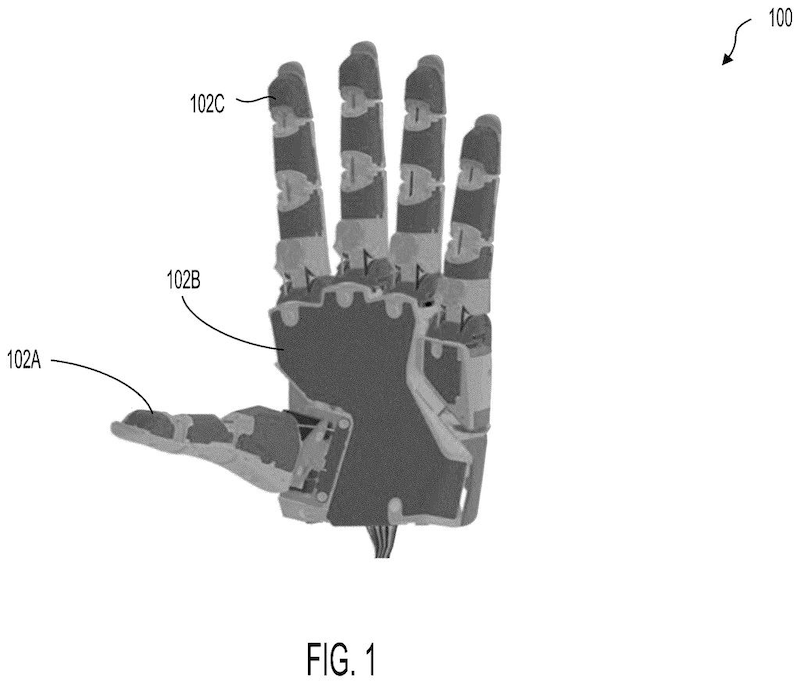
Tesla has filed a US patent application for a touch-sensitive “skin” that can be molded around robot fingers and palms, potentially providing humanoid robots with a scalable way of detecting contact, force and pressure.
The application, US 2026/0310299 A1, was published on October 8 and describes a manufacturing process in which tactile sensors can be printed onto flat, flexible materials before being heat-formed into three-dimensional shapes.
The filing was brought to the attention of Robotics & Automation News by patent intelligence publication Patentlyze, which has published an analysis of the application.
Tesla’s proposed sensor uses two flexible substrate layers carrying conductive regions, separated by a compressible layer. Where conductive regions overlap, they form individual sensing points capable of detecting changes caused by pressure.
The patent describes both capacitive and piezoresistive approaches and lists thermoplastic polyurethane, PET and polyimide among the possible substrate materials.
One of the potentially significant aspects of the filing is its emphasis on manufacturability. Tesla describes processes including screen printing, laser cutting, conductive paste deposition and thermoforming – established manufacturing techniques that could potentially allow tactile surfaces to be produced at scale.
The application says: “The 3D tactile sensors can conform to curved geometries and can be used for measuring surface force, touch, and pressure.”
Although the filing does not specifically establish that the technology will be used in Tesla’s Optimus humanoid robot, it identifies robot fingertips, palms and end-effectors among potential applications.
Tactile sensing is becoming an increasingly important area of humanoid robotics as developers attempt to move beyond basic grasping towards more dexterous manipulation of objects with different shapes, weights and materials.
Patentlyze notes that the filing does not provide figures for the sensor’s sensitivity, resolution or durability, meaning its practical performance cannot yet be assessed.
The patent nevertheless provides another indication of Tesla’s work on the hardware required to give robots more sophisticated manipulation capabilities – not simply allowing a robotic hand to grasp an object, but potentially enabling it to feel how firmly it is holding it.
