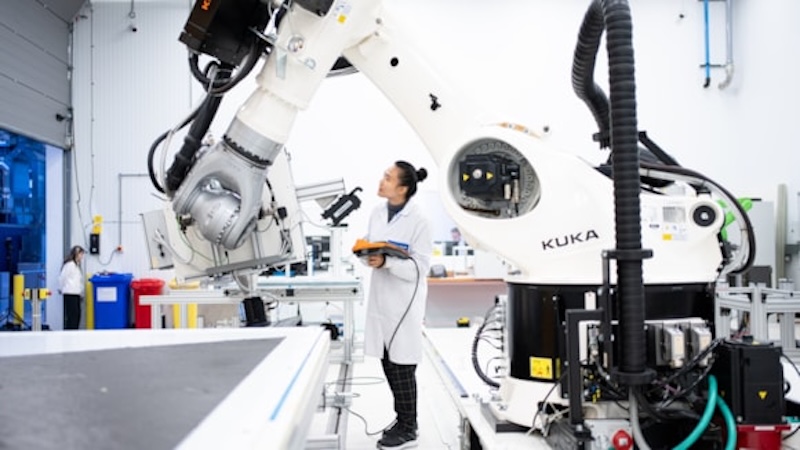
Businesses across the Greater South West region of the UK will receive dedicated support to explore and adopt robotics and automation through a new £9.8 million regional programme.
The National Composites Centre (NCC) will lead the one-to-one business advisory service within the Greater South West Robotics Adoption Hub, providing practical support to help businesses explore robotics and automation opportunities and navigate the route to adoption and return on investment.
The Hub is led by Bristol Robotics Laboratory through the University of Bristol, in partnership with UWE Bristol and NCC. It brings together 23 partners from industry, academia and local government and has secured £7.2 million from Innovate UK, alongside £2.6 million from project partners.
It is one of eight Robotics Adoption Hubs selected for funding across the UK, forming a national network that will work together to accelerate robotics adoption.
For many businesses, the challenge is not understanding the potential of robotics and automation, but knowing where to start, which technologies are right for their operations and whether the investment will deliver. The Hub aims to help businesses navigate these early decisions.
NCC’s advisory service will provide practical, one-to-one support to help businesses work through these questions. Advisers will help companies identify automation opportunities, assess potential solutions, build investment cases and connect with the expertise, finance and wider support needed to progress.
The service will build on NCC’s experience in advanced manufacturing and industrial innovation, as well as its existing work supporting businesses across the region, including through the Made Smarter programme delivered in partnership with Oxford Innovation Advice.
Katy Riddington, managing director of supporting growth at NCC, said: “Robotics and automation can help businesses address some very practical challenges, from improving productivity and consistency to responding to skills and workforce pressures. But understanding where to start and how to make the right investment can be difficult.
“Our role is to work directly with businesses to understand the challenges they are facing, identify where robotics could make a difference and help them build a clear case for adoption.
“By bringing together NCC’s innovation expertise with robotics capability, practical business support and a strong regional network, the Hub will help businesses understand not just where technology could make a difference, but how to adopt it effectively.
“As part of a national network of Robotics Adoption Hubs, businesses will also benefit from expertise and learning beyond the region, helping turn opportunities into practical change.”
Alongside the NCC-led advisory service, the Hub will provide opportunities for businesses to see robotics in action through industrial site visits, demonstration facilities and proof-of-concept activities.
An ecosystem programme will also bring together businesses, technology suppliers and specialist support organisations through events, networking and knowledge sharing, creating a single point of access to robotics support across the region.
The programme will support businesses across a range of sectors and applications, including maritime, energy, food and drink, aerospace manufacturing and healthcare.
Professor Arthur Richards, Professor of Robotics at the University of Bristol and project lead, said: “The range of industry in our region is inspiring, from large world-class operations to the most enterprising small artisans. Through the Hub, we aim to help all these businesses to realise the benefits of robotics in a sustainable and confident fashion.
“Our consortium provides one-stop access to an all-round perspective on robotics, giving each business the tools to adopt the right robots for their unique needs. Our Hub will connect adopters, suppliers, enablers and innovators to create a vibrant ecosystem for robotics adoption across the greater southwest.”
The Greater South West Robotics Adoption Hub is expected to be fully operational by January 2027, when businesses across the region will be able to access advice, events and demonstrations.
