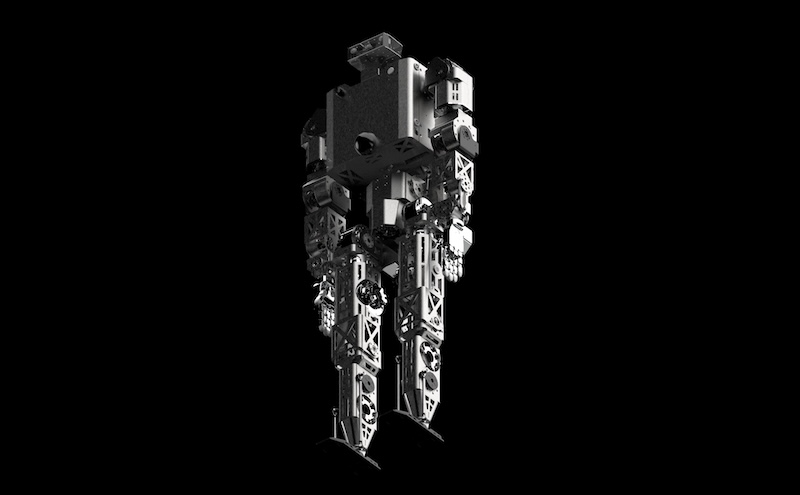
Minerva Humanoids has emerged from stealth with approximately $10 million in pre-seed funding to develop semi-autonomous humanoid robots for hazardous work in the energy and public safety sectors.
The funding round was led by General Catalyst, with Long Journey Ventures and Credo Ventures as co-leads. MVP Ventures, Kaya, RunwayFBU, Compound, Founders Embassy, Hugging Face, Codecademy, YG, Walter Ventures, Tiny Ventures, Chaotica, and Babylon also participated.
The San Francisco-based company is also launching its first paid industry pilot this month.
Minerva is developing a humanoid robot called Roger, designed to enable trained specialists to remotely perform dangerous tasks while remaining physically outside hazardous environments.
The company is initially targeting applications including onshore and offshore oil and gas operations, explosive ordnance disposal (EOD), hazardous material response, and other public safety work.
Founded by CEO Sandor Felber and CTO Maurice Rahme, Minerva designed Roger around the judgment and dexterity of specialists already performing these jobs rather than attempting to remove people entirely from the process.
The semi-autonomous robot can be operated through a VR headset and force-feedback haptic gloves. The system enables an operator to see through the robot’s cameras, receive tactile feedback from its hands and remotely carry out fine manipulation tasks.
Minerva Intelligence, the company’s proprietary AI control system, handles functions including balance, fall recovery and navigation while translating commands from the remote operator into physical actions.
According to Minerva, low-latency control loops provide an immediate response to the operator’s movements, and users can learn full-body control of the robot in under five minutes.
Felber says: “People are dying every day doing jobs the rest of the world takes for granted.
“We didn’t set out to replace the people doing them. We set out to build a robot that lets their judgment do the job without asking them to risk their lives for our safety, or for our energy.”
Minerva estimates that around 7,000 energy workers worldwide die on the job each year, equivalent to approximately one death every 75 minutes.
The figure is the company’s own estimate, calculated by applying the International Labour Organization’s global fatal work accident rate to the International Energy Agency’s estimate of a global energy workforce of 76 million people.
Minerva also points to the risks faced by EOD and hazardous material response teams, where remote robots have been used for decades but are typically wheeled machines with a single robotic arm and limited dexterity.
Prototype developed in five months
Minerva says it went from an initial concept to a fully functional walking humanoid in five months, including the design, manufacture and assembly of Roger.
Its software and AI are primarily developed in the United States, while the first Roger prototypes are manufactured and assembled in Germany.
The company says it plans to manufacture commercial versions of its humanoid robots in both Germany and the United States, building a Western-based supply chain that does not depend on single-source Chinese components.
Felber previously played a core role in launching MIT CSAIL’s research line on humanoid robots using AI and worked on Tesla’s Optimus program.
Rahme spent six years at Boston Dynamics as one of the technical leads on the Stretch robot, taking it from an early prototype to a commercially deployed product.
Robin Dechant, partner at General Catalyst, says: “Building a humanoid from scratch is often a years-long project, but Sandor and Maurice did it in less than six months.
“Shipping hardware at this speed takes physical AI out of the lab and into the world where it matters and builds resiliency into critical sectors by removing people from the most dangerous working environments.”
Lee Jacobs, partner at Long Journey Ventures, says: “Robots can go where no man should.
“Minerva is bringing the world robots that will protect the Western world’s critical infrastructure, and we couldn’t be more thrilled to have been their second believer.”
Energy and public safety deployments
Ahead of its official launch, Minerva completed a showcase and keynote at the NATO Explosive Ordnance Disposal Centre of Excellence in Samorin, Slovakia.
The company has also established research partnerships with the Mohamed bin Zayed University of Artificial Intelligence (MBZUAI) and the University of Waterloo.
Its work with MBZUAI focuses on developing humanoid capabilities for the energy sector, while the University of Waterloo collaboration is intended to improve humanoid perception in smoke, darkness, sensor failure and other conditions where normal vision systems may be compromised.
Minerva says it is also exploring deployments at two of the world’s 10 busiest airports and has completed on-site testing focused on high-risk public safety applications.
The company plans to use the new funding to continue developing Roger’s AI and hardware for energy and EOD applications, with further deployments planned for later this year.
