
IBM has developed a concept for enabling humanoid robots to autonomously recharge by standing on specially equipped floor tiles, according to a recently published US patent application highlighted by patent analysis website Patentlyze.
The system combines wireless power transmission, RFID-based positioning and electromagnets embedded in a humanoid robot’s boots and the floor beneath it.
The patent application, US 2026/0291257 A1, was filed by International Business Machines Corporation in March 2025 and published on September 24, 2026.
Patentlyze, which identified and analyzed the filing, describes the concept as a way for humanoid robots to recharge without being manually plugged in or connecting to a conventional docking station.
Under the proposed system, a robot would autonomously navigate to a designated charging location and position its feet over components embedded in the floor.
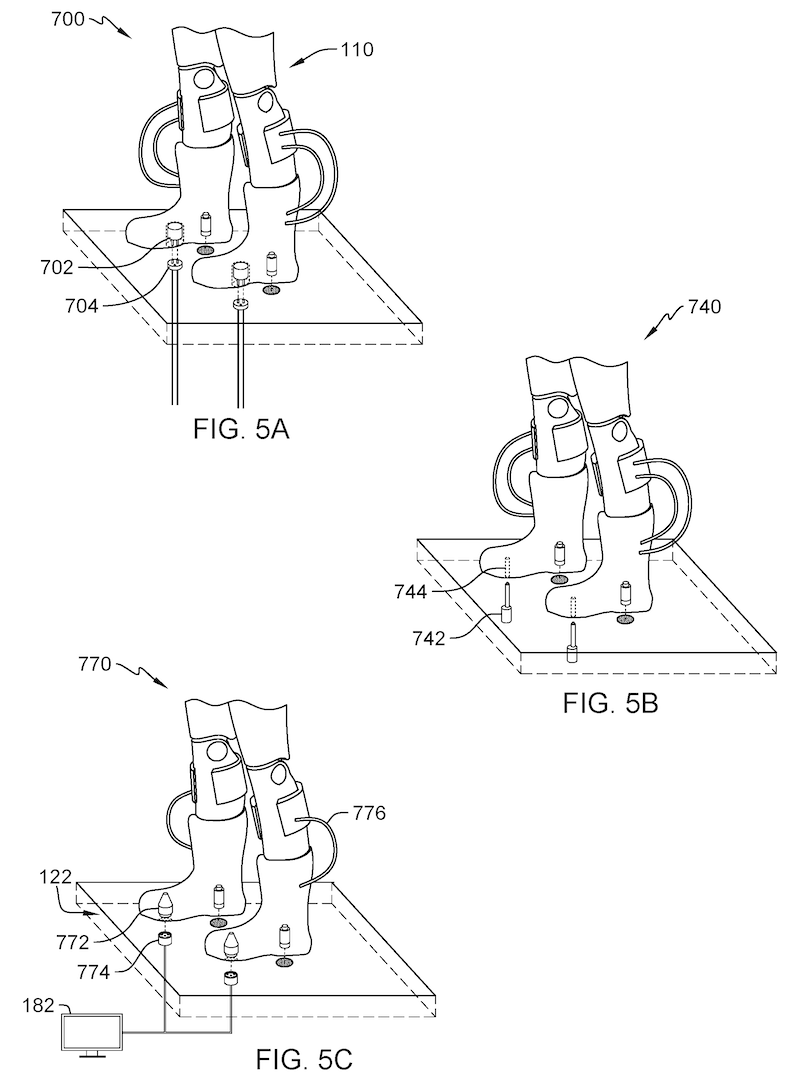
Each robot boot would incorporate a wireless power receiver, an RFID reader and an electromagnet. Corresponding wireless power transmitters, RFID tags and electromagnets would be installed in the floor.
The RFID system would help establish that the robot’s feet are correctly positioned before charging begins, while the electromagnets would secure the robot in place during the charging process.
The patent’s abstract states: “… an electromagnet in each of the boots can be aligned to an electromagnet in the floor at the location which secures the boots to the floor in a locked position when the electromagnet is turned on.”
Once properly aligned and secured, electrical power could be transferred wirelessly through the soles of the robot’s feet.
Addressing humanoid robot charging
The concept addresses an increasingly important practical issue as companies attempt to deploy humanoid robots for longer periods in factories, warehouses and other industrial environments.
Battery capacity remains a constraint for mobile robots, and autonomous charging could allow humanoids to move between work and charging without requiring employees to connect cables or manually position the machines in docking stations.
Patentlyze notes that the magnetic locking mechanism is particularly significant because maintaining precise alignment is important for reliable wireless power transfer.
The website says: “The electromagnet lock is the detail that makes this practical rather than theoretical. Wireless charging already exists, but a robot that can be nudged off its charging pad mid-session is a reliability problem.”
The RFID component provides an additional positioning check before power transfer begins.
According to Patentlyze, the patent’s first claim covers a process involving alignment of the robot’s boots with the charging location, including alignment of the wireless power receiver in the boots with the transmitter in the floor.
The filing states: “aligning boots of a humanoid robot to a location on a floor in a work venue; the aligning of the boots including aligning a power receiver in the boots to a power transmitter in the floor; …”
The system could therefore potentially allow a humanoid to incorporate charging into its normal autonomous operating schedule, walking to an equipped location when its battery reaches a specified level and returning to work after charging.
Infrastructure for humanoid robots
The patent is also notable because it focuses on the infrastructure surrounding humanoid robots rather than the robots themselves.
As humanoids move toward industrial deployment, factories and warehouses may require new supporting infrastructure covering charging, communications, safety and fleet management.
Floor-integrated charging could provide one approach by allowing charging points to become part of the facility rather than requiring large standalone docking equipment.
However, publication of a patent application does not mean IBM will necessarily commercialize the technology, nor does it indicate that a product based on the system is under development.
The application names Joseph Scaglione, Ryan Elsasser, Daniel Ruiz and Schuyler Mann as inventors and contains 20 claims.
Patentlyze characterizes the filing as addressing a relatively straightforward but potentially important operational problem for humanoids.
The website says: “As a practical matter, this is a workmanlike filing that solves a real problem: autonomous recharging for humanoid robots in messy, populated spaces. The RFID-as-alignment-check is the clever bit, because it turns a passive, cheap chip into a precision positioning signal before expensive power transfer begins.”
The patent comes as developers of humanoid robots increasingly turn their attention from demonstrations toward the practical requirements of operating machines for extended periods in real workplaces.
If humanoid fleets eventually become commonplace in factories and warehouses, automated charging systems – whether through floor interfaces, conventional docking stations or other methods – could become an important part of the infrastructure required to keep them operating with minimal human intervention.
