A multi-vehicle crash in Pomona can leave everyone involved with different accounts of what happened and how the impacts unfolded.
Several drivers may have made decisions within seconds of one another, while the resulting damage and injuries can vary from vehicle to vehicle.
Sorting out responsibility in that setting requires more than identifying which car made contact first. The circumstances surrounding each movement, reaction, and impact can shape how the collision is understood.
For people injured in a multi-vehicle accident, consulting a Pomona car accident lawyer can help bring the different pieces of the crash into a clearer legal picture.
A lawyer can review the available evidence, consider each driver’s actions, and examine the insurance coverage that may apply to the resulting losses.
This matters especially when conflicting accounts make it hard to determine how responsibility should be divided among those involved.
Why Multi-Vehicle Fault is Difficult
A chain-reaction crash often develops in seconds. One driver may rear-end a stopped vehicle, pushing it into another car. A following driver may then collide with the original vehicles, adding another impact and another potential cause of injury.
The first collision does not always establish complete responsibility. A driver who was speeding, following too closely, changing lanes carelessly, or driving while distracted may share fault even after another driver created the initial hazard.
People injured in these collisions often need a detailed review of traffic footage, vehicle damage, witness accounts, police reports, and medical records.
A car accident lawyer can examine how each impact occurred, identify the available insurance coverage, and present evidence that separates one driver’s conduct from another’s. That analysis helps prevent an insurer from placing every loss on the most obvious driver.
How California Assigns Shared Fault
California follows a pure comparative negligence system. A person can pursue damages even when they bear part of the responsibility, but recovery decreases by their percentage of fault.
For example, suppose a jury finds that one driver caused 60 percent of a collision, a second driver caused 25 percent, and an injured passenger caused 15 percent through unsafe conduct.
The passenger’s damages would be reduced by 15 percent. A driver who carries most of the blame still cannot avoid liability simply because another person also contributed.
Courts and insurers assign percentages based on conduct that caused the crash or worsened the injuries. The analysis may include speed, following distance, lane position, reaction time, visibility, vehicle maintenance, and compliance with traffic signals.
Evidence That Separates Each Driver’s Role
Evidence must connect conduct to a particular impact. A police report can record initial statements and roadway conditions, but it does not always resolve every fault question.
Physical And Digital Evidence
Vehicle damage can show impact direction, contact points, and whether one collision occurred before another. Skid marks, debris patterns, airbag data, and event data recorder information can help establish speed and timing.
Traffic cameras, nearby business footage, dashcam recordings, and phone records can provide additional information. Witnesses can describe lane changes, braking, and driver behavior before the crash. Investigators should preserve this evidence quickly because recordings often overwrite themselves.
Medical and Insurance Records
Medical records help connect an injury to a particular collision or impact. In a multi-vehicle crash, one impact can cause an initial injury while another makes it worse. Treatment notes, diagnostic imaging, and physician opinions can help distinguish those events.
Insurance policies also require careful review. Each driver may have separate liability coverage, while an injured person may have uninsured or underinsured motorist protection. Commercial vehicles and rideshare vehicles can involve additional policies based on the driver’s status and the vehicle’s use.
Liability for Injuries and Property Damage
California’s rules treat economic and noneconomic damages differently in some multi-party cases. Economic losses include medical bills, future treatment, lost income, and repair costs.
Under California law, each responsible defendant can face broader liability for economic damages, although payment disputes and insurance limits still matter.
Non-economic losses include pain, emotional distress, and reduced quality of life. A defendant generally pays according to that defendant’s assigned share of responsibility. The final outcome depends on the evidence, the parties involved, and the claims asserted.
Property damage also requires a separate assessment. Repair estimates, photographs, vehicle value, rental expenses, and evidence of preexisting damage can affect the amount claimed.
Steps After a Multi-Vehicle Crash
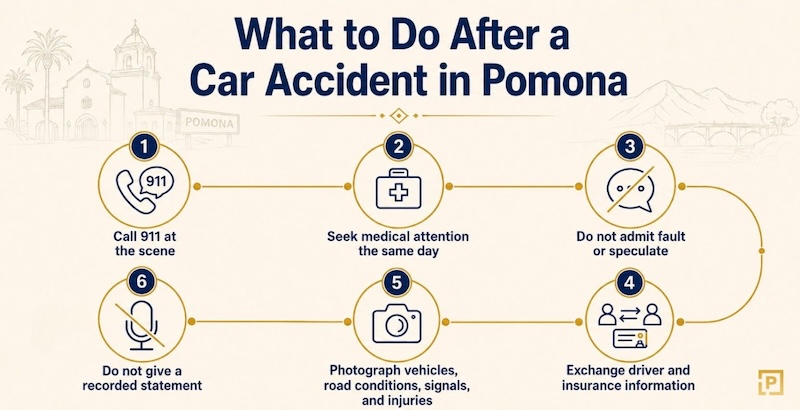
An injured person should seek medical care, report the collision, and collect the insurance information for every involved driver. Photographs should show vehicle positions, roadway conditions, traffic controls, visible injuries, and damage from each side.
Statements to insurers require care because an adjuster may use an incomplete description to assign blame. The injured person should avoid guessing about speed, timing, or fault. Keeping a symptom record and saving medical bills also creates a clearer record of the injury claim.
Conclusion
Fault in a multi-vehicle crash depends on evidence, timing, and each driver’s conduct. California’s comparative negligence rules allow recovery when an injured person shares responsibility, but the award decreases by that percentage.
Anyone involved should preserve photographs, video, vehicle data, witness information, and medical records before evidence disappears. A prompt legal review can identify each liable party, evaluate available coverage, and protect the claim from an unfair early settlement.
