Industrial equipment can weigh thousands of pounds, generate enormous force, and perform work no person could accomplish alone.
Yet some of those machines depend on components small enough to disappear inside a pocket and inexpensive enough to seem almost insignificant.
Seals have the difficult job of keeping fluids, gases, pressure, and contaminants where they belong. They may operate inside powerful hydraulic systems, moving equipment, pumps, motors, and countless other applications where a tiny opening can become a much larger problem.
That creates an interesting engineering contradiction. Massive machines can depend on remarkably small components to continue operating properly.
Working with a Parker seals distributor can help businesses identify sealing components suited to the specific conditions and demands of an application.
A Seal Has a Surprisingly Difficult Job
A seal may look simple when sitting on a workbench. Once installed inside operating equipment, however, that small component can face an environment far more demanding than its appearance suggests.
Pressure may push against it continuously. Components can move across its surface, creating friction and wear. Temperatures may rise, fall, or cycle repeatedly, while oils, fuels, chemicals, water, or other substances come into direct contact with the sealing material.
The surrounding environment adds another challenge. Dirt, dust, moisture, and other contaminants may need to stay outside while lubricants or pressurized fluids remain inside.
Different applications create different combinations of these stresses, which is why choosing a seal involves more than finding something that physically fits the opening. It has to function under the conditions the machine will actually create.
Tiny Leaks Can Create Very Large Problems
A small leak can be easy to dismiss, particularly when it begins as nothing more than a drop of fluid. Inside machinery, however, that visible drop may be evidence that a sealing system is no longer performing as intended.
Fluid loss can reduce lubrication or affect systems that depend on maintaining pressure. Contaminants may also find their way into places where clean operating conditions matter.
Over time, these problems can contribute to declining performance, additional wear, or damage to surrounding components.
There is also the practical cost of stopping equipment. A relatively inexpensive component can become responsible for much more expensive downtime if replacing it requires shutting down a machine or production process.
This doesn’t mean every failed seal causes catastrophic damage. It does show why small components deserve serious attention when their job is preventing larger systems from losing the conditions they need to operate.
Material Choice Changes Everything
Two seals can have nearly identical dimensions and still behave very differently once installed. The material used to manufacture them plays a major role in determining the environments and substances they can tolerate.
Different elastomers and other sealing materials respond differently to heat, cold, chemicals, fuels, oils, pressure, and repeated movement. A material that performs well in one application may swell, harden, soften, crack, or wear prematurely when exposed to conditions it wasn’t intended to handle.
That makes compatibility essential. Engineers and maintenance teams need to consider the fluid or gas being sealed along with operating temperatures, pressure, movement, and environmental exposure.
Choosing based only on size can overlook much of what determines whether the component will actually work. The right material isn’t necessarily the strongest in every category. It is the one whose properties fit the demands of the specific application.
The Right Shape Matters Just as Much as the Material
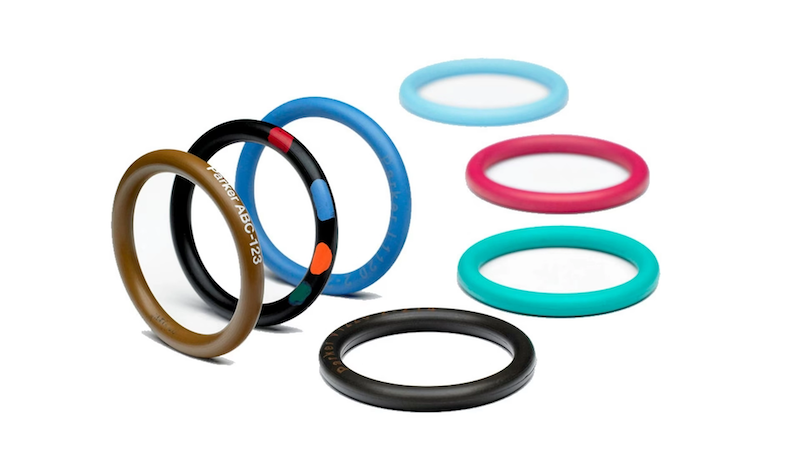
The familiar O-ring may be one of the best-known sealing components, but it represents only one approach to controlling fluids, pressure, and contamination. Machinery uses many different seal designs because components don’t all move or operate in the same way.
Hydraulic seals may work around pistons and rods moving through pressurized systems. Rotary applications introduce continuous movement around shafts.
Gaskets create seals between mating surfaces, while other specialized designs address particular combinations of motion, pressure, space, and environmental exposure.
Geometry therefore matters alongside material selection. A seal designed for a stationary connection faces different demands from one repeatedly sliding against another component.
Even installation space and surface conditions can influence what design makes sense. Selecting a seal means matching both its material and physical design to the job rather than assuming that every barrier between two surfaces works essentially the same way.
Conclusion
Machines naturally attract attention to their biggest components. Motors, cylinders, pumps, shafts, and heavy structures look important because they visibly perform the work. The small seals hidden between those components are much easier to overlook.
Yet keeping pressure, fluids, gases, lubricants, and contaminants under control can be essential to everything those larger components are trying to accomplish.
A seal may occupy very little space while carrying responsibility for maintaining the conditions an entire system needs.
That is what makes these components such an interesting part of engineering. Their importance isn’t proportional to their physical size.
Material selection, design, operating conditions, and proper installation can all influence whether a tiny component quietly does its job or becomes the reason a much larger machine stops doing its own. Sometimes the smallest piece in the system carries one of its biggest responsibilities.
