
Manufacturing payroll involves serious challenges. Between piece-rate workers on the floor, salaried supervisors, seasonal contractors, and rotating shift schedules, the best manufacturing payroll software has to handle the demands that generic platforms weren’t built around.
Keeping up with FLSA rules, state tax codes, and union agreements across multiple facilities adds another layer entirely. After reviewing platforms serving mid-sized manufacturers, this guide covers five options that actually hold up when things get messy.
How we chose
Publicly available information shaped every pick here, including user reviews, platform feature pages, third-party ratings, and real-world case studies pulled from review directories and official company websites. Only platforms with a clear, verifiable track record in manufacturing payroll made the cut.
→ See the full research breakdown
- Hybrid Payroll – Best for small to mid-size manufacturing payroll and HR management
- Gusto – Best for midmarket manufacturing companies needing integrated payroll and HR management
- Rippling – Best for mid-market to enterprise payroll and employee management automation
- BambooHR – Best for small to medium-sized business HR and payroll management
- Paycor – Best for small to mid-sized manufacturing businesses needing integrated payroll and HR solutions
Why Picking the Right Manufacturing Payroll Software Matters
Plant-floor payroll is genuinely different from office payroll. Shift differentials, overtime variances, piece-rate calculations, and irregular schedules create conditions where the wrong software doesn’t just slow things down, it produces errors that cost money and create audit risk.
Staying current with federal, state, and local labor law across multiple facilities isn’t optional. A missed update to a state tax code or a miscalculated overtime rate can trigger penalties that far outweigh the cost of better software.
The right platform cuts payroll processing time per pay cycle, brings the error rate down to something manageable, and keeps compliance risk close to zero. Manufacturers who’ve made the switch consistently report exactly that, which is why getting the tool right from the start matters more than most teams realize.
Compare the Top 5 Manufacturing Payroll Software
Note: All data in this table is sourced from review platforms and the official websites of the listed companies.
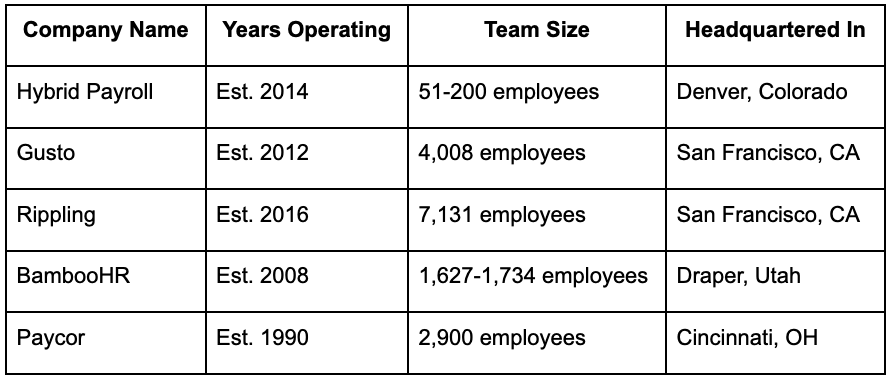
1. Hybrid Payroll – Best for Small to Mid-Size Manufacturing Payroll and HR Management
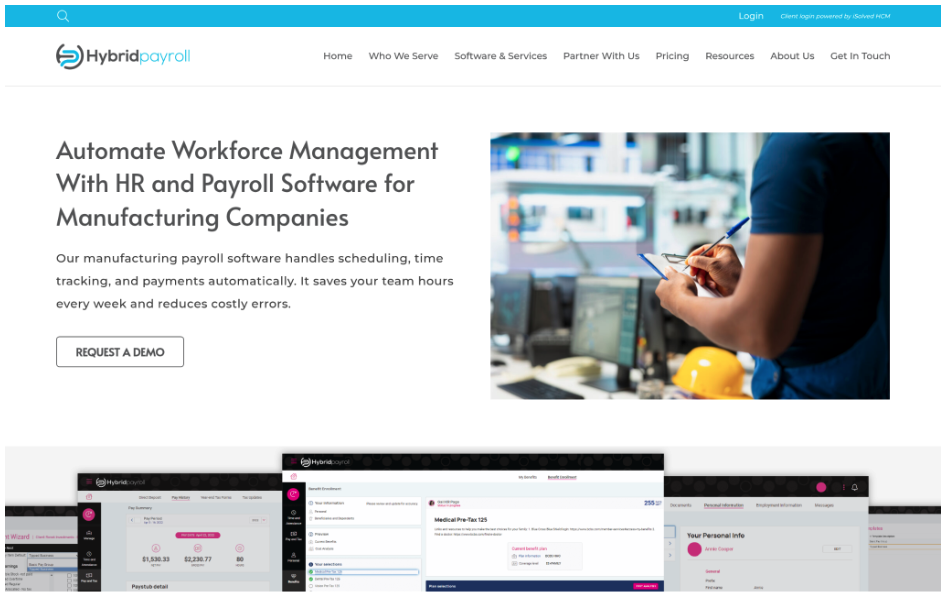
What Role Does Hybrid Payroll Play?
Hybrid Payroll sits in a useful middle ground between a payroll processor and a full-scale HR firm. They work as both a payroll provider and a Professional Employer Organization, which means manufacturers don’t have to stitch together separate tools for payroll processing, tax calculations, benefits administration, and HR management.
What’s worth noting is that their bundles are built around specific industries, not adapted from a generic template.For manufacturers navigating complex pay structures, evolving labor regulations, and co-employment responsibilities, Hybrid Payroll provides industry-specific payroll and HR solutions designed to simplify these challenges through its dedicated manufacturing services: https://hybridpayroll.com/manufacturing/
Why Does Hybrid Payroll Belong on this List for Manufacturing Payroll Software?
Manufacturing payroll carries a level of regulatory and operational demands that requires more than a plug-and-play platform. Hybrid Payroll’s industry-specific bundling means manufacturers aren’t left configuring a general tool to fit their workflow.
Their combination of PEO services, automated payroll, and strategic HR consulting gives mid-sized manufacturers the kind of support structure that typically only larger companies can access.
User Reviews, Summarised:
Reviews consistently point to the personalized service model as a standout. Teams that have used generic payroll platforms before tend to notice the difference in how quickly issues get resolved. The flexibility in service delivery also comes up often, which matters when payroll cycles shift during peak production seasons.
2. Gusto – Best for Midmarket Manufacturing Companies Needing Integrated Payroll and HR Management
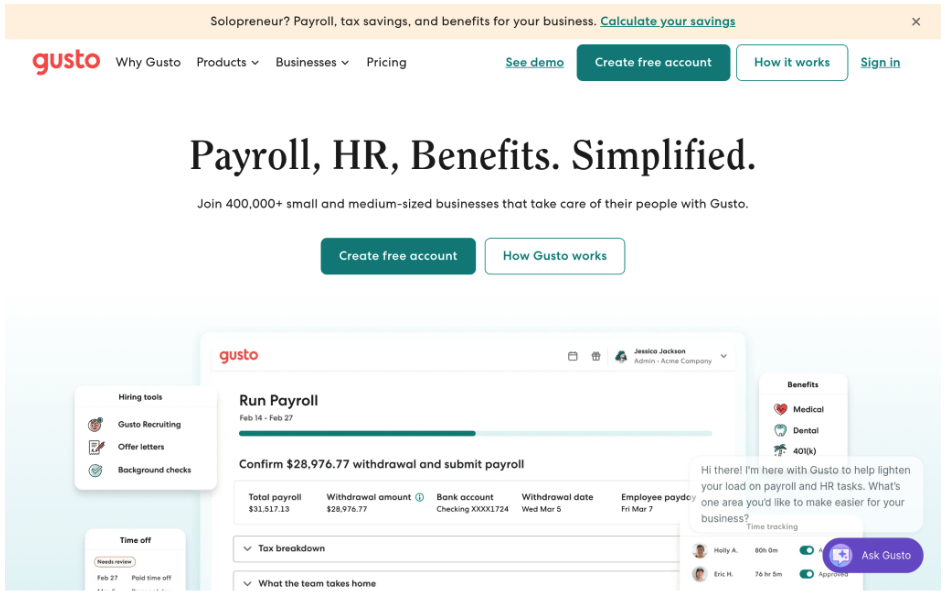
What Role Does Gusto Play?
Gusto is a fully online HR and payroll platform that handles everything from payroll processing and tax filing to benefits enrollment and employee setup. The platform serves around 400,000 customers across the US, which gives it serious scale.
What stands out for manufacturing is that automatic payroll tax filing is included at no extra cost, so mid-sized manufacturers aren’t paying add-on fees every time a state tax form goes out.
With connections to nearly 150 other software products, it also fits into existing tech stacks without much friction (not always the case with payroll platforms at this price point).
Why Does Gusto Belong on this List for Manufacturing Payroll Software?
For manufacturers managing a mixed workforce of hourly, salaried, and seasonal workers, Gusto’s breadth of features at a transparent price point removes a lot of the administrative overhead that payroll teams deal with week to week.
The platform’s recognition as the number one highest satisfaction software on G2 for 2026 reflects what users actually experience, not just what the marketing says.
User Reviews, Summarised:
Reviewers consistently point to the clean interface as a genuine advantage, especially for HR teams without deep technical backgrounds. The most common positive pattern is how quickly new users get up to speed. That kind of usability is harder to find than it should be in payroll software.
3. Rippling – Best for Mid-Market to Enterprise Payroll and Employee Management Automation
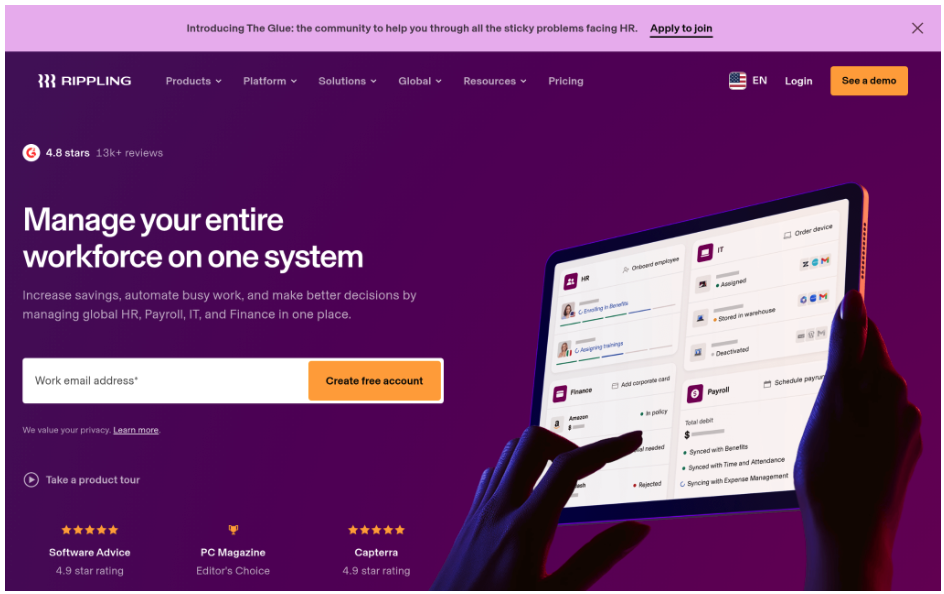
What Role Does Rippling Play?
Rippling treats payroll as one piece of a much larger employee management system. The platform connects payroll to devices, apps, benefits, and corporate cards, all built on a single source of employee data.
That matters for manufacturers with multiple facilities because one change to an employee record flows through every connected system automatically. The stat that gets attention is their 90-second full setup claim across payroll, computers, benefits, and apps simultaneously.
For plants dealing with high turnover and rapid seasonal hiring, that kind of workforce setup speed has real dollar value. They also rank number one for vendor satisfaction and payroll and benefits platform quality, offering enterprise-grade capability without always requiring enterprise pricing.
Why Does Rippling Belong on This List for Manufacturing Payroll Software?
Where other platforms handle payroll and leave system connections as an afterthought, Rippling’s single-source architecture means manufacturing HR teams aren’t reconciling data across five different tools at the end of every pay period.
Their number one mid-market payroll ranking from G2’s 2026 awards backs up what their feature set already suggests.
User Reviews, Summarised:
The automation depth is what users talk about most. Teams that moved to Rippling from disconnected systems consistently mention fewer manual steps and a noticeable drop in payroll correction frequency. The breadth of what the platform covers is both its biggest strength and, occasionally, its steepest learning curve.
4. BambooHR – Best for Small to Medium-Sized Business HR and Payroll Management
What Role Does BambooHR Play?
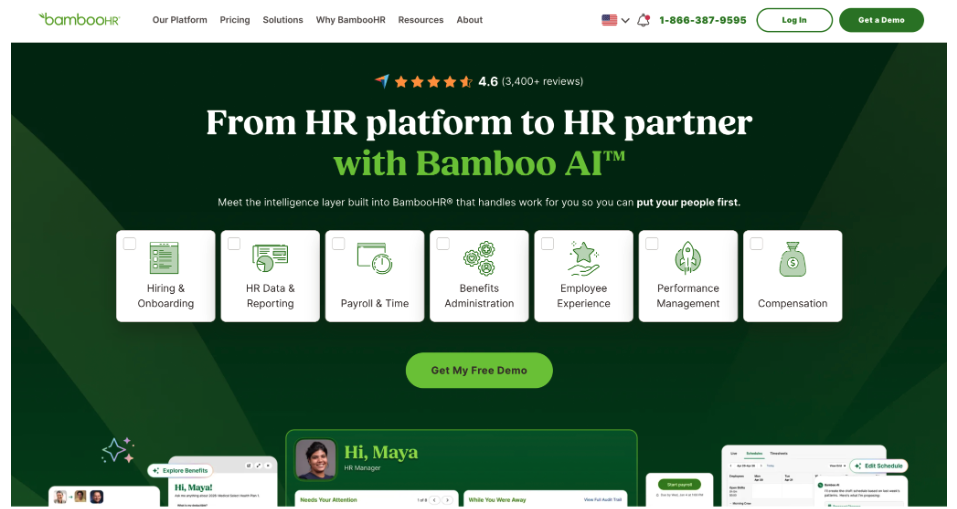
BambooHR built their platform around the idea that HR, payroll, and benefits should live in one connected system rather than separate tools forced together.
Founded in 2008, they now serve over 34,000 customers across 190 countries. For smaller manufacturers, pricing starts at $250 per month for small teams, which is accessible compared to enterprise HCM platforms.
The platform includes applicant tracking, employee setup, full-service tax filing, performance management, and analytics, all native to the same system.
The embedded AI and connected ecosystem approach means less manual data entry between modules, which cuts down on the kind of payroll errors that come from moving information between platforms.
Why Does BambooHR Belong on This List for Manufacturing Payroll Software?
Smaller manufacturers often face a choice between simple payroll tools and expensive enterprise systems. BambooHR fits comfortably in the gap between those two options.
Their 2025/26 Cloud Award for Best Cloud HR/HRMS Solution reflects the kind of recognition that comes from building something that actually works for the businesses it targets.
User Reviews, Summarised:
Users frequently describe BambooHR as the first platform that made HR feel manageable without a dedicated HR department. The native connection between payroll and the rest of the HR features comes up regularly as a practical time-saver.
For manufacturers scaling from 50 to 200 employees, that kind of connected experience is rare at this price point.
5. Paycor – Best for Small to Mid-Sized Manufacturing Businesses Needing Integrated Payroll and HR Solutions
What Role Does Paycor Play?
Paycor has been in the HCM space since 1990, which gives them a depth of experience that newer platforms are still building toward. They serve over 30,000 customers and 2 million employees across all 50 states.
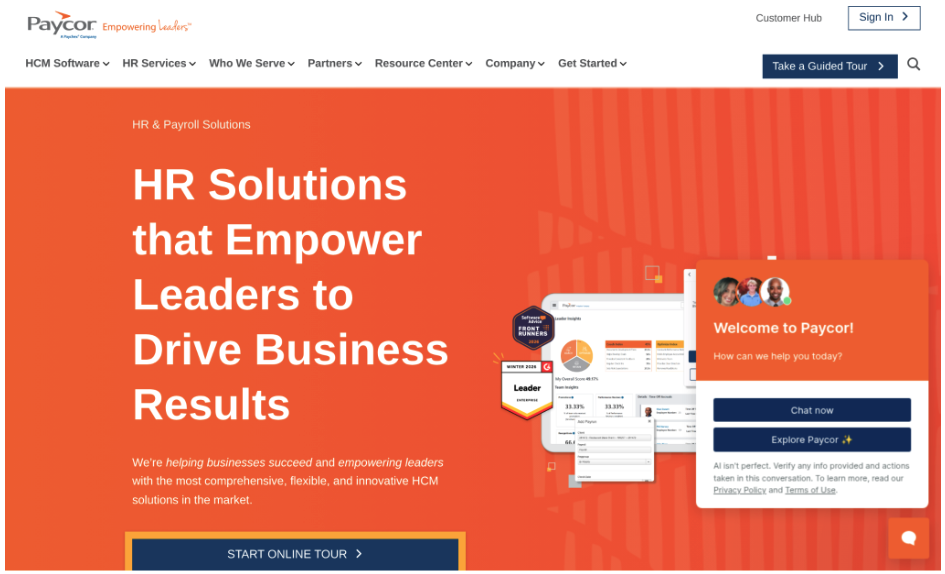
The platform covers setup, payroll, time-keeping, recruiting, and career development in a unified system built specifically for small and mid-sized businesses.
One thing that stands out is their fastest implementation award, meaning manufacturers can get from contract to live payroll faster than competitors in their category.
For HR managers who’ve sat through painful implementation timelines before, that matters more than any feature list item. Their eight G2 Winter 2026 awards across workforce management, learning, and recruiting categories also show this isn’t a one-trick platform.
Why Does Paycor Belong on this List for Manufacturing Payroll Software?
Paycor’s industry-specific configurability means manufacturers don’t have to bend a generic workflow into something that fits their operations.
Their partnership-driven customer service model, which customers consistently point to in reviews, means ongoing support doesn’t disappear after the implementation call ends.
User Reviews, Summarised:
The partnership approach to customer service comes up in reviews more than almost any other point. Manufacturing clients appreciate that their account teams understand sector-specific payroll questions rather than routing everything to generic support.
The analytics capabilities also get solid mention from teams tracking labor cost as a percentage of production output.
Vetting Process and Selection Criteria
Building this shortlist started with a broad sweep across review platforms, software directories, and industry-specific publications to identify which payroll platforms manufacturers were actually using and talking about. The goal was to surface options based on real-world usage patterns, not just vendor marketing.
Data Collection Fundamentals
The initial list came together through a structured review of third-party directories, user review aggregators, and publicly available case studies.
Each source was cross-referenced to identify patterns in which platforms kept appearing across manufacturing-specific payroll discussions.
Company websites were reviewed for feature depth and industry-specific positioning. Ratings and review counts from major platforms helped establish which options had enough real-world usage to be worth evaluating.
Filtering Candidates by Important Criteria
Once the broader list was assembled, options were narrowed based on a few non-negotiable factors. Any platform without verifiable user reviews or a documented track record in payroll processing for hourly or mixed workforces was removed from consideration.
Review patterns were analyzed carefully, not just for average scores, but for what users repeatedly flagged as strengths or friction points. Platforms with strong scores but thin review volume were treated with appropriate caution.
How Claims Stack Up Against Evidence
Every claim made by a platform on their own website was checked against what actual users reported in reviews and case studies.
Where vendor claims around payroll speed, tax filing accuracy, or compliance management didn’t show up in customer feedback, those claims were discounted.
The goal was to identify platforms where stated capabilities matched what customers described experiencing, particularly around error rates and payroll cycle processing time.
Industry Reputation and Recognition
Third-party recognition carries weight when it comes from credible sources. G2 rankings, cloud software awards, and category-specific recognitions were reviewed for each platform.
Recognition was treated as a supporting signal rather than a deciding factor. A platform with strong awards but weak reviews for manufacturing-specific use cases would still rank lower than one with consistent, relevant customer feedback and fewer headline awards.
Manufacturing Payroll Software-Specific Track Record Check
Each platform was evaluated for evidence that they serve manufacturing payroll needs directly, not just general payroll. This meant looking for dedicated manufacturing or industrial pages on their websites, verified reviews from manufacturing company users, and case studies that addressed real plant-floor payroll challenges.
Platforms that could only show general payroll capability without evidence of handling shift differentials, piece-rate pay, or multi-site scenarios were not included in the final list.
What Matters When Selecting Manufacturing Payroll Software
Choosing a platform for manufacturing payroll isn’t just about features on a checklist. The right fit depends on how well a platform handles the specific demands of plant-floor pay structures, and whether the team behind it understands what that complexity actually looks like.
Industry/Domain Experience: Look for platforms with documented experience in manufacturing payroll, not just general payroll capability. A platform that’s handled piece-rate calculations, shift differentials, and union agreements before will cause fewer problems than one learning on your payroll cycle.
Features and Service: Payroll processing, automated tax filing, benefits administration, and time-keeping integration should all be present. The question is whether they’re genuinely connected or just loosely linked modules from different acquisitions.
Pricing Structure: Understand what’s included in the base price and what triggers add-on fees. Tax filing costs, multi-state processing fees, and implementation charges can change the total cost significantly compared to the advertised rate.
Results Measurement: The platform should give you visibility into payroll processing time per pay cycle, overtime cost variance, and error correction frequency. If you can’t measure it, you can’t manage it.
Industry Knowledge and Compliance: FLSA, state tax code updates, and prevailing wage requirements change regularly. The platform, and the team supporting it, needs to stay current so your compliance posture doesn’t slip between updates.
What it Means for You
Picking the right manufacturing payroll software comes down to how well a platform handles your specific workforce structure, not how polished the demo looks.
The platforms on this list each bring something distinct, whether that’s Hybrid Payroll’s industry-specific bundling, Rippling’s automation depth, or Paycor’s implementation speed.
As manufacturing workforces grow more complex and labor regulations keep shifting, platforms built with that complexity in mind will continue to separate themselves from the field.
