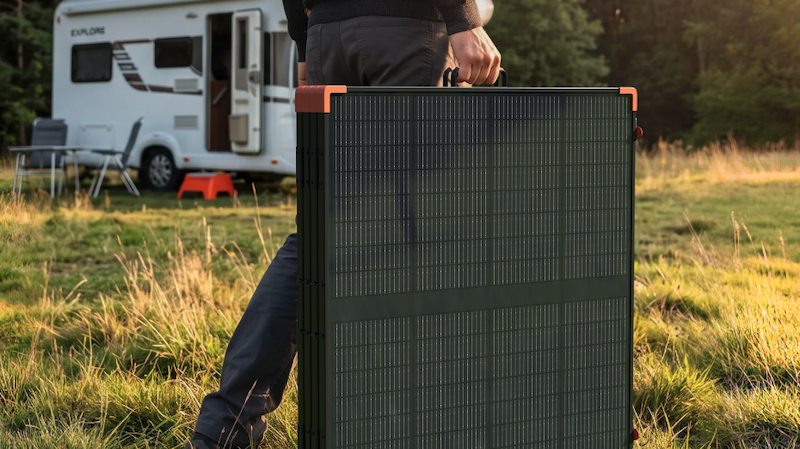
It’s not just about the installation of more solar panels for the next generation of renewable energy. It has to do with the utilization of every single square meter of PV surface in an even better way, and with the use of a combination of new PV technologies and smarter installation methods, energy storage solutions, automation, and intelligent power management.
This change is especially critical for those systems that do not connect to the grid because each watt counts. Local utility connections are often unavailable for remote workshops, agricultural facilities, cabins, telecommunications sites or small industrial facilities.
A Solar system must thus be designed to ensure that energy is generated as much as possible and energy is managed efficiently during the day.
The Rise of Bifacial Photovoltaic Technology
A promising advancement is bifacial photovoltaics (PVs). Bifacial modules are able to absorb light that reflects or scatters onto their back surface as well as the front surface, whereas a conventional monofacial panel will only absorb light on the front surface.
This enables the installation to produce more electricity from the same fundamental panel footprint if the design is right.
For system designers, this provides a significant opportunity: no longer is the efficiency based on the rated wattage that’s printed on a panel.
Other factors such as ground reflectivity, elevation of panels, spacing, tilt angle, and surface reflectivity of surrounding surfaces can affect the amount of additional energy that reaches the back of a bifacial module.
These factors have been shown to be important in research. A long-term field study has recently been conducted and has shown that the system-level benefit of bifacial varies from 9% to 15% depending on the ground conditions, with large gains being seen with white gravel.
An easy rule for homeowners and businesses weighing the installation of bifacial solar panels The panel is just the beginning. Its back mounting capability can be utilized to the maximum depending on the surrounding environment and mounting configuration.
Smarter Design Means More Than Higher Efficiency
Efficiency – while often discussed with regards to cell technology – is much more complex in a real system.
High-efficiency cell architectures like TOPCon and heterojunction can be integrated in the modern design, plus bifacial configuration brings more energy capture.
The International Energy Agency Photovoltaic Power Systems Programme indicates that efficiencies over 60% can be realized on the rear-side of bifacial cells and, in some technologies, over 90% of the front-side efficiency.
The next step is to make these improvements part of intelligence energy systems.
A smart off-grid installation can manage the solar generation, batteries, electrical loads and backup equipment based on power requirements and the state of the solar array.
Solar energy can be used to charge batteries or to provide energy to flexible loads when they are not required when the sun is shining. Stored electricity can then be used to provide power to critical equipment during periods of low PV generation.
This method is changing the way solar energy is generated, which is beyond the scope of a generation source, into a managed energy ecosystem.
Robotics is Entering Solar Construction
The brain power needed to generate renewable energy is also coming before a solar system starts to produce electricity.
The construction of solar energy itself is becoming more and more automated. As of 2026, AES has placed over 180,000 solar modules (over 100 MW) on the ground, utilizing the Maximo robotic system.
The system aims to operate on active construction sites, with real-time perception capabilities to deal with a changing environment, including modules and equipment, weather, and gradient.
That’s important because the work on utility-scale solar projects is repetitive and requires a lot of manpower. Installation teams can benefit from automation in managing bigger and heavier modules, consistency, and faster construction.
During a field demonstration, another solar installation robot, unveiled by Rosendin, placed modules with LiDAR, GPS and mapping technology without the need for a human operator, with panels being installed in about half the time as a typical manual process.
The overall picture is pretty clear: robotics and renewable energy are beginning to go hand in hand.
Building Better Off-Grid Systems
The same concepts can be used in a smaller application that’s off the grid.
A shed, workshop, remote office or agricultural outbuilding may require only a relatively low level of electric power, however it can be attractive to make good use of design of the system.
Rather than just installing the largest possible array, designers can take into account when the electrical loads will be used and battery capacity, and how that relates to the available sunlight and the solar array orientation.
This is where off-grid power solutions come in handy. A well-designed system can supply power to lights, communication equipment, tools and pumps, monitoring systems and other loads without connecting to a conventional electrical power grid.
Of particular significance is energy storage. The solar generation schedules vary according to the weather and availability of daylight and many electrical loads operate according to human schedules, not the availability of solar energy. Batteries fill the gap, so energy produced can still be there when it’s needed.
Smart controllers can go one step further and adjust for critical loads, check the battery SoC, and prioritize the use of available solar energy where it would be most beneficial.
The Role of Reflective Surfaces and System Layout
Bifacial can also inspire designers to consider space behind a solar array.
The back of a bifacial panel is partly dependent on reflected light, so surfaces with high reflectivity can boost the irradiance on the backside. Spacing panels further apart, placing modules off the ground and using the correct ground material can therefore have an impact on the overall energy yield.
This only makes the design of solar increasingly multidisciplinary. The performance of a PV installation depends on both electrical engineering and materials science, mechanical design, software, and environment.
A More Intelligent Renewable-Energy Future
It seems solar power will not be a single product, but a collection of innovative advances. Rather, it will be through a multitude of improvements that progress will be achieved.
More efficient cells will generate more output per square unit. Useful light can be captured by bifacial modules from both sides of the module. Reverting to better mounting strategies can help to increase the irradiance on the backside.
The batteries can store energy during the sunny time of day and release it when it is needed. Smart controllers can make the most effective use of that energy. And, robotics can make the construction process of large-scale Photovoltaic installations quicker and safer.
This turns into a transformation from merely putting up solar panels to creating full energy systems.
The difference is particularly useful for anyone who does not have access to the grid. With no utility connection to rely on, it is not an option but a necessity to be efficient, reliable and smart with energy.
As PV technology advances, the most sophisticated PV systems will consist of cutting-edge PV equipment and innovative system design.
Solar energy is not only cleaner, but more automated, more efficient and significantly more flexible in locations where traditional energy infrastructure is lacking.
