
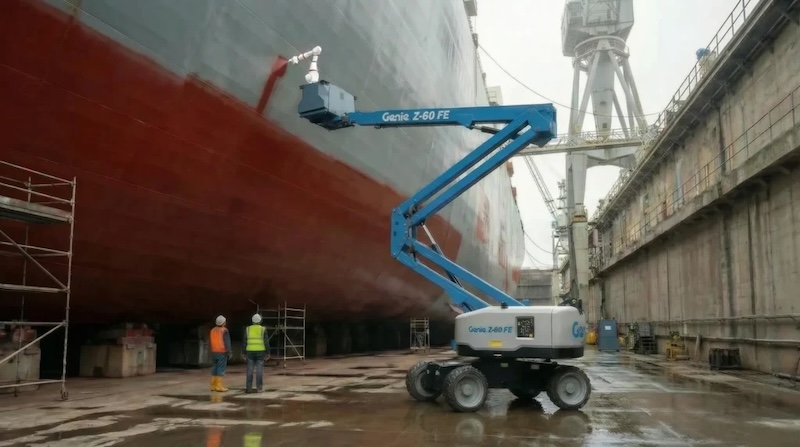
Raise Robotics has unveiled plans to develop shipbuilding robots specialized in coating applications.
The systems are designed to coat large surfaces autonomously without crawling on them, and to operate with the certifications required for explosive atmospheres, including engineering toward ATEX Zone 2 requirements used in paint halls and other hazardous coating environments.
The ‘bottleneck is still people, not docks’
Industrial coating on large structures remains one of the harder problems in shipbuilding automation. Most approaches still put workers or machines directly on the surface using scaffolding or crawling systems, often where flammable coatings make the air itself part of the hazard analysis.
That problem is becoming more urgent as Washington pushes to expand yard capacity. A recent National Security Presidential Memorandum directed planning for a fifth public shipyard to support submarine and carrier work. Navy leaders and outside analysts have already flagged the constraint a new yard does not solve: people.
Adm. Daryl Caudle, chief of naval operations, has asked whether new infrastructure is worth it “if I can’t get the workforce there”.
The US shipbuilding industry faces a projected need for 200,000 to 250,000 additional skilled workers over the next decade, with high attrition in trades that include painting and coating.
Off the surface, in the hazard zone
“A shipyard, a factory floor, and a 13-story façade look like the same problem to our base,” said Rishabh Aggarwal, CTO of Raise Robotics. “Heavy, hazardous, and short on people.
“Adding dry docks does not add painters who can work inside an explosive atmosphere. We’re building machines that can take on that work without putting a person or a crawler on the surface.”
Raise’s approach uses a multi-purpose mobile platform already operating in commercial industrial environments. The same base is being developed to carry industrial coating systems for hulls and other large structures and is being engineered toward ATEX Zone 2 requirements covering pressurized enclosures, certified equipment, and operation where solvent fumes are present.
5,000 hours before the shipyard
The company has logged roughly 5,000 autonomous hours across 18 commercial projects, including high-rise facade work.
Aggarwal is the lead designer of the platform. Before Raise, he helped take a harvesting robot from a single prototype to more than 150 field units at Tortuga AgTech.
He has also worked on pollution-control hardware and energy-storage systems. An autonomous coating robot for the shipyard was the next use of the same base: one machine for large, hazardous structures.
“Language models get to retry,” Aggarwal said. “A robot 100 feet up a façade does not. The same is true in a paint hall. The spec sheet is what happens on the 400th day, not the demo.”
Near-term work remains commercial deployment with industrial customers, while the coating roadmap targets autonomous, off-surface work in environments classified as hazardous.
