Thomas Genestar, managing director of western Europe at Exotec
The e-commerce explosion has forced organisations to adapt and update their logistics operations. Automation and AI are no longer a bonus, they are the baseline for operational excellence and agility.
In the warehouse, innovation is now essential. Resilience, reliability, and operational continuity are the pillars shaping strategic decisions in 2026 and beyond.
Considering this, Thomas Genestar, managing director of western Europe at Exotec, decodes the 4 strategic pillars currently re-defining the supply chain.
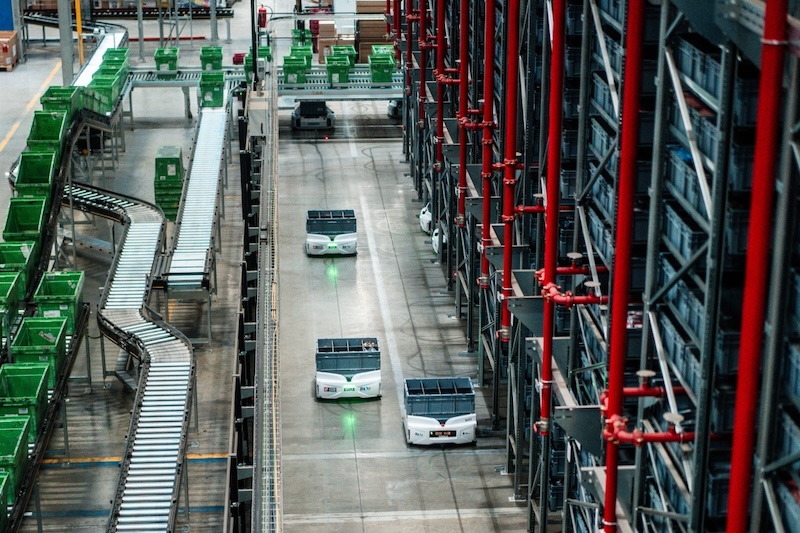
Goods-to-person (G2P) automation
“G2P solutions which automatically feed bins to human operators rather than requiring them to move are continuing to gain traction”, said Genestar.
“They are reversing the usual logic by keeping operators at workstations and delivering the necessary items to them. This is resulting in fewer round trips, more consistent tasks, more predictable access to items, and fewer heavy or hazardous loads for operators.”
According to the G2P Solutions 2025 market report by STIQ, put-away, storage and picking operations account for up to 52% of costs in non-automated warehouses.
“Industrial G2P systems do more than increase density it also manages thousands of SKUs and volatile demand, doubles productivity, and improves quality of work life by reducing the physical strain of walking up to 15km per day.”
Demand sensing: real-time adjustment of forecasts and production
“Traditional forecasting models are no longer the standard. Organisations are now utilising AI/ML models to repeatedly recalculate demand levels by combining rapid signals (promotions, seasonality, weather) and weak signals (trends, economic fluctuations, inflation),” added Genestar.
“However, the goal is no longer the ‘perfect’ prediction, but regular synchronisation between demand and production capability.
“By implementing demand sensing, organisations are seeing shorter planning cycles, better peak management and a shift from just-in-time to more resilient just-in-case models. This also includes greater long-term sustainability and resilience.”
Circular logistics and remanufacturing
“Reverse logistics involves structuring reverse flows (take-back, sorting, reconditioning, restocking) to maximise the lifecycle of industrial assets,” Genestar continued. “Having been inspired by frictionless return models in e-commerce, industrial players are now adapting this to remanufacturing, albeit with stricter technical standards.
“This includes the implementation of standardised return processes where customers return worn parts and receive their deposit back, if eligible. The part then enters the remanufacturing process and will ultimately be re-introduced as ‘new’.”
Digital twins and predictive simulation
“Long the preserve of aerospace and advanced manufacturing, digital twin technology is now establishing itself as a major transformation lever within the logistics sector – creating a virtual, real-time replica of a warehouse or robotics system to simulate, anticipate and optimise without ever interrupting live operations.
“In an industry where every minute of downtime translates directly into lost productivity, the ability to test scenarios under virtual conditions represents a considerable competitive advantage,” said Genestar.
Use cases are multiplying rapidly: modelling new workflows ahead of a capacity ramp-up, predictive fault detection, dynamic optimisation of robotic trajectories, and simulation of seasonal activity peaks. Fed continuously by IoT and WMS data, the digital twin becomes a forward-looking decision tool – no longer just a mirror of current operations.
“For logistics operators facing growing pressure on lead times, costs and flexibility, the digital twin delivers unprecedented visibility into the real performance of their installations,” continued Genestar.
“It reflects a broader structural shift toward data-driven logistics, where operational intelligence no longer rests on intuition but on predictive modelling. The organisations that embed this technology into their automation strategy will secure a decisive advantage in the race for efficiency.”
Genestar concluded: “Logistics is entering a pivotal chapter. Whether embracing circular logistics, implementing G2P automation or deploying digital twin technology, industry players will demand tools that can protect continuity while enabling growth.
“The organisations that succeed will be those that invest in predictive intelligence, think long term, and build supply chains capable of thriving amid disruption.”
