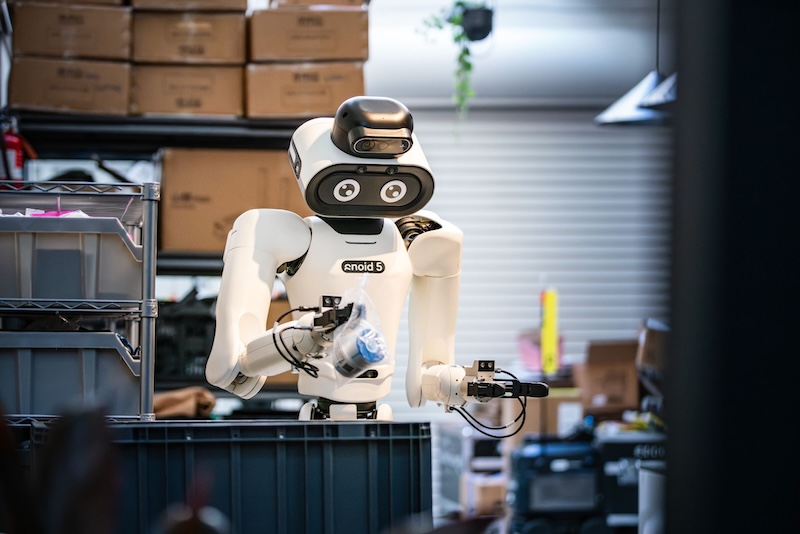
Robot.com, the company putting robots to work in the real world, has announced its entry into humanoid labor solutions with the commercial launch of R-noid, a robot “purpose-built for the repetitive, multi-shift, and hard-to-staff jobs”.
Deployed under a Robot-as-a-Service (RaaS) model, Robot.com can go from the first visit of a customer’s site to autonomous on-site R-noid operation in as few as eight to twelve weeks.
The R-noid launch commences with five initial solution categories – restaurant assistant, packer, picker, folder, and host – deployed across six industry verticals, including industrial, logistics, healthcare, food services, lodging, and experiential. These solutions target the roles operators chronically struggle to fill.
Robot.com showcased R-noid alongside its proven R-kiwi, R-kiwi+, and R-cargo solutions at the recent Automate Show in Chicago in the Humanoid Pavilion.
The problem R-noid fills is structural and pervasive. Quick-service restaurants experience staff turnover upwards of 130 percent. Warehouse picker tenure averages just 1.2 years.
More than 67 percent of hotel operators report critical staffing gaps in both housekeeping and laundry. These staffing shortfalls put customer experience at risk as the jobs simply don’t stay filled. R-noid never resigns.
“The future of work isn’t fewer people. It’s people freed from the parts of the job that grind them down, doing more of what they’re good at,” said Felipe Chavez Cortes, CEO and co-founder.
“We build the robots that make that trade real, taking the repetitive physical work off your team so they can focus on craft, care, and the customer.”
Launching with support from Nvidia Robotics, Astribot, FieldAI, Formic, Physical Intelligence, Robots for America, and Yukai Engineering, R-noid brings humanoid labor solutions to Robot.com’s broader fleet – R-kiwi for delivery, R-cargo for transport, and R-kiwi+ for advertising – all running on the same software stack and five-phase engagement model.
Robot.com is working with FieldAI to bring its general-purpose Field Foundation Models (FFMs) to R-noid as the autonomy brain.
FFMs serve as an operational AI layer that generalizes across robots and environments and serves three roles: enabling safe and reliable operations in dynamic, real-world spaces without prior information or supporting infrastructure; preventing model hallucinations through physics-grounded AI models; and coordinating multiple robots working together.
The body that work runs on is built for reach and stability: dual 7-degree-of-freedom (DoF) arms, a 4-DoF articulated torso with 0 to 1.9m of vertical reach, and a holonomic mobile base that lets R-noid reposition in tight, busy spaces.
For the robot’s design language and character, Robot.com partnered with Yukai Engineering, a Japanese studio known for emotionally expressive consumer robots.
Yukai advised on materials, manufacturing, and interaction design, and the collaboration produced R-soul, the expression and behavior system designed to earn people’s trust in seconds.
It’s a goal Robot.com has pursued since 2017: building robots that open people’s hearts and minds to the future of technology. R-soul lets the robot communicate intent, status, and personality.
The dexterity comes from Physical Intelligence. R-noid runs on π0.7, Physical Intelligence’s vision-language-action model built for generalist manipulation.
It reads a natural-language instruction, looks at the scene in front of it, and produces the arm and hand movements to carry out the task, adapting as objects, layout, and order change.
One model spans packing, picking, and folding, so adding a task means extending the same system rather than engineering a new robot for each job.
At launch, R-noid can perform 19 deployable tasks across five categories. Lighthouse deployments are already underway, demonstrating the new humanoids’ speed-to-impact on business performance. The R-noid Packer is live at an award-winning golf course, handling on-site order packing operations.
The Packer category is also moving toward production at a major food manufacturing facility, with early results validating R-noid’s end-of-line capabilities at scale.
The Picker is designed to integrate directly into existing pick ports across logistics operations, with no facility retrofit required.
Formic serves as Robot.com’s deployment partner for humanoid solutions, helping customers pilot, deploy, and scale automation in production environments.
“Our answer to ‘how long will this take?’ is weeks, not years,” said David Rodriguez, co-founder of Robot.com.
“With thoughtful hardware design, best-in-class software, and our proven platform, we can have a robot doing real work in your facility within weeks of the first conversation. No other humanoid platform can make that claim.”
Robot.com’s fleet is built on Nvidia’s full robotics stack; the robots run on Nvidia Jetson modules, which power the robot’s perception, planning, and control stack on-device – delivering the low-latency inference real-world operations demand.
Across its development cycle, Robot.com uses Nvidia Isaac Sim to simulate, validate, and stress-test each robot before deployment, ensuring reliability before any unit touches a customer floor.
In addition to its Automate debut, R-noid will be among the featured players in Robot.com’s first appearance at Cannes Lions, where the company is the official Robotics Innovation Partner for PMG’s AI & Tech Sandbox.
