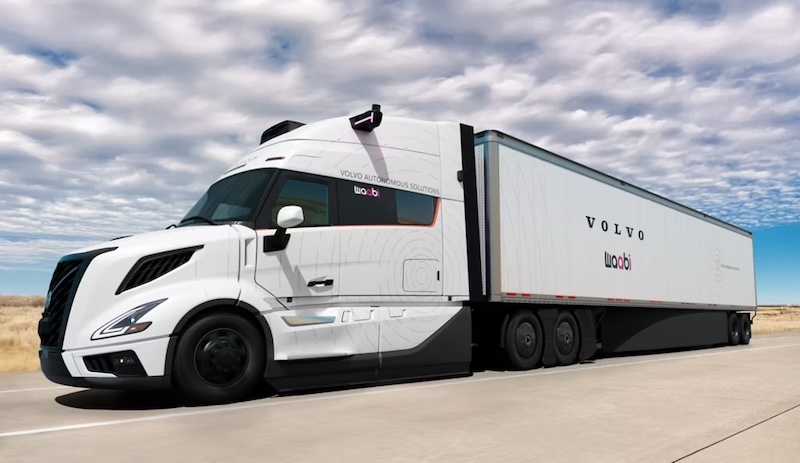
Waabi says it has demonstrated what it describes as a major advance in autonomous driving by transferring its AI-powered virtual driver from one autonomous truck platform to another without requiring additional training, engineering or new data.
The company says its Waabi Driver software was integrated with the Volvo VNL Autonomous truck, developed in partnership with Volvo Autonomous Solutions, and was able to operate autonomously on highways and complex surface streets from its first deployment.
According to Waabi, the system achieved what is known as “zero-shot” generalization, meaning the AI driver transferred to an entirely different vehicle platform without requiring new real-world data, simulation data or fine-tuning.
The company says the Waabi Driver had previously been trained to operate a Peterbilt 579 truck before being deployed on the Volvo VNL Autonomous, which has different sensors, control systems and vehicle characteristics.
Waabi argues that this demonstrates a significant step toward scalable autonomous trucking by enabling the same AI system to operate across multiple vehicle platforms without the lengthy engineering and validation processes that have traditionally been required.
The company says the achievement builds on an earlier milestone in which the Waabi Driver expanded beyond highway driving to operate on complex urban streets.
Waabi says the ability to generalize across both driving environments and vehicle platforms is essential if autonomous driving systems are to scale commercially.
Nils Jaeger, president of Volvo Autonomous Solutions, said: “Road testing the Volvo VNL Autonomous, integrated with the Waabi Driver, on public roads is an important proof point of our partnership with Waabi.
“It also demonstrates the scalability of Volvo’s autonomous truck platform, which is designed to integrate different vehicle models and virtual drivers to enable a wide range of use cases and applications. Together with Waabi, we are advancing autonomous transport solutions toward commercial reality.”
Waabi says the capability could also have implications beyond autonomous trucking, describing it as an important step toward more adaptable physical AI systems capable of operating across a range of machines and environments.
Raquel Urtasun, founder and CEO of Waabi, said: “This is a defining moment for physical AI. For the first time in the industry, we have shown that a virtual driver can generalize across fundamentally different embodiments without requiring a single training example – neither real or simulated – or finetuning.
“This capability has the potential to transform far more than transportation. It is the foundation for a new generation of intelligent machines that can adapt, scale, and operate across the physical world, creating possibilities and opportunities we can scarcely imagine today.”
Waabi says the demonstration marks a step toward deploying the same autonomous driving system across different truck platforms and operating environments, which the company believes is necessary for large-scale commercial deployment of autonomous transport.
