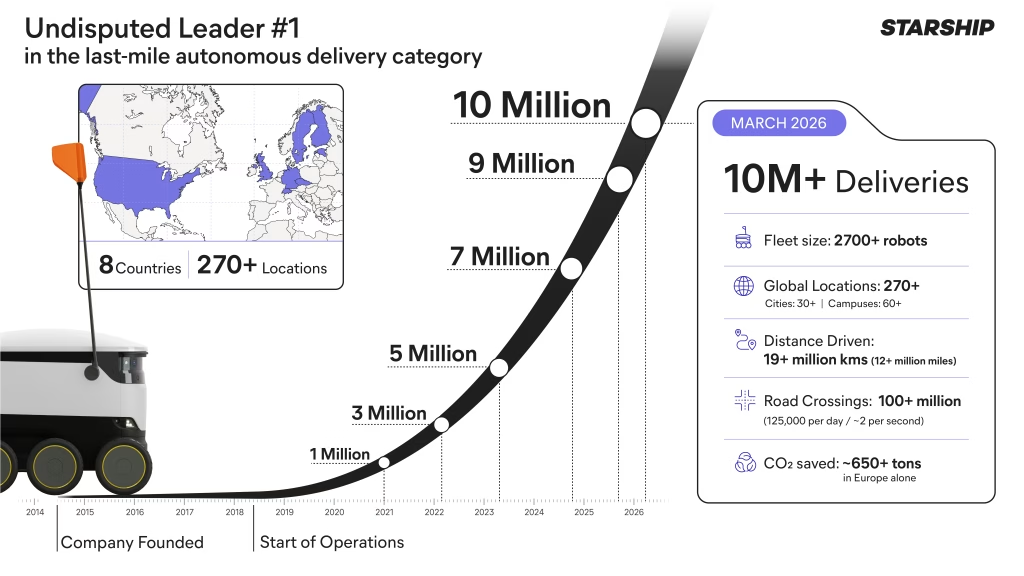
Autonomous delivery is moving from pilot programs to large-scale commercial deployment, according to Starship Technologies, which says it has now completed more than 10 million deliveries using its fleet of sidewalk robots.
The company describes the milestone as a turning point for so-called “physical AI” systems operating in real-world environments, with its robots now deployed across multiple countries and use cases.
From pilot projects to scaled operations
Starship says its network of more than 3,000 autonomous robots operates across more than 300 locations in eight countries, including the United States and several European markets.
In total, the fleet has travelled over 22 million kilometers autonomously and completed approximately 200 million road crossings. The company says its robots now perform more than 125,000 road crossings per day – roughly two per second – operating at Level 4 autonomy without active human supervision.
“Ten million deliveries means we’ve moved beyond proving the technology – we’re now scaling it,” said Ahti Heinla. “It is becoming part of the infrastructure of modern logistics – deployed commercially across eight countries, integrated with the world’s leading delivery platforms, and delivering measurable value to customers at scale.”
Starship’s robots are currently used for grocery and hot food deliveries across seven European countries, as well as on more than 65 university campuses in the US.
Data-driven autonomy at scale
The company attributes its progress to the scale of real-world operational data collected by its fleet. Each delivery contributes to ongoing improvements in navigation, perception, and safety systems.
Starship says its robots rely on AI-driven navigation technologies, including visual simultaneous localization and mapping (Visual SLAM), enabling them to operate without fixed infrastructure while adapting to dynamic urban environments and varying weather conditions.
The company positions this continuous learning loop as a key differentiator in scaling autonomous systems beyond controlled environments.
Economic pressure reshaping last-mile delivery
Beyond the technical milestone, Starship is framing autonomous delivery as a potential shift in the economics of last-mile logistics.
The company says autonomous delivery is already $3–4 cheaper than traditional rider-based delivery models, with a long-term target of around $1 per drop.
External research cited in the announcement suggests that such cost reductions could have broader implications for delivery platforms. According to Reuters, citing Barclays research, autonomous delivery could unlock an estimated $16 billion in annual profitability globally.
While those projections remain dependent on wider deployment and regulatory acceptance, they point to growing interest in automation as a way to address rising labor costs and persistent inefficiencies in last-mile logistics.
Regulatory and market expansion
Starship’s operations span markets including the UK, Germany, Switzerland, Sweden, Finland, Estonia, and the Czech Republic, alongside the United States.
The company says it has secured regulatory approvals across these regions over more than a decade of development, positioning itself as one of the few operators with large-scale, multi-country deployment experience.
It also highlights user acceptance as a factor in its expansion, citing internal research indicating a 97 percent approval rate among students on US campuses where its robots are deployed.
From novelty to infrastructure
The milestone reflects a broader shift in how autonomous delivery is being perceived – from experimental technology to operational infrastructure.
While challenges remain, including scaling economics, urban integration, and competition from alternative delivery models, Starship’s latest figures suggest that autonomous delivery systems are beginning to achieve sustained commercial use.
For now, the company’s 10 million delivery mark provides a data point for an industry still in transition – one that is increasingly focused not on whether autonomous delivery works, but on how widely and profitably it can be deployed.
