Environmental damage has traditionally been addressed in bursts – a cleanup operation here, a monitoring campaign there. But the scale of modern environmental challenges is no longer episodic.
Each year, an estimated 8 to 12 million tonnes of plastic enter the oceans. Air pollution is linked to roughly 7 million premature deaths annually, according to the World Health Organization. The economic cost of environmental degradation runs into the trillions of dollars globally.
Against that backdrop, a shift is under way.
Environmental work is becoming too large-scale, too dangerous, and too continuous for humans alone. Increasingly, robotics and autonomous systems are becoming the operational backbone of how pollution is detected, monitored, and, in some cases, removed.
More subtly – and perhaps more importantly – the availability of these technologies is beginning to shape ambition itself. Projects that would once have been dismissed as impractical are now being actively pursued, precisely because robots make them conceivable.
The problem: Scale, danger, and invisibility
Pollution is rarely concentrated neatly in one place. It spreads across oceans, rivers, airspace, and industrial landscapes, often in ways that are difficult to detect until damage is already done.
Many of the environments involved are also inherently hazardous. Chemical spills, offshore infrastructure, nuclear facilities, and landfill sites all present risks that limit human access. Even where conditions are safe, the sheer scale of monitoring required makes continuous human oversight unrealistic.
Traditional environmental monitoring has therefore been:
- Periodic rather than continuous
- Labor-intensive and expensive
- Often reactive rather than preventative
The result is a system that struggles to keep up with the pace and scale of environmental change.
A new layer of infrastructure: Robotic sensing networks
What is now emerging is something closer to infrastructure than a set of tools.
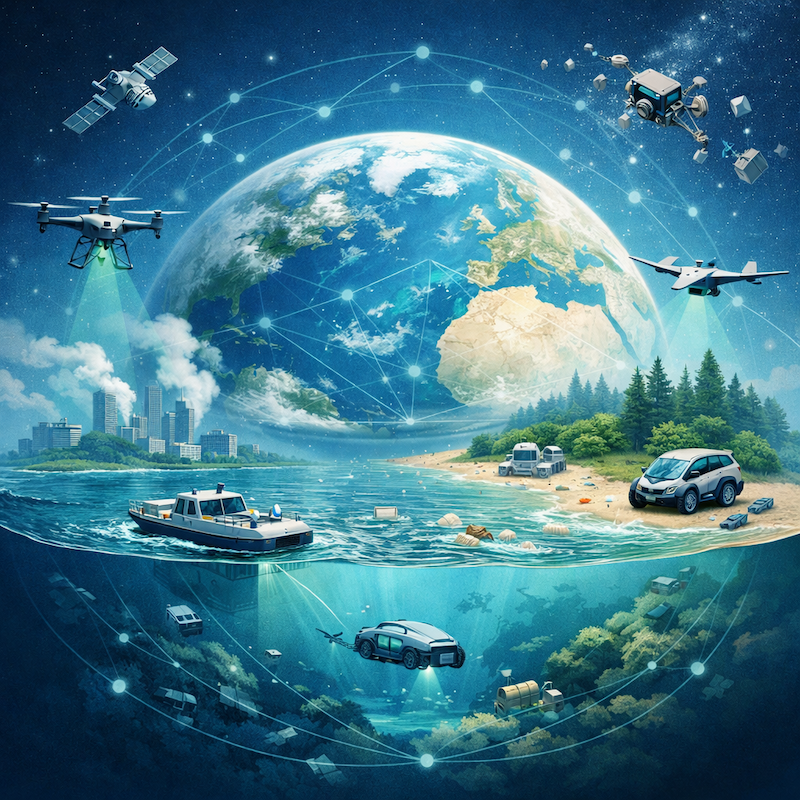
Drones patrol airspace, autonomous vessels traverse oceans, underwater robots inspect subsea environments, and ground-based systems monitor industrial and waste sites. Together, these systems form distributed sensing networks capable of generating continuous streams of environmental data.
Companies such as Saildrone deploy fleets of wind- and solar-powered surface vehicles that collect oceanographic and climate data over long durations. While not focused on cleanup, such systems play a critical role in making environmental conditions visible at scale.
The shift is from snapshots to persistence – from occasional measurement to real-time environmental intelligence. In effect, the planet is beginning to acquire something resembling a digital monitoring layer.
Drones: Turning monitoring into a high-frequency activity
Aerial drones have become one of the most widely deployed tools in environmental monitoring.
Used by organizations ranging from regulators to energy companies, drones are now routinely employed for:
- Air quality mapping in urban environments
- Methane leak detection in oil and gas infrastructure
- Wildfire detection and tracking
- Monitoring illegal dumping and deforestation
Manufacturers such as DJI and Skydio provide increasingly autonomous platforms capable of operating with minimal human intervention.
The key advantage is frequency. Tasks that might previously have been carried out monthly or quarterly can now be performed daily – or continuously – dramatically improving visibility and response times.
Robots in water: From mapping to cleanup
If the air is data-rich, the oceans have historically been the opposite.
Autonomous surface and underwater systems are beginning to change that. But water-based robotics is also where monitoring and cleanup begin to converge.
The Ocean Cleanup project is one of the most ambitious examples. Its systems combine passive collection barriers with active vessels to remove plastic from ocean gyres and rivers. Just as importantly, the project relies heavily on data – tracking debris patterns and ocean currents – to make large-scale cleanup feasible.
In parallel, monitoring-focused companies such as Saildrone are mapping ocean conditions with unprecedented coverage, providing the environmental intelligence that cleanup efforts depend on.
The broader point is that oceans are no longer beyond reach. Robotics is turning them into measurable, and increasingly manageable, environments.
Canals, harbors, and coastlines: Localized cleanup robots
Beyond large-scale ocean systems, a growing number of smaller, highly targeted robots are addressing pollution in urban waterways and coastal environments.
In the Netherlands, systems such as the WasteShark – a small autonomous surface vehicle – are used to collect floating debris from canals, ports, and marinas. These robots operate continuously, removing plastic and waste before it disperses into larger bodies of water.
Similarly, beach-cleaning robots such as BeBot are being deployed in locations including California. Designed to sift sand and remove microplastics and debris, such systems address pollution at the shoreline – the interface between land and ocean.
These examples illustrate an important shift: cleanup is becoming distributed and continuous, rather than centralized and occasional.
Waste sorting and recycling: Robots as resource recovery systems
Environmental cleanup is not only about removing waste – it is also about recovering value.
Robotic systems are increasingly used in recycling facilities to identify and sort materials with high precision. Using computer vision and machine learning, these systems can distinguish between different types of plastics, metals, and other materials at speeds that would be difficult for human workers to match.
Companies such as AMP Robotics, ZenRobotics, and Tomra are deploying systems that improve both the efficiency and the economic viability of recycling.
The implication is significant: waste streams are increasingly being treated as supply chains.
Hazardous environments: Where robots make intervention possible
In some cases, robotics is not simply an efficiency tool – it is the only viable option.
Following the Fukushima Daiichi nuclear disaster, robots have been deployed to inspect and map areas too dangerous for human workers due to radiation exposure. Similar approaches are used in chemical plants, mining operations, and disaster zones.
Inspection robots from companies such as Boston Dynamics are increasingly used in environments where safety risks would otherwise limit access.
In these contexts, robotics does not just improve performance – it expands the boundaries of what can be done at all.
From detection to action: Closing the loop
Despite these advances, many environmental robotics systems today remain focused on detection rather than intervention.
The emerging next phase is the integration of sensing, analysis, and action into closed-loop systems.
Examples include:
- Autonomous vessels that both detect and collect oil spills
- Robotic systems that identify waste and immediately remove it
- Coordinated fleets that monitor and respond to environmental changes in real time
This shift – from observation to autonomous response – represents a fundamental change in how environmental management is approached.
Economics: Prevention versus cleanup
Environmental damage is costly, both financially and socially.
Cleanup operations often require large, one-off expenditures, while the indirect costs – health impacts, ecosystem damage, regulatory penalties – can be even higher.
Robotics introduces a different model.
Continuous monitoring allows issues to be detected earlier, reducing the scale and cost of intervention. Over time, this shifts environmental management from reactive cleanup to proactive prevention.
For industries such as energy, shipping, and manufacturing, the economic case is increasingly aligned with regulatory and environmental priorities.
Challenges and limitations
Despite rapid progress, several challenges remain.
Battery life and endurance limit the operating time of many systems, particularly in remote environments. Harsh conditions – including saltwater corrosion, extreme temperatures, and radiation – place additional strain on hardware.
Data integration is another constraint. Collecting large volumes of environmental data is one thing; turning it into actionable insight is another.
Regulation also plays a role, particularly for aerial drones operating beyond visual line of sight.
Finally, the market remains fragmented, with many specialized solutions rather than unified platforms.
Companies developing environmental robotics systems
The environmental robotics landscape is broad, spanning monitoring, cleanup, inspection, and resource recovery. The following companies illustrate the growing range of applications and approaches across the sector:
Ocean and water monitoring / cleanup
- Saildrone – autonomous surface vessels for long-duration ocean data collection
- Ocean Cleanup – large-scale ocean and river plastic removal systems
- RanMarine – developer of the WasteShark for canal and harbor cleanup
- WasteShark – small autonomous vehicle collecting floating debris in urban waterways
- Clearbot – solar-powered autonomous boats for water pollution cleanup
- Sea Machines Robotics – autonomous control systems for marine vessels
- Bluefin Robotics – autonomous underwater vehicles for inspection and monitoring
- Teledyne Marine – subsea robotics and sensing systems
Airborne monitoring and environmental intelligence
- DJI – widely used drone platforms for environmental monitoring
- Skydio – AI-driven drones for inspection and data collection
- senseFly – mapping and surveying drones for environmental analysis
- Wingtra – VTOL drones used for large-area environmental mapping
- NASA – advanced aerial and satellite systems for climate and environmental monitoring
Waste, recycling, and resource recovery robotics
- AMP Robotics – AI-powered robotic sorting systems
- ZenRobotics – robotic waste sorting for construction and industrial waste
- Tomra – sensor-based sorting and recycling solutions
- Greyparrot – vision systems analyzing waste streams in real time
Coastal, beach, and land-based cleanup
- BeBot – autonomous beach-cleaning robot removing debris and microplastics
- Poralu Marine – developer of BeBot and marina solutions
- Ecovacs Robotics – developer of autonomous outdoor cleaning robots (including large-scale commercial variants)
Robots redefine what’s possible
Environmental robotics is not a single market or technology. It is better understood as a developing layer of global infrastructure – one that combines sensing, data, and physical intervention.
Perhaps the most significant shift is conceptual.
In the past, environmental challenges were often framed in terms of what was practical to address. Today, the availability of robotics and autonomous systems is expanding that boundary.
Projects such as large-scale ocean cleanup, continuous air monitoring, and distributed waste collection are no longer theoretical. They are under way.
The question is no longer whether environmental damage can be detected. It is whether autonomous systems can be deployed at the speed and scale required to respond.
