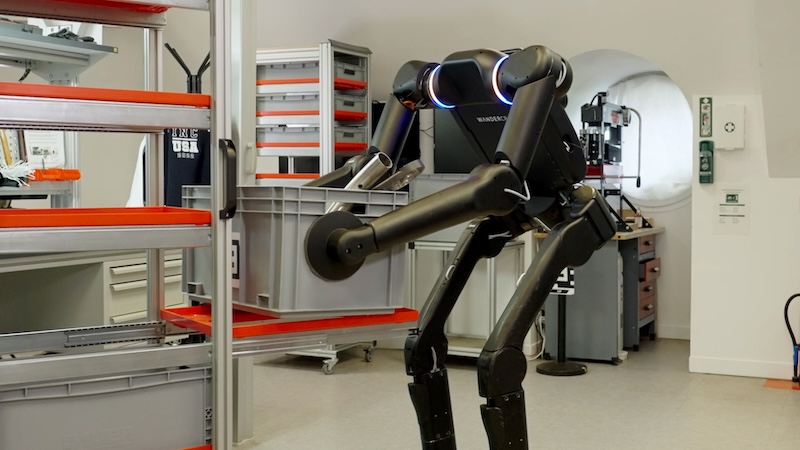
Automotive giant Renault Group is planning to deploy up to 350 humanoid robots across its manufacturing operations over the next 18 months, in what would represent one of the largest industrial rollouts of humanoid systems to date.
The initiative, developed in partnership with Wandercraft, was outlined during Renault’s recent “futuREady” strategy event, with details reported by Metrology News.
The robots – part of the Calvin platform – are already operating in production environments. At Renault’s Douai plant in France, a humanoid unit is being used for tyre-handling tasks, a physically demanding process traditionally carried out by human workers.
According to the report, the system is designed to work within existing factory layouts rather than requiring new infrastructure.
This positions the robots for so-called “brownfield” deployment, targeting repetitive or ergonomically challenging tasks that are difficult to automate using conventional fixed robotic systems.
Unlike many humanoid robotics projects that remain at the demonstration stage, Renault’s approach appears focused on near-term industrial use.
The Calvin platform is designed to handle heavy components, navigate autonomously, and operate alongside human workers in shared environments.
The planned scale-up to hundreds of units suggests a shift from pilot projects toward broader operational deployment. The company is expected to use the systems to improve efficiency and reduce strain on workers, while maintaining flexibility within existing production lines.
Renault’s program builds on its earlier investment in Wandercraft, whose expertise in self-balancing robotic systems underpins the humanoid platform.
While limitations remain in areas such as dexterity and complex assembly, the deployment signals growing confidence that humanoid robots can deliver value in selected industrial applications.
