Automation in remanufacturing and repair – extending product lifecycles
For decades, industrial automation has focused on one goal: producing more goods, faster and cheaper. But a quieter shift is now under way. Increasingly, manufacturers are turning their attention not to making new products, but to extending the life of existing ones.
This shift is being driven by a combination of economic pressure and environmental necessity. Global e-waste alone reached an estimated 62 million tonnes in 2022, according to the United Nations, and is projected to continue rising sharply. At the same time, raw material costs and supply chain volatility are forcing companies to rethink how value is created – and preserved.
Remanufacturing, once considered a niche activity, is emerging as a serious industrial strategy. In sectors such as automotive and heavy machinery, remanufactured components can cost 40 to 80 percent less than new equivalents while delivering comparable performance. The global automotive remanufacturing market alone is valued in the tens of billions of dollars.
Yet despite its promise, remanufacturing has historically been difficult to scale. The reason is simple: it is labor-intensive, inconsistent, and resistant to traditional automation.
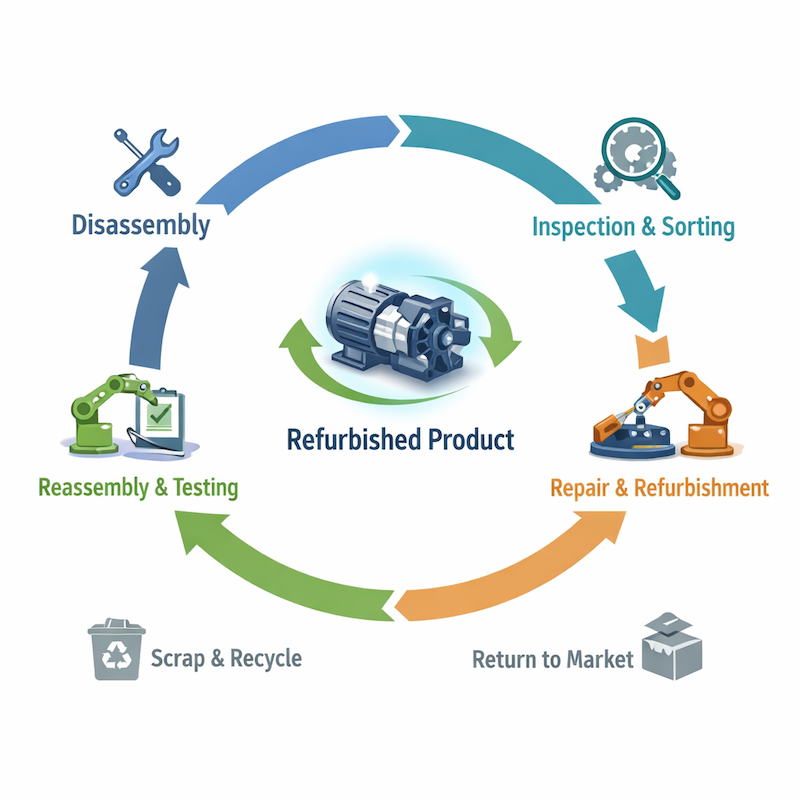
Simplified remanufacturing process
That may now be changing.
An unstructured problem: Why remanufacturing is hard
Unlike conventional manufacturing, where processes are repeatable and predictable, remanufacturing deals with products that have already lived a life.
Each returned item is different. Components may be worn, damaged, corroded, or missing entirely. Fasteners may be stripped or seized. Documentation is often incomplete or unavailable. Even identical products can arrive in radically different conditions.
This variability makes remanufacturing fundamentally an unstructured problem.
It also explains why automation has lagged in this space. Industrial robots excel in controlled environments, where every part arrives in the same orientation and condition. Remanufacturing offers the opposite: uncertainty at every step.
Traditionally, this has left most remanufacturing work in the hands of skilled human technicians.
Breaking down the process: Where automation fits
Despite these challenges, advances in robotics and artificial intelligence are beginning to enable automation across the remanufacturing workflow. Rather than a single solution, the process is best understood as a chain of stages.
Disassembly
The first step is often the most complex. Products must be taken apart without causing further damage, and without knowing exactly what condition they are in.
Robotic disassembly systems are beginning to emerge, using machine vision to identify components and tools to remove fasteners. However, variability remains a major obstacle. Seized bolts, deformed parts, and inconsistent assembly methods all complicate automation.
Cleaning and surface preparation
Once disassembled, components typically undergo cleaning. This is one of the more mature areas of automation, with established systems for washing, blasting, and chemical treatment.
Laser cleaning technologies are also gaining traction, offering precise removal of coatings and contaminants without damaging underlying materials.
Inspection and defect detection
Inspection is a critical stage, determining whether a component can be reused, repaired, or scrapped.
AI-powered vision systems are increasingly capable of detecting cracks, corrosion, and wear patterns. In high-value sectors such as aerospace, non-destructive testing methods – including ultrasound and X-ray imaging – are used to assess internal integrity.
This stage is central to the economics of remanufacturing. Accurate inspection ensures that only viable components proceed further, reducing waste and avoiding costly failures.
Repair and refurbishment
Repair processes vary widely depending on the application. They may include machining, welding, coating, or even rebuilding parts using additive manufacturing.
Hybrid systems that combine robotics with CNC machining and AI-driven decision-making are beginning to emerge, enabling more flexible and adaptive repair workflows.
Reassembly and testing
Once components are restored, they must be reassembled and tested. Compared to disassembly, this stage is more structured and therefore easier to automate.
Robotic assembly systems, combined with automated testing rigs, can ensure that remanufactured products meet performance standards comparable to new units.
Key technologies enabling automated remanufacturing
Several technological advances are making this transition possible.
AI and machine vision
Modern vision systems can identify objects even in degraded or partially obscured conditions. Machine learning models can be trained to recognize wear patterns and classify defects, improving decision-making throughout the process.
Force-sensitive robotics
Disassembly and repair often require delicate handling. Force-torque sensors allow robots to “feel” their way through tasks, adjusting movements in response to resistance or unexpected conditions.
Digital twins and product data
Access to original design data can significantly improve remanufacturing outcomes. Digital twins enable comparison between a product’s intended state and its current condition, guiding repair strategies.
Mobile robots
Autonomous mobile robots (AMRs) can transport irregular and unpredictable items through remanufacturing facilities, improving workflow efficiency.
Additive manufacturing
In some cases, damaged components can be rebuilt rather than replaced. Additive techniques allow material to be added precisely where needed, extending the usable life of parts.
Industry applications: From engines to electronics
Automation in remanufacturing is already gaining traction across several sectors.
Automotive
Automotive remanufacturing is one of the most established applications. Engines, transmissions, and increasingly electric vehicle batteries are being refurbished at scale.
Major OEMs have long operated remanufacturing programs, recognizing both the cost advantages and the potential for additional revenue streams.
Electronics and e-waste
Consumer electronics present a different challenge due to their small size and complexity. Robotic systems have been developed to disassemble devices such as smartphones, enabling recovery of valuable materials and components.
Aerospace
In aerospace, the high value of components justifies extensive remanufacturing efforts. Turbine blades, landing gear, and other critical parts are routinely inspected, repaired, and certified for reuse under strict regulatory frameworks.
Heavy industry
Industrial equipment such as pumps, valves, and compressors is frequently refurbished to extend service life. In sectors such as oil and gas, where downtime is costly, remanufacturing plays a key role in maintenance strategies.
The business case: Why remanufacturing is gaining momentum
Several factors are converging to make remanufacturing more attractive.
Rising material costs and supply chain disruptions have increased the value of existing assets. At the same time, environmental regulations and corporate sustainability targets are pushing companies to reduce waste and carbon emissions.
Remanufacturing addresses both concerns. It reduces the need for raw materials, lowers energy consumption compared to new production, and can deliver faster turnaround times.
In some cases, it also offers higher margins. By recovering value from used products, companies can generate additional revenue streams while reducing input costs.
Barriers to scale
Despite its potential, automated remanufacturing faces significant challenges.
Product variability remains the most fundamental issue. Designing systems that can handle a wide range of conditions is technically complex and often expensive.
Another barrier is the lack of design-for-disassembly. Most products today are not built with remanufacturing in mind, making them difficult to take apart efficiently.
Data availability is also limited. Without detailed information on a product’s usage history, it is difficult to predict its condition or optimize repair processes.
Finally, the economics are not always clear. While remanufacturing can offer cost savings, the upfront investment in automation systems can be substantial.
Designing for a second life
Looking ahead, one of the most important developments may not be in robotics itself, but in product design.
Manufacturers are beginning to consider how products can be designed for easier disassembly, repair, and reuse. This includes modular architectures, standardized fasteners, and embedded sensors that track usage over time.
The idea is simple: instead of treating remanufacturing as an afterthought, build it into the product from the start.
Toward circular automation systems
The broader implication is that manufacturing systems themselves may evolve.
Instead of linear production lines that end with disposal, future factories could incorporate reverse production lines – systems designed to take products apart, restore them, and return them to service.
In this model, automation is not just about creating new value, but about preserving existing value.
Remanufacturing, supported by robotics and AI, offers a pathway toward a more circular industrial economy. While significant challenges remain, the direction of travel is becoming clear.
The next phase of automation may not be defined by how efficiently we produce goods, but by how effectively we keep them in use.
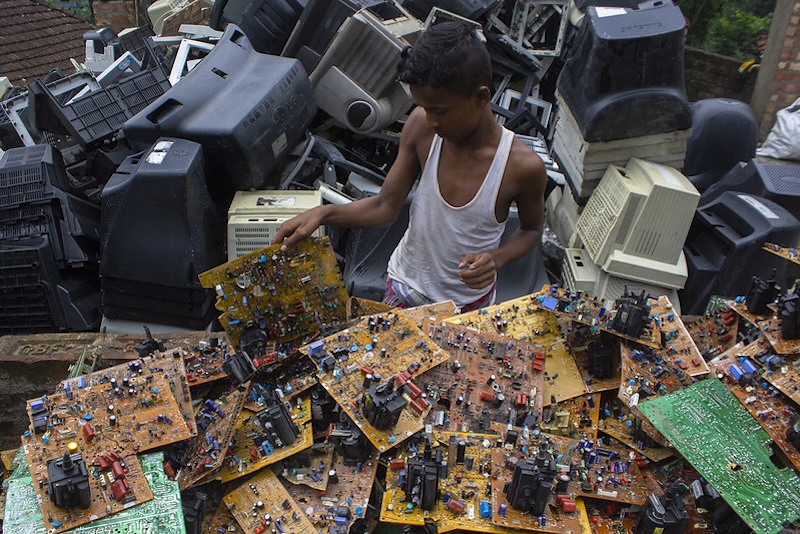
Main image: A trained, young person is sorting discarded electronics in rural West Bengal. E-waste has dangerous metals which if unrecycled, can release toxic substances in the environment. The proper training to handle electronic waste can generate a steady source of income for the youth. Also, recycling leads to a greener future. Credit: CC BY-NC-SA 3.0 IGO © UNESCO-UNEVOC/Sudip Maiti
