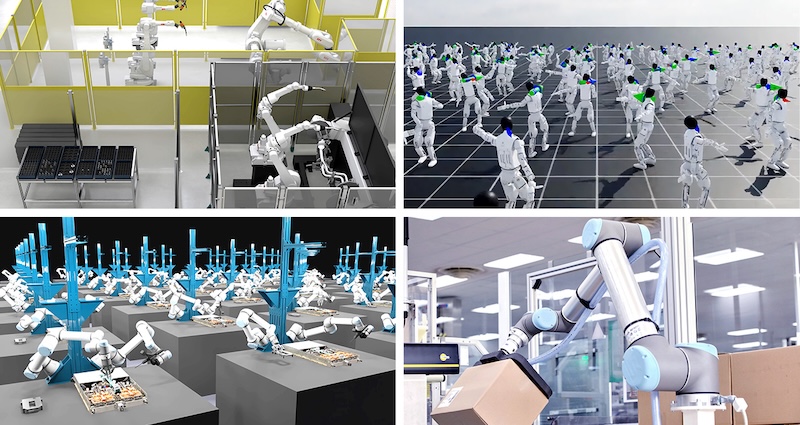
Nvidia is rapidly emerging as the central technology provider to the global robotics industry, with a growing list of partners spanning traditional industrial robot manufacturers, surgical robotics firms, and a new wave of humanoid startups.
In a sweeping set of announcements at its GTC conference, the company revealed that many of the world’s best-known robotics companies – including ABB, Fanuc, Yaskawa and Kuka – are now building on its platforms, alongside newer entrants such as Agility Robotics, Figure AI and 1X.
The breadth of that ecosystem suggests a shift that has been under way for several years: robotics is becoming an AI-driven industry, and Nvidia is positioning itself as the default supplier of the underlying compute, simulation and software infrastructure.
“Physical AI has arrived – every industrial company will become a robotics company,” said Jensen Huang, founder and CEO of Nvidia.
“Nvidia’s full-stack platform – spanning computing, open models and software frameworks – is the foundation for the robotics industry, uniting a worldwide ecosystem to build the intelligent machines that will power the next generation of factories, logistics, transportation and infrastructure.”
A unified platform for a fragmented industry
Historically, robotics has been a fragmented sector. Industrial robot makers developed their own control systems, software stacks and programming environments, often optimized for highly specific applications such as welding, assembly or material handling.
That model is now being disrupted by the rise of AI-driven robotics, where machines are expected to perceive, reason and adapt in more human-like ways.
To support this shift, Nvidia has spent years building a “full-stack” robotics platform – combining high-performance chips, simulation environments, and increasingly, foundation models for robot behavior.
Key elements include:
- Jetson modules for edge AI computing inside robots
- Omniverse for digital twins and simulation
- Isaac Sim and Isaac Lab for training and validation
- Cosmos world models for synthetic data generation and reasoning
- GR00T models aimed at general-purpose robot intelligence
Taken together, these tools allow robotics companies to design, train and deploy machines in a unified environment – from simulation to real-world operation.
The incumbents: Industrial robot giants move toward AI
Perhaps the most striking aspect of Nvidia’s latest announcements is the extent to which traditional industrial robot manufacturers are embracing its technology.
These companies have built the global automation industry over decades, with millions of robots installed across factories worldwide.
Traditional industrial robotics leaders adopting Nvidia platforms:
- ABB
- Fanuc
- Yaskawa
- Kuka
- Universal Robots
- Hexagon Robotics
These firms are integrating Nvidia’s simulation and AI tools into their existing platforms, particularly for digital twin environments and real-time inference on the factory floor.
With a combined installed base exceeding 2 million robots, companies such as Fanuc, ABB, Yaskawa and Kuka are now using Nvidia-powered simulation to design and validate entire production lines before deployment.
This marks a significant evolution. Where industrial robots were once programmed manually for fixed tasks, they are increasingly being trained in simulated environments and deployed with adaptive capabilities.
The new wave: humanoids and AI-native robotics companies
At the same time, a new generation of robotics companies is emerging – many of them focused on humanoid robots or general-purpose AI systems.
Unlike traditional manufacturers, these firms are often building their platforms around AI from the outset – and many are standardizing on Nvidia’s stack.
New-generation and humanoid robotics companies building on Nvidia:
- Agility Robotics
- Figure AI
- 1X
- Agibot
- NEURA Robotics
- Humanoid
- Mentee Robotics
- Boston Dynamics
- Skild AI
- World Labs
These companies are using Nvidia’s simulation tools and foundation models to accelerate development, particularly in areas such as locomotion, manipulation and general task learning.
Nvidia’s GR00T models, in particular, are designed to enable robots to learn generalized skills – a key requirement for humanoids operating in dynamic, real-world environments.
The company says its next-generation GR00T N2 model can help robots succeed at new tasks “helps robots succeed at new tasks in new environments more than twice as often as leading vision language action models”, highlighting the growing importance of AI models in robotics development.
From simulation to reality
One of the long-standing challenges in robotics has been the so-called “sim-to-real gap” – the difficulty of transferring behaviors learned in simulation into real-world environments.
Nvidia’s strategy is to close that gap through increasingly realistic physics engines, synthetic data generation, and tightly integrated hardware-software systems.
This approach is already being applied across multiple sectors:
- Manufacturing: Digital twins of production lines for optimization and testing
- Logistics: Autonomous warehouse systems trained in simulation
- Healthcare: Surgical robots validated before clinical deployment
- Construction: Autonomous systems trained for complex environments
The implication is that robotics development is becoming more like software development – iterative, data-driven, and heavily reliant on simulation.
A dominant position – or an emerging one?
It may be too early to say Nvidia has complete dominance over robotics, but its influence is clearly growing.
Few other chipmakers have developed such a comprehensive, robotics-specific ecosystem.
Companies such as Infineon and NXP have recently signaled increased interest in robotics, particularly in areas such as real-time processing, safety systems and edge computing. However, their efforts remain more fragmented compared to Nvidia’s integrated approach.
The contrast is reminiscent of earlier shifts in computing.
Just as some observers argue that Intel was slow to adapt to the rise of mobile computing – allowing competitors to gain ground – there is a growing sense that parts of the semiconductor industry may have underestimated the importance of robotics.
Nvidia, by contrast, appears to have embraced the sector early, investing not just in hardware but in the broader software and developer ecosystem required to support it.
A lesson for the industry?
Nvidia’s rise has been driven by multiple factors, including gaming, AI training, and – at one point – demand from cryptocurrency mining.
But robotics represents something different: a long-term industrial transformation rather than a cyclical market.
By building tools specifically for robotics developers and fostering a broad ecosystem of partners, Nvidia has positioned itself at the center of what it calls “physical AI” – the convergence of artificial intelligence and machines operating in the real world.
Whether that position translates into lasting dominance remains to be seen.
What is clear is that robotics is no longer a niche sector. As AI capabilities expand, more industries are adopting automation, and more companies are building robots of increasing sophistication.
If that trend continues, the question may not be whether Nvidia leads the robotics industry, but how far ahead it can stay – and whether its competitors can close the gap before the next wave of automation fully takes hold.
