
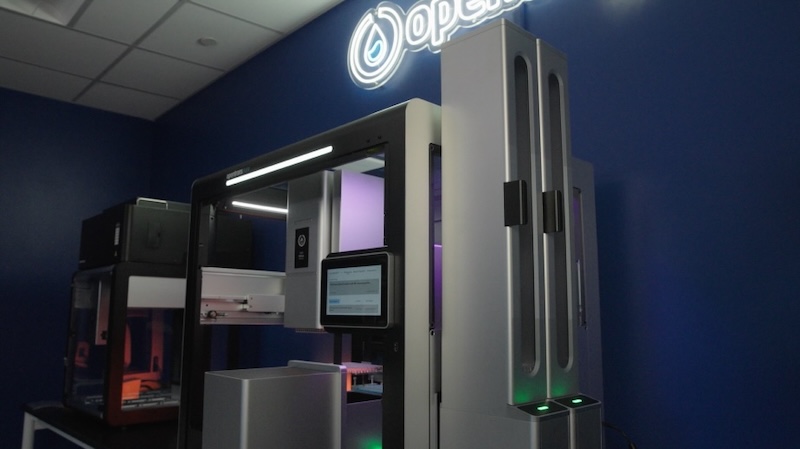
HighRes, a laboratory automation and orchestration software provider, and Opentrons Labworks, a laboratory robotics company building the physical infrastructure for AI-driven autonomous science, have agreed a strategic partnership to co-develop “the industry’s first AI agent-to-agent laboratory workflow”.
Together, the companies are introducing a new model for workflow automation that connects intuitive, modular robotics with enterprise-grade orchestration and AI-ready infrastructure. They demonstrated their innovation at the recent Society for Laboratory Automation and Screening event.
This collaboration brings Opentrons’ flexible, high-throughput Opentrons Flex robotic platforms and OpentronsAI, together with the FlexPod Configurable Lab Automation Platform and Cellario, HighRes’ industry-leading scheduling and orchestration software, enabling scientists to adopt automation quickly and scale seamlessly as workflows grow in complexity.
“We see Opentrons as an innovative partner that has driven democratization of lab automation through cost-effective, capable liquid handling and more accessible, agentic protocol creation,” said Ira Hoffman, CEO of HighRes.
“We share that philosophy, and together we’re unlocking greater speed and access for scientists while maintaining the reliability and repeatability life science organizations demand.”
“This is a joint effort to rethink how automation actually gets used in real labs,” said James Atwood, CEO of Opentrons. “With HighRes, we’re creating a tightly integrated system where AI-driven intent is translated directly into reliable, physical execution at the bench.”
Debuting the first agent-to-agent workflow at SLAS
At SLAS 2026, HighRes and Opentrons held a live demonstration of the agent-to-agent lab workflow, showing how autonomous software agents communicate across platforms to plan and execute experiments using natural language.
The demonstration featured:
- Agent-to-agent orchestration, leveraging HighRes orchestration software, OpentronsAI, and the Opentrons MCP server to generate semi-automated qPCR workflows from natural-language input
- A unified digital lab experience, integrating experiment planning, execution, and data management
- A scalable automation pathway, extending accessible, bench-friendly robotics into fully orchestrated lab ecosystems
- An AI-ready operational model, unifying data, devices, and decisions through a shared orchestration layer
Designed for interoperability and scale
Interoperability underpins the partnership, with both companies committed to open, extensible APIs and transparent system architectures.
This approach enables Opentrons’ robotic platforms to operate alongside instruments from multiple vendors within HighRes’ orchestration environment, say the companies.
